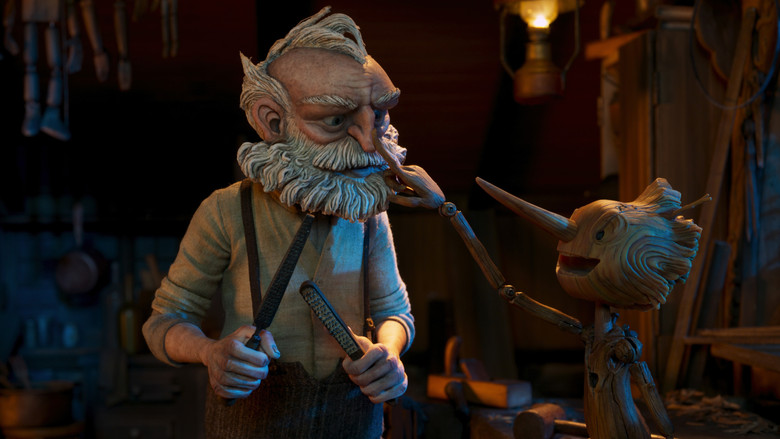

"Love will give you life."
Guillermo del Toro's Pinocchio - Symbolism & Philosophy
Symbols & Motifs
The Pinecone
The pinecone symbolizes the cycle of life, death, and legacy. It represents the connection between Geppetto's lost son, Carlo, and Pinocchio, bridging the gap between grief and new life.
Carlo finds a perfect pinecone just before he is killed, which Geppetto cherishes. Geppetto plants a pine tree over Carlo's grave, and it's the wood from this very tree that he uses to carve Pinocchio. The film opens and closes with the image of a pinecone, framing the entire story as a reflection on the brief, cyclical nature of life.
The Hourglass
The hourglass in the afterlife symbolizes Pinocchio's immortality and the finite nature of time for mortals. It's a visual representation of the time he must wait before returning to the world of the living after each death.
Each time Pinocchio dies, he meets Death, who stands before a set of hourglasses. She explains that he cannot truly die but must wait for the sand in an hourglass to run out before he can return. He ultimately chooses to break an hourglass, sacrificing his immortality to return to life quickly and save Geppetto, signifying his understanding of the value of precious, limited time.
Crucifix vs. Pinocchio
The large wooden crucifix in the village church represents rigid, dogmatic belief and an idealized form of sacrifice. Pinocchio, also made of wood, is presented as a contrasting figure—a messy, imperfect, but living and loving being. The comparison raises questions about organized religion versus innate goodness.
Geppetto is the carver of the church's crucifix. When Pinocchio first enters the church, the priest and villagers react with fear, calling him a demon. Pinocchio observes the crucifix and says, “He's made of wood too. Why do they like him and not me?”. This directly contrasts the villagers' reverence for a static wooden icon with their rejection of a living, albeit chaotic, wooden boy.
Philosophical Questions
What is the true meaning of being 'human' or 'real'?
The film challenges the traditional idea that being human is a physical state. Pinocchio remains a wooden puppet, yet he arguably becomes the most 'human' character. The film suggests humanity is defined by the capacity for love, empathy, making mistakes, feeling grief, and ultimately, the choice to sacrifice for others. Pinocchio achieves this not by changing his body, but by developing his soul.
Is disobedience a virtue?
In the context of the film's Fascist setting, disobedience is framed as a moral necessity. Pinocchio's inability to blindly obey orders, from Geppetto's simple rules to the Podestà's military commands, is presented as his greatest strength. It is his innate rebelliousness that allows him to see the truth and resist the dehumanizing conformity demanded by authoritarian figures, suggesting that true morality requires questioning authority, not simply following it.
Does immortality have value without shared experience?
The film presents immortality not as a gift, but as a potential curse. Death explains to Pinocchio that life is precious *because* it is brief. His immortality alienates him, as he must watch everyone he loves grow old and die. The poignant ending, where he is left utterly alone, forces the audience to consider that a finite life, rich with shared moments, is more meaningful than an eternal one spent in solitude.
Core Meaning
Guillermo del Toro's central message subverts the traditional moral of Pinocchio. Instead of a tale about a puppet who must be obedient to become a 'real boy', this film posits that disobedience, questioning authority, and embracing imperfection are the very qualities that define humanity. The film argues that life's meaning is found not in conformity but in the messy, finite, and precious connections we forge. It's a story about an 'imperfect son and an imperfect father' finding acceptance and love. Del Toro rejects the idea that Pinocchio needs to physically change to be worthy of love; instead, it is Geppetto who must transform, learning to love the son he has, not the one he lost. Ultimately, the film is a meditation on mortality, suggesting that the very brevity of human life is what makes it meaningful and precious.