Skip to content
Hijack 1971
A suffocating Cold War airborne thriller that transforms a cramped commercial cockpit into a pressure cooker of dread, where claustrophobic suspense collides with pure human selflessness as a steel bird flies on a knife-edge between life and political oblivion.
Hijack 1971

Hijack 1971

하이재킹

"One passenger with a different destination."

21 June 2024 South Korea 100 min 6.7 (157)

Director: Kim Sung-han

Cast: Ha Jung-woo, Yeo Jin-goo, Sung Dong-il, Chae Soo-bin, Moon You-kang

Crime Action Thriller Cold War Division and Ideological Victimhood Guilt, Duty, and Self-Sacrifice Professional Responsibility vs. State Authority Human Compassion in Life-or-Death Crisis
Box Office: $14,602,614

Overview

Set against the backdrop of heightened Cold War tensions on the Korean Peninsula, Hijack 1971 opens in 1969 with Air Force fighter pilot Tae-in (Ha Jung-woo) facing an agonizing decision. Ordered to shoot down a hijacked commercial airliner heading across the 38th parallel toward North Korea, Tae-in hesitates out of concern for the civilian passengers on board. His refusal to destroy the engine allows the plane to cross the border, resulting in the indefinite detention of several South Koreans in the North and leading to Tae-in’s dishonorable discharge from military service.

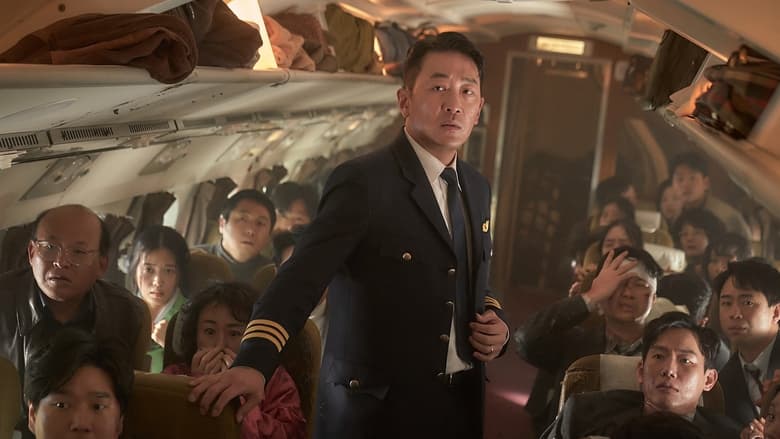
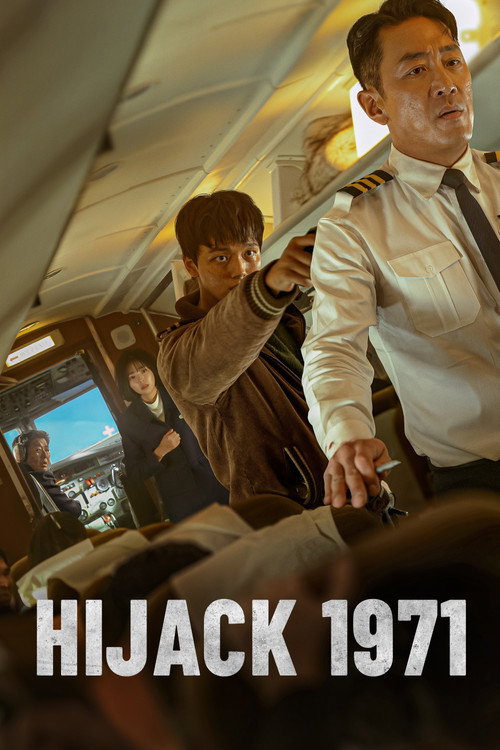
Two years later, in the winter of 1971, Tae-in is working as a commercial co-pilot alongside veteran Captain Gyu-sik (Sung Dong-il). During a routine domestic flight from Sokcho Airport to Seoul’s Gimpo International Airport, a young passenger named Yong-dae (Yeo Jin-goo) detonates improvised explosives in the cabin. Armed with a knife and additional pipe bombs, Yong-dae takes control of the aircraft, blinds Captain Gyu-sik in one eye, and demands that the plane be rerouted directly to Pyongyang.

With limited fuel, damaged instruments, an injured captain, and an explosive-wielding hijacker in the cockpit, Tae-in must navigate extreme atmospheric conditions, military air interception, and intense psychological warfare inside the cabin. Alongside flight attendant Lee Ok-soon (Chae Soo-bin), Tae-in works to outwit the hijacker and keep all 55 passengers alive while remaining firmly south of the border.
Core Meaning

The core message of Hijack 1971 centers on the supreme value of human life over political boundary lines and bureaucratic doctrines. Director Kim Sung-han explores how ordinary individuals, haunted by trauma and systemic injustice, make defining ethical choices under extreme pressure. The film asserts that true moral duty lies not in blindly obeying state commands, but in taking personal responsibility for the lives entrusted to one's care.

Thematic DNA

Cold War Division and Ideological Victimhood 30%
Guilt, Duty, and Self-Sacrifice 30%
Professional Responsibility vs. State Authority 20%
Human Compassion in Life-or-Death Crisis 20%

Cold War Division and Ideological Victimhood

The film illustrates how the ideological split between North and South Korea ruined ordinary lives. Both Tae-in and Yong-dae are shaped by this divide; Yong-dae’s family was destroyed by state paranoia and false 'communist' branding, while Tae-in’s career was wrecked by the geopolitical standoff.

Guilt, Duty, and Self-Sacrifice

Tae-in carries the emotional burden of the 1969 hijacking, continually questioning whether his restraint led to innocents being trapped in North Korea. His actions aboard the 1971 flight represent an absolute commitment to saving every passenger, culminating in ultimate self-sacrifice.

Professional Responsibility vs. State Authority

The narrative contrasts cold military protocol—which views civilian casualties as acceptable collateral damage to prevent a defecting aircraft—with the instinct of pilots and crew who view passenger safety as an inviolable sacred trust.

Human Compassion in Life-or-Death Crisis

Amid chaos, the passengers and crew evolve from a disparate group arguing over unreserved seats into a unified community supporting one another to survive terrorism in the sky.

Character Analysis

Jeon Tae-in

Ha Jung-woo

Archetype: Tragic Hero / Redeemer Key Trait: Unwavering courage, exceptional tactical flying skills

Motivation

To prevent another tragedy like the 1969 abduction and ensure no passenger under his care is left behind.

Character Arc

Moves from a guilt-ridden, suspended Air Force pilot unable to perform independent commercial landings into a selfless leader who gives his life to protect his passengers.

Kim Yong-dae

Yeo Jin-goo

Archetype: Tragic Antihero / Relentless Antagonist Key Trait: Volatile intensity, desperate ruthlessness

Motivation

Escape persecution in South Korea, gain recognition/bounty in North Korea, and take revenge on the state that destroyed his family.

Character Arc

A young man broken by poverty, police torture, and societal prejudice who turns into an unyielding terrorist, seeking escape to North Korea at all costs.

All 4 characters and cast

Symbols & Motifs

"Hope" (희망) Cigarettes

Meaning:

They symbolize Tae-in's quiet yearning for peace and redemption.

Context:

Tae-in exclusively smokes 'Hope' brand cigarettes, noting that he likes them for their pretty package pattern, serving as a peaceful prelude before chaotic events erupt.

Improvised Grenades and Bombs

Meaning:

They represent the volatile, destructive desperation generated by social persecution and poverty.

Context:

Utilized by Yong-dae to hijack the aircraft and demand to be rerouted directly to Pyongyang.

The Cockpit Door

Meaning:

Acts as a physical metaphor for the 38th parallel, where crossing it signifies losing control and entering an authoritarian abyss.

Context:

The battered door physically separates the explosive-wielding hijacker in the cockpit from the rest of the aircraft.

Inverted Flight / Aerial Acrobatics

Meaning:

Physically symbolizes inverting the power dynamic and subverting gravity to disarm chaos.

Context:

Tae-in's radical maneuver of flying the commercial airliner upside down to throw Yong-dae off balance.

Unreserved Rush for Seats

Meaning:

Symbolizes simple human innocence and democratic equality before disaster strikes.

Context:

The opening sequence shows passengers wildly rushing onto the tarmac to claim seats on the flight.

Memorable Quotes

이 비행기는 지금부터 북으로 간다.
— Kim Yong-dae

Context

Declared right after detonating his pipe bomb in the cabin.

Meaning

This line instantly pivots the film from a normal flight into a high-stakes hostage thriller.

손님들이 타고 있는데 어떻게 쏩니까!
— Jeon Tae-in

Context

Spoken during the 1969 prologue when ordered to shoot down a hijacked airliner.

Meaning

Establishes Tae-in's core morality—he values civilian lives over military obedience.

All 3 quotes

Philosophical Questions

Is it justifiable to disobey military orders when compliance guarantees innocent civilian casualties?

Explored through Tae-in's refusal to shoot down the airliner in 1969, prioritizing human lives over strict adherence to military orders and geopolitical consequences.

Can systemic cruelty and false societal persecution explain or lessen personal moral accountability for acts of terror?

Examined via Yong-dae's character arc, contrasting his history of state-inflicted trauma, police torture, and social exclusion with his volatile, dangerous hijacking of the passenger flight.

What constitutes true duty—following legal protocols or risking oneself for human lives?

Highlighted through the choices made by the aircrew and military commanders, contrasting cold bureaucratic doctrine with self-sacrificing human compassion.

Alternative Interpretations

The Geopolitical Victimhood Reading: Critics discuss the film as a tragedy where both hero (Tae-in) and villain (Yong-dae) are collateral damage of the Cold War division. Yong-dae is driven mad by state abuse, while Tae-in is cast aside by military dogma.

Full ending explanation

Cultural Impact

In 1971, South Korea was under authoritarian rule with intense anti-communist surveillance. Anyone suspected of leftist leanings faced severe discrimination, torture, and social exclusion—a context that explains Yong-dae's extreme alienation.

The real 1971 incident forced the South Korean government to radically overhaul airport security, mandate armed Sky Marshals on domestic flights, and install reinforced lockable cockpit doors.

Critics praised the movie for its technical execution, practical gimbal sets, and emotional weight, noting that it avoided cheap melodrama while delivering continuous tension.

Audience Reception

Hijack 1971 was highly praised as one of South Korea's most intense, technically impressive, and emotionally grounded aviation thrillers.

Praised Aspects:

  • Outstanding sound design and physical effects that induce visceral motion sickness and claustrophobia.
  • Yeo Jin-goo’s chillingly human antagonist performance.
  • High-stakes pacing that keeps tension elevated across the entire 100-minute runtime.

Main Points of Criticism:

  • Fictionalized character backstories that take artistic liberties compared to exact real-world records.
  • Occasional reliance on classic disaster-movie character archetypes (e.g., panicked or selfish passengers).

Interesting Facts

  • Hijack 1971 marks the feature directorial debut of Kim Sung-han, who previously worked as the assistant director on the 2019 blockbuster Ashfall.
  • The movie is directly inspired by the real-life January 23, 1971 hijacking attempt of a Korean Air Fokker F27 airliner flying from Sokcho to Seoul.
  • Production built a precise, full-scale replica of the Fokker F27 fuselage mounted on a massive hydraulic gimbal, surrounded by circular LED screens playing real-sky footage.
  • Actor Yeo Jin-goo, famously known in South Korea as the 'Nation's Younger Brother' for his gentle hero roles, took on his first intense villain role after extensive discussions with the director.
  • Released on June 21, 2024, the film quickly surpassed 1 million admissions within nine days and accumulated over $14.6 million at the international box office.

Easter Eggs

Historical Accuracy of 'Hope' Cigarettes

The 'Hope' (희망) cigarette smoked by Tae-in was an actual real brand manufactured in South Korea between 1964 and 1973.

Reference to the 1969 KAL YS-11 Hijacking

The prologue directly references the real December 11, 1969 abduction of a Korean Air YS-11 aircraft to Wonsan, North Korea, where 11 South Koreans were never allowed to return.

1970s Aviation Culture

The film accurately reproduces historical aviation quirks of 1970s South Korea, including unreserved seating (passengers sprinting across the tarmac to grab good seats) and smoking inside the cabin.

Kim Dong-wook Cameo

Popular actor Kim Dong-wook makes a special cameo appearance as Dong-chul, Tae-in's fellow Air Force fighter pilot wingman in the 1969 sequence.

Frequently Asked Questions

Explore More About This Movie

Dive deeper into specific aspects of the movie with our detailed analysis pages

Comments (0)

Leave a comment

No comments yet. Be the first to share your thoughts!

Similar Movies