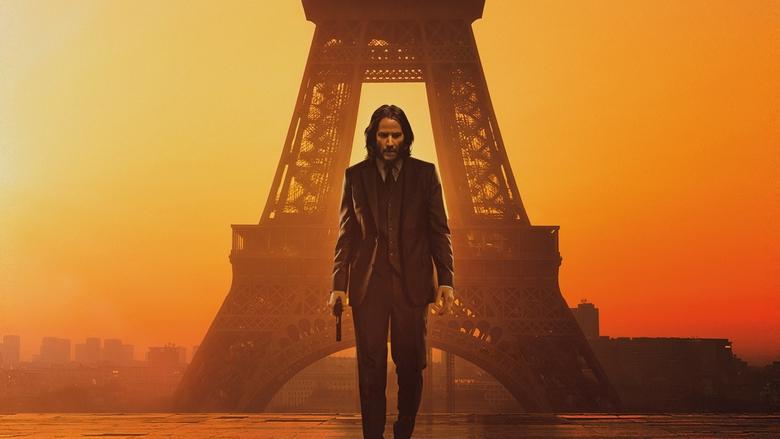
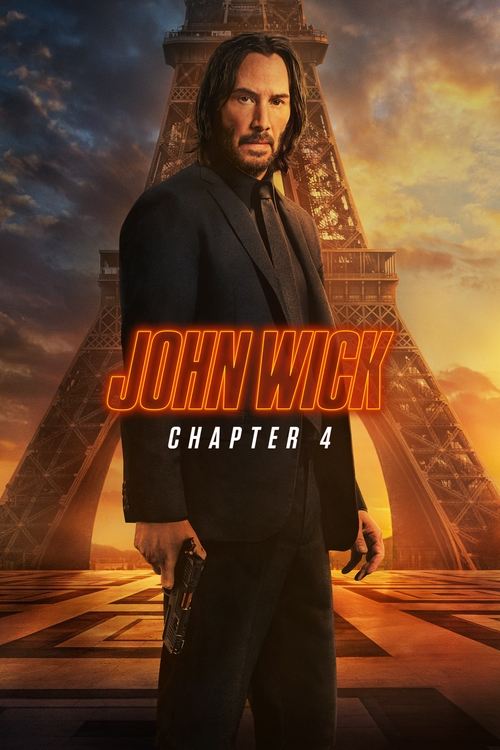
John Wick: Chapter 4
Neo-noir mythos woven into a ballet of bullets, where the quest for freedom becomes a Sisyphean climb toward a beautiful, bloody sunrise. A symphony of violence and brotherhood reflecting on the cost of consequences.
John Wick: Chapter 4

John Wick: Chapter 4

"No way back, one way out."

22 March 2023 Germany 170 min ⭐ 7.7 (7,639)
Director: Chad Stahelski
Cast: Keanu Reeves, Donnie Yen, Bill Skarsgård, Ian McShane, Laurence Fishburne
Crime Action Thriller
Consequences and Causality Friendship vs. Duty Freedom through Death The Sisyphean Struggle
Budget: $100,000,000
Box Office: $440,157,245

Overview

John Wick: Chapter 4 continues the relentless saga of the legendary hitman as he uncovers a path to defeating the High Table. With the price on his head increasing, John travels globally—from the deserts of Morocco to the neon-soaked streets of Osaka, the thumping clubs of Berlin, and the historic grandeur of Paris—seeking out the most powerful players in the underworld.

The antagonist, the Marquis Vincent de Gramont, fueled by unwavering ambition, seeks to eradicate the idea of John Wick to consolidate his own power. He enlists Caine, a blind assassin and former friend of John, forcing him into a deadly confrontation by threatening his daughter. Old alliances are tested, and new enemies emerge as the rules of the assassin world are pushed to their breaking point.

Ultimately, the film culminates in a high-stakes duel, an ancient ritual that offers John a final chance at freedom. As the clock ticks down, John must fight through hordes of mercenaries to reach the designated dueling ground at Sacré-Cœur, leading to a climax that redefines the meaning of victory and peace.
Core Meaning

At its heart, the film explores the concept of a "good death" as the only true path to freedom for men bound by violence. It posits that in a world governed by rigid rules and consequences, one's life is defined not by how they live, but by how they choose to die. It is a meditation on friendship, the weight of the past, and the idea that true liberation requires the ultimate sacrifice.

Thematic DNA

Consequences and Causality 30%
Friendship vs. Duty 25%
Freedom through Death 25%
The Sisyphean Struggle 20%

Consequences and Causality

The mantra of the series, "Consequences," reaches its zenith here. Every action John has taken leads to this moment, affecting not just him but everyone he touches—Shimazu, Charon, and Winston. The film illustrates that one cannot outrun the repercussions of their actions; they must face them head-on.

Friendship vs. Duty

The bond between John, Caine, and Shimazu Koji highlights the tragic conflict between personal loyalty and professional obligation. The characters are torn between the codes they live by and the love they bear for their "brothers," often leading to fatal choices.

Freedom through Death

The film consistently questions what freedom looks like for John Wick. It suggests that a peaceful life is impossible within the High Table's reach, and that the only true escape from the cycle of violence is death—either literal or metaphorical.

The Sisyphean Struggle

Visually represented by the stairs at Sacré-Cœur, John's journey is an endless uphill battle. Each time he rises, he is knocked back down, yet he persists. This theme emphasizes resilience and the sheer will to continue despite the absurdity and inevitability of the struggle.

Character Analysis

John Wick

Keanu Reeves

Archetype: The Tragic Hero / The Ronin
Key Trait: Indomitable Will

Motivation

To find peace and true freedom from the High Table, honoring the memory of his wife Helen.

Character Arc

John moves from a fugitive seeking mere survival to a man seeking a definitive end. He transitions from fighting for his life to fighting for his legacy and the safety of his friends, ultimately accepting that his death may be the only way to destroy the monster he created.

Caine

Donnie Yen

Archetype: The Reluctant Antagonist / The Mirror
Key Trait: Ruthless Pragmatism

Motivation

To protect his daughter form the High Table's wrath.

Character Arc

A blind assassin forced out of retirement, Caine mirrors John's potential future. He fights not out of loyalty to the Table, but to protect his daughter. His journey is one of tragic necessity, leading him to aid John in the end while still fulfilling his obligation.

Marquis Vincent de Gramont

Bill Skarsgård

Archetype: The Tyrant
Key Trait: Arrogant Ambition

Motivation

To consolidate absolute power and establish a new order within the High Table.

Character Arc

The Marquis represents the new, arrogant face of the High Table. He seeks not just to kill John, but to kill the legend of John Wick to cement his own power. His hubris ultimately leads to his downfall when he underestimates the old codes.

Winston Scott

Ian McShane

Archetype: The Survivor / The Mentor
Key Trait: Machiavellian Intellect

Motivation

Revenge for Charon and the restoration of his status as Manager.

Character Arc

After being stripped of his status and losing Charon, Winston is driven by cold revenge. He maneuvers John as a weapon to regain his Kingdom (The Continental), proving he is the ultimate player of the Game.

Shimazu Koji

Hiroyuki Sanada

Archetype: The Loyal Friend / The Samurai
Key Trait: Unwavering Honor

Motivation

Honor and loyalty to his friend John Wick.

Character Arc

Koji stands as the moral anchor, choosing to die for the principle of friendship rather than live by the Table's oppression. His death sets his daughter, Akira, on a path of vengeance.

Symbols & Motifs

The Stairs of Sacré-Cœur

Meaning:

Symbolizes the Sisyphean task and the arduous path to redemption. John's repeated falls and ascents represent the relentless nature of his existence and the immense effort required to achieve peace.

Context:

During the climax, John fights his way up the 222 steps to the church, only to be thrown all the way back to the bottom, forcing him to start over with Caine's help.

The Duel Cards

Meaning:

Represents fate and chance within a rigid system. They highlight that even in a world of strict rules, luck and the turn of a card can dictate life or death.

Context:

Used during the negotiation scene between the Marquis and John (via Winston) to determine the weapons, time, and location of the final duel.

Cherry Blossoms (Sakura)

Meaning:

A traditional Japanese symbol of the transience of life, beauty, and the acceptance of death (Bushido). It underscores the fleeting nature of the warriors' existence.

Context:

Prominently featured in the Osaka Continental sequence, framing the battles and Caine's confrontation with Shimazu Koji.

The Hourglass

Meaning:

Symbolizes time running out and the inevitability of the end. It serves as a visual countdown to John's potential demise or liberation.

Context:

The Marquis uses an hourglass to mark the time remaining before the duel, emphasizing the urgency of the sunrise.

Painting: Liberty Leading the People

Meaning:

Reflects the revolutionary spirit and the fight against tyranny. It mirrors John's rebellion against the High Table's oppressive rule.

Context:

Displayed prominently in the Louvre during the meeting between the Marquis and Winston.

Memorable Quotes

Those who cling to death, live. Those who cling to life, die.

— Caine / John Wick

Context:

Spoken by Caine before the battle in Osaka, and repeated by John to Caine before their duel.

Meaning:

A philosophy of war and Bushido. It suggests that only by accepting death can a warrior survive the battle, while fear of death leads to hesitation and defeat.

Friendship means little when it's convenient.

— Shimazu Koji

Context:

Koji says this to the hotel staff and later to Caine when refusing to give up John Wick.

Meaning:

Defines the film's core value of loyalty. True friendship is tested only in adversity, not when it is safe or easy.

Such is life.

— Ned Kelly / Winston

Context:

Winston quotes the bushranger Ned Kelly's final words, and Charon repeats it before his execution.

Meaning:

A stoic acceptance of fate. It reflects the characters' understanding that they are players in a game much larger than themselves, and death is an inevitable part of it.

A man has to look his best when it's time to get married, or buried.

— The Bowery King

Context:

Said when presenting John with a new ballistic suit before the final act.

Meaning:

Highlights the ritualistic nature of the assassin world, where appearance and style are maintained even in the face of death.

Consequences.

— John Wick

Context:

John says this right before shooting the Marquis in the head at the duel.

Meaning:

The singular word that defines the entire franchise. It is John's final judgment on the Marquis, reminding him that arrogance has a price.

Philosophical Questions

Can a person ever truly escape their past?

The film argues that the past is immutable. No matter how far John runs or who he kills, his past as 'Baba Yaga' defines his future. True escape is only found in the cessation of the struggle (death).

What constitutes a 'good death'?

Through the characters of Shimazu and John, the film explores the Bushido concept that the manner of death defines the value of life. Dying for a friend or a principle is presented as the ultimate redemption for a life of sin.

Alternative Interpretations

The Death of John Wick: The most debated interpretation concerns the ending. While John appears to die and is buried, several clues suggest he may have faked his death to truly be free. The wound was in a non-lethal spot (similar to the doctor scene in Chapter 3), and his dog looks up from the grave as if seeing someone. This ambiguity allows the film to serve as a definitive conclusion while leaving a door open for the studio.

The High Table as Fate: Some critics interpret the High Table not just as a crime syndicate, but as a metaphor for Fate or the Greek Gods—omnipotent, cruel, and impossible to defeat, meaning the only victory against them is choosing the terms of one's own death.

Cultural Impact

John Wick: Chapter 4 cemented the franchise as a modern action masterpiece, often compared favorably to Mad Max: Fury Road for its pure kinetic energy. It revitalized the "gun-fu" genre, influencing a wave of action cinema that prioritizes long takes, clear choreography, and stunt work over quick cuts and CGI. The film's critical and commercial success demonstrated that R-rated, original action properties could still dominate the box office. Culturally, it deepened the appreciation for stunt performers, leading to renewed calls for a Stunt Oscar category. The character of Caine also sparked discussions on the representation of blind warriors in cinema, paying homage to Zatoichi.

Audience Reception

The film received near-universal acclaim from audiences and critics alike, boasting high scores on Rotten Tomatoes and IMDb. Praised aspects included the relentless, creative action sequences (particularly the Dragon's Breath shotgun scene and the Arc de Triomphe fight), the cinematography by Dan Laustsen, and the performances of Donnie Yen and Keanu Reeves. Criticisms were minor, mostly focused on the sheer runtime (169 minutes) and the suspension of disbelief required for John's durability (falling from buildings, getting hit by cars). Overall, it was hailed as the best entry in the sequel trilogy and a perfect send-off for the character.

Interesting Facts

  • The match-cut transition from The Bowery King blowing out a match to the sunrise in the desert is a direct homage to 'Lawrence of Arabia'.
  • The overhead 'top-down' shot of John Wick clearing an apartment with a dragon's breath shotgun was inspired by the video game 'The Hong Kong Massacre'.
  • Donnie Yen initially pushed back against the original costume and name for his character, wanting to avoid Asian stereotypes, leading to the cool, suit-wearing Caine.
  • The film features a radio DJ narrator (WUXIA) guiding the assassins, a clear reference to the 1979 film 'The Warriors'.
  • Keanu Reeves reportedly only speaks about 380 words of dialogue in the entire nearly three-hour film.
  • The staircase scene at Sacré-Cœur involved massive stunt work; the fall John takes was performed by stunt double Vincent Bouillon, who tumbled down most of the 222 steps.
  • Lance Reddick (Charon) passed away shortly before the film's release, making his character's on-screen death poignant and the film dedicated to his memory.

Easter Eggs

Radio Station 'WUXIA'

The radio station is named 'WUXIA', referencing the Chinese genre of martial arts fiction and cinema, honoring the influences on the film's choreography.

Ruska Roma Tattoo

The tattoo seen on the arm of the new Elder and others connects back to John's origins with the Ruska Roma crime syndicate, explored in Chapter 3.

Obeying the Traffic

During the Arc de Triomphe fight, cars do not stop for the gunfight, referencing the chaotic, indifferent nature of the world and possibly the famous 'Frogger' game dynamic.

⚠️ Spoiler Analysis

Click to reveal detailed analysis with spoilers

Frequently Asked Questions

Explore More About This Movie

Dive deeper into specific aspects of the movie with our detailed analysis pages

Comments (0)

Leave a comment

No comments yet. Be the first to share your thoughts!