
Skip to content
HIM
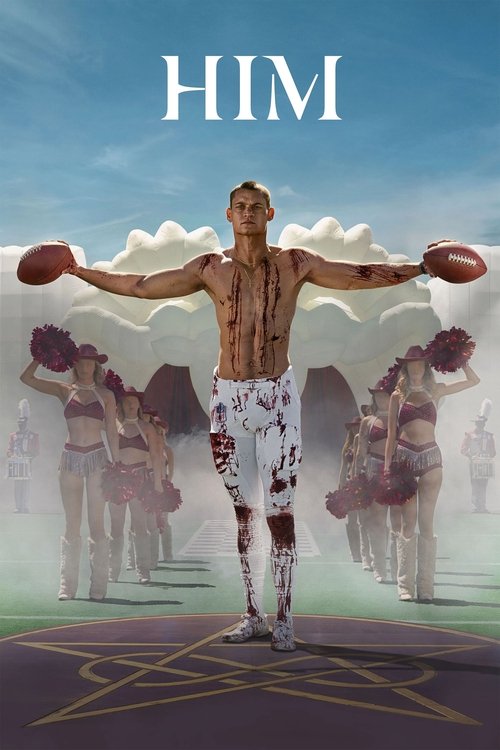
A suffocating psychological descent into athletic mania, HIM drowns the glitz of professional sports in visceral body horror, portraying ambition as a gilded slaughterhouse where the human soul is systematically drained for an idolatrous crowd.
HIM

HIM

"Greatness demands sacrifice."

18 September 2025 United States of America 96 min 5.6 (450)

Director: Justin Tipping

Cast: Tyriq Withers, Marlon Wayans, Julia Fox, Tim Heidecker, Jim Jefferies

Thriller Mystery Horror Toxic Hypermasculinity & Generational Trauma Commodification & Exploitation of Black Athletic Bodies The Faustian Pact & Ambition at Any Cost Sports as Fanatical Modern Religion
Budget: $27,000,000
Box Office: $27,834,512

Overview

Directed and co-written by Justin Tipping (Kicks) and produced by Jordan Peele’s Monkeypaw Productions alongside Universal Pictures, HIM (2025) operates as a rare hybrid of gridiron drama, psychological thriller, and occult horror. The narrative follows Cameron "Cam" Cade (Tyriq Withers), a generational collegiate quarterback standing on the threshold of the professional draft. Cam's lifelong ambition has been fueled by memories of his late father and their shared idol: Isaiah White (Marlon Wayans), the eight-time championship quarterback for the San Antonio Saviors who miraculously recovered from a gruesome, career-threatening leg injury decades prior.

On the eve of the pre-draft scouting combine, Cam’s dreams are violently derailed when a mysterious, masked assailant attacks him on a deserted field, inflicting a catastrophic traumatic brain injury. With team scouts balking at his prognosis, Cam receives an unexpected lifeline: Isaiah White himself, nearing retirement, invites the young prospect to an exclusive, weeklong training retreat at his secluded compound deep in the desert. Desperate to salvage his future and step into his idol's cleats, Cam accepts.

Upon arriving at the compound—a compound surrounded by fanatic, paint-smeared tailgaters living in a perpetual purgatorial vigil—Cam discovers that Isaiah’s training regimen extends far beyond playbook drills. Flanked by an influencer spouse (Julia Fox), an eccentric personal physician (Jim Jefferies), and sycophantic handlers, Isaiah subjects Cam to increasingly bizarre, torturous physical, biochemical, and psychological trials. As reality blurs under blinding desert heat and mounting neurological trauma, Cam must discern whether he is being groomed as an heir or led to an altar of sacrifice.


Core Meaning

At its core, HIM serves as an indictment of the modern cult of athletic celebrity and the destructive doctrine of toxic hypermasculinity. Director Justin Tipping explores how young athletes—particularly Black athletes—are conditioned by parental figures and patriarchal systems to view their bodies as expendable commodities in exchange for glory, fame, and wealth. By framing football through supernatural and Faustian tropes, the film argues that the relentless pursuit of being the "G.O.A.T." (Greatest of All Time) is a form of spiritual self-immolation. Tipping highlights that modern sporting institutions function like Roman gladiatorial rings or modern sacrificial altars, where fans and executives worship spectacle while demanding the total physical and mental destruction of the players.

Thematic DNA

Toxic Hypermasculinity & Generational Trauma 30%
Commodification & Exploitation of Black Athletic Bodies 25%
The Faustian Pact & Ambition at Any Cost 25%
Sports as Fanatical Modern Religion 20%

Toxic Hypermasculinity & Generational Trauma

Cam’s entire worldview is built upon his late father's toxic decree: real men endure any pain, bleed without complaint, and sacrifice their bodies for victory. Isaiah exploits this internalized wound, demanding Cam suppress empathy, fear, and self-preservation to attain "greatness".

Commodification & Exploitation of Black Athletic Bodies

The film draws deliberate parallels between modern sports drafts and historic auction blocks. Cam's physical suffering, concussions, and flesh are analyzed and bartered by white agents, executives, and parasitic handlers who profit off his physical devastation.

The Faustian Pact & Ambition at Any Cost

Mirroring the classical Faust legend, Isaiah’s longevity is revealed to be the byproduct of literal and metaphorical bargains. The film examines how far an individual will go—surrendering bodily integrity, sanity, and morality—when promised legendary immortality.

Sports as Fanatical Modern Religion

By christening the dynasty franchise the "Saviors" and positioning Isaiah White as a messianic figure, the film equates Sunday NFL fandom with religious fervor. The delirious fans camping at the desert gates resemble religious zealots worshipping a bloodthirsty deity.

Character Analysis

Cameron "Cam" Cade

Tyriq Withers

Archetype: The Tragic Initiate / Fallen Prodigy Key Trait: Desperate, stubborn perseverance at the expense of his own well-being.

Motivation

To realize his deceased father's dream, overcome his debilitating brain trauma, and become the undisputed league quarterback.

Character Arc

Begins as an eager, impressionable rookie; descends through confusion, chemical dependency, and paranoia; ultimately is forced into a violent reckoning over the cost of his ambition.

Isaiah White

Marlon Wayans

Archetype: The Corrupted Mentor / Demonic Patriarch Key Trait: Narcissistic megalomania masked by athletic discipline.

Motivation

To maintain his immortal legacy and extend his dominion over the San Antonio Saviors by any occult or bodily means necessary.

Character Arc

Starts as a charismatic, zen-like athletic elder statesman before his charming facade curdles into manic, predatory madness.

All 5 characters and cast

Symbols & Motifs

The Stitched Head Scar

Meaning:

Physically renders Cam as a human ball—an object designed to be battered, thrown, and traded.

Context:

Following brain surgery, Cam’s head wound is sealed with surgical staples that mirror the thick laces of an American football.

The G.O.A.T. (Acronym vs. Sacrificial Beast)

Meaning:

Bridges the gap between sports prestige and pagan sacrificial offerings, doubling as a sinister occult motif.

Context:

The term "Greatest of All Time" is used alongside goats appearing throughout the film’s iconography.

The Desert Gate Purgatory

Meaning:

Represents sports fandom as an inescapable limbo, where parasitic consumers feast endlessly on athlete pain.

Context:

A mass of painted, unhinged tailgaters permanently lives outside Isaiah's compound in a perpetual vigil.

Marco’s Syringes and Unmarked Elixirs

Meaning:

Symbolizes performance-enhancing drugs, medical gaslighting, and the occult draining of youth to sustain an aging master.

Context:

Glowing serums and repeated blood transfusions administered to Cam by Dr. Marco.

The Last Supper Banquet Table

Meaning:

Directly evokes da Vinci's The Last Supper, foreshadowing imminent betrayal and messianic sacrifice.

Context:

A pivotal sequence depicts Cam seated at the center of a grand desert banquet table flanked by duplicitous sycophants and handlers.

The Suffocating Plastic Bag

Meaning:

Visualizes the literal and psychological asphyxiation that accompanies instant celebrity.

Context:

During an unhinged training hallucination, a plastic bag is forced over Cam's head amid flashbulbs.

Memorable Quotes

That’s what real men do. They make sacrifices. No guts. No glory.
— Cam’s Father

Context

Spoken during the prologue as young Cam watches Isaiah suffer an agonizing compound bone fracture on television.

Meaning

Serves as the ideological prison that dictates Cam's destructive choices throughout his life.

The game is the game. It can be joyful and beautiful and all those things... but it demands your blood.
— Isaiah White

Context

Delivered mid-way through Cam’s isolation training when Cam questions the extreme nature of the drills.

Meaning

Isaiah strips away sports romanticism to reveal the brutal commercial and metaphysical exchange required of elite competitors.

All 3 quotes

Philosophical Questions

What is the moral cost of eternal greatness?

The film questions whether the preservation of an immortal sports legacy justifies the complete destruction of one's ethical and physical humanity.

Where does athletic discipline end and systemic abuse begin?

Through Isaiah's grueling regimen, the narrative explores the threshold at which a mentor demanding total physical subjugation transitions into vampiric exploitation.

Is toxic masculinity a self-perpetuating generational curse?

The story explores how the rigid edicts of fathers (such as "no guts, no glory") trap sons into repeating destructive cycles of physical self-harm for external validation.

Alternative Interpretations

The film invites three distinct readings:

Full ending explanation

Cultural Impact

HIM arrived amid intense cultural reckoning regarding chronic traumatic encephalopathy (CTE), concussions, and long-term neurodegenerative damage among NFL veterans. It also engaged with the broader sports discourse analyzing the monetization of college athletes and the commercial machinery that treats players as disposable assets.

While the film met with a largely negative critical response (holding a 30% approval rating on Rotten Tomatoes and a 39/100 on Metacritic) and struggled commercially, it garnered niche discussion as one of the few horror films in cinema history to center directly on American professional football. Furthermore, Marlon Wayans received widespread acclaim for his intense, terrifying dramatic turn, showcasing an unhinged, magnetic villainy that subverted his comedic roots.

Audience Reception

Aggregated reviews reflected mixed to negative reactions, highlighted by specific points of praise and heavy criticism:

  • Praised Elements: Marlon Wayans’ ferocious, go-for-broke dramatic performance balancing comedic timing with menacing intensity; the unique premise of utilizing American football as a horror staging ground; Kira Kelly's atmospheric cinematography; and Bobby Krlic's oppressive score.
  • Main Criticisms: Screenplay incoherence resulting from juggling too many unresolved themes (CTE, religion, racial commodification, cult rituals); bludgeoning, blunt metaphors (such as football-lace surgical staples and Last Supper imagery); and a lack of sustained suspense in its convoluted second half.
  • Controversial Moments: The abrupt escalation from a grounded sports recovery drama into gonzo, hallucinatory blood-magic, and the ambiguous handling of Cam's initial brain injury.

The overall consensus viewed the film as an audacious, visually stylish concept carried by Marlon Wayans that ultimately fumbled its ambitious social critique into an overstuffed, uneven horror narrative.

Interesting Facts

  • The screenplay, initially titled GOAT, was written by Zack Akers and Skip Bronkie (creators of the acclaimed sci-fi podcast/series Limetown) and sat on the prestigious Hollywood Black List before Jordan Peele’s Monkeypaw acquired and developed it.
  • Director Justin Tipping (Kicks) was brought aboard to direct and collaborated on final revisions of the script with Akers and Bronkie to amplify its psychological and racial undercurrents.
  • Marlon Wayans and Tyriq Withers underwent rigorous daily athletic regimens and QB-mechanics training to execute authentic footwork, throws, and conditioning drills on camera without relying extensively on doubles.
  • The film’s menacing musical score was composed by British producer and multi-instrumentalist Bobby Krlic (also known as The Haxan Cloak), famous for scoring Ari Aster’s Midsommar.
  • The visual look was crafted by Emmy-nominated cinematographer Kira Kelly (13th, Queen Sugar), who prioritized claustrophobic shallow depth of field and sun-baked desert imagery.
  • The production recruited real-world musicians into the fold, including appearances by Grammy-nominated rapper Tierra Whack and West Coast hip-hop artist Guapdad 4000.
  • The film was produced on a budget of approximately $27 million and grossed $28 million worldwide during its theatrical run under Universal Pictures, struggling to break even theatrically.

Easter Eggs

Homage to Joe Theismann

The catastrophic, bone-protruding leg injury that Isaiah White survives in the prologue is a direct visual recreation of Washington quarterback Joe Theismann’s infamous 1985 career-ending broken leg on Monday Night Football.

Da Vinci's "The Last Supper"

A stylized sequence positions Cam at the center of a lavish desert banquet table with twelve handlers and disciples arrayed around him, explicitly referencing Leonardo da Vinci's mural and foreshadowing Judas-like betrayals.

North Dallas Forty Homage

Isaiah’s reliance on illicit medical concoctions administered by Dr. Marco mirrors Peter Gent’s seminal 1979 football critique North Dallas Forty, transmuting sports doping into occult body horror.

The "GOAT" Dual Meaning

Beyond the contemporary sports acronym ("Greatest of All Time"), the film litters background artwork, statues, and horns throughout Isaiah's estate evoking the Baphomet and goat sacrifices common in occult lore.

Musician Cameos

Rappers Guapdad 4000 and Tierra Whack make cameo appearances as part of the eccentric entourage and competitive ecosystem swirling around Isaiah’s dynasty.

Frequently Asked Questions

Explore More About This Movie

Dive deeper into specific aspects of the movie with our detailed analysis pages

Comments (0)

Leave a comment

No comments yet. Be the first to share your thoughts!

Similar Movies