
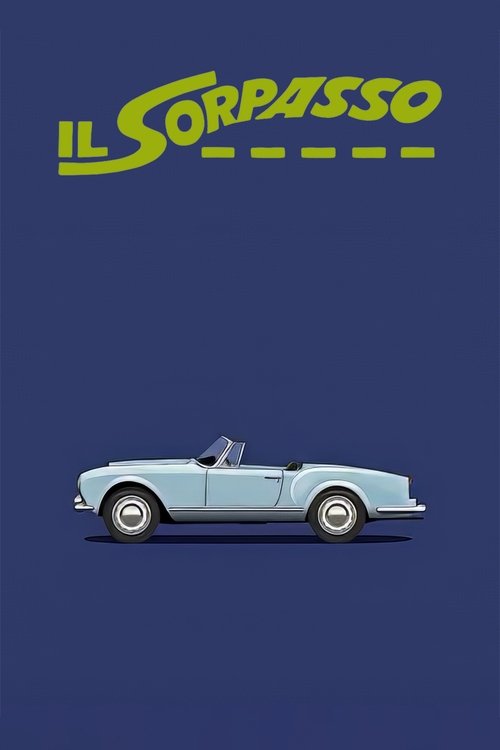
Il sorpasso
Il Sorpasso - Symbolism & Philosophy
Symbols & Motifs
The Lancia Aurelia B24 Convertible
The car is the film's central symbol, representing the allure and danger of the new, modern Italy. It embodies speed, freedom, consumerism, and masculine virility. Initially a symbol of elegance, Bruno's modified, loud, and constantly speeding car represents the corruption of the Italian dream into something vulgar, obnoxious, and dangerous. It is both the vehicle of liberation for Roberto and the instrument of his death.
The car is a constant presence, the third main character of the film. The title itself, 'The Overtaking,' refers to Bruno's aggressive driving style. The customized, loud horn is used repeatedly to assert Bruno's dominance on the road. The car's ultimate crash off a cliff symbolizes the catastrophic end of the reckless pursuit of modernity that it represents.
The Via Aurelia (The Road)
The Via Aurelia, the coastal road they travel, symbolizes the path of modern life during the economic boom. It is a route of escape from the city and tradition, leading to seaside resorts that represent leisure and consumer culture. However, the road is also fraught with peril, and the constant, reckless 'sorpassi' (overtakings) mirror the cutthroat, competitive nature of the new society. The road offers the illusion of progress and freedom, but it ultimately leads to a dead end.
The entire film takes place along this road, from the empty streets of Rome on Ferragosto to the sunny beaches and, finally, to the treacherous cliffside curves of Tuscany where the journey ends tragically.
Ferragosto (August 15th Holiday)
The film's setting during Ferragosto, a major Italian summer holiday, symbolizes a time of societal pause and inversion. The empty city of Rome, described by Bruno as a 'graveyard,' creates a liminal space where the normal rules of life are suspended. This holiday atmosphere allows for the improbable encounter between Bruno and Roberto and facilitates their spontaneous, convention-defying journey. It represents a temporary, illusory escape from reality that must inevitably and tragically end.
The film opens on the morning of Ferragosto, with Bruno desperately searching for cigarettes and a phone in a deserted Rome. The two-day trip is contained within this holiday period, enhancing the dreamlike, and ultimately nightmarish, quality of the events.
Philosophical Questions
Does true freedom lie in the rejection of all responsibility?
The film explores this through Bruno, who lives a life seemingly free from societal constraints, family ties, and long-term planning. His existence is a series of impulsive pleasures. However, the film systematically deconstructs this notion of freedom, revealing it as a source of profound loneliness, immaturity, and ultimately, destruction. It posits that a life devoid of responsibility is not freedom but a hollow, frantic escape that leaves a wake of emotional damage and, in this case, literal death.
What is the true cost of rapid societal modernization?
Il Sorpasso uses its characters and setting to question the uncritical celebration of the 'economic miracle.' It suggests that while modernization brings wealth, mobility (symbolized by the car), and new forms of leisure, it also fosters superficiality, moral decay, and a loss of community and tradition. Roberto's tragic fate serves as a metaphor for the destruction of the country's more thoughtful, humane past by a new, aggressive, and empty consumer culture.
Can fundamentally opposing natures truly connect, or does one inevitably consume the other?
The relationship between Bruno and Roberto is a study in contrasts. For a time, it seems a genuine, if unlikely, friendship is forming. Roberto is drawn to Bruno's vitality, and Bruno seems to enjoy the novelty of Roberto's earnestness. However, the film's conclusion suggests a predatory dynamic. Bruno's lifestyle doesn't just influence Roberto; it completely overwhelms and annihilates him. The film bleakly suggests that the reckless, vital force of modernity (Bruno) cannot coexist with the cautious, intellectual traditions of the past (Roberto) but must inevitably destroy it.
Core Meaning
Il Sorpasso is a masterful critique of Italy's 'economic miracle' of the early 1960s. Director Dino Risi uses the road trip as a metaphor to explore the seductive but ultimately hollow nature of the new consumerist society. The film contrasts the traditional, thoughtful Italy (represented by Roberto) with the modern, superficial, and fast-paced nation obsessed with status and immediate gratification (embodied by Bruno and his car). The core message is a cautionary one: the reckless pursuit of 'the easy life,' abandoning moral and personal responsibility, leads not to freedom but to tragedy. It is a poignant examination of a country losing its soul in a frantic, exhilarating, and ultimately destructive race toward modernity.