Full spoilers follow.
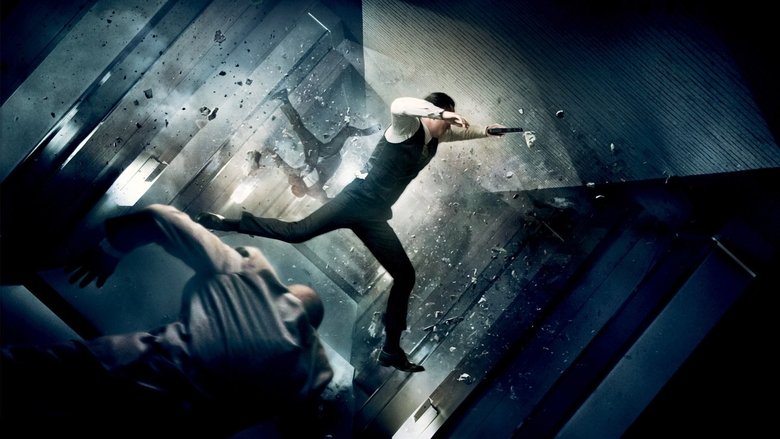
The job. Saito hires Cobb not to steal but to plant: Robert Fischer, heir to a rival energy conglomerate, must decide to dissolve his father's empire and believe the decision is his own. In exchange, Saito will make one phone call and clear the murder charge keeping Cobb out of the United States and away from his children. The crew nests three dream levels — Yusuf's rain-soaked city, Arthur's hotel, Eames's snow fortress — each running at a slower subjective time, with a synchronised chain of kicks to bring everyone back up. The heavy sedative required for the stacking means that anyone who dies in a dream does not wake: they drop into limbo, raw unstructured subconscious where a few minutes above can be decades below.
What Cobb is hiding. The mission's real obstacle is his own memory. Cobb and Mal once spent what felt like fifty years building a world together in limbo; Mal locked away her knowledge that it was a dream, and to bring her home Cobb broke into that hidden place and planted the idea that her world was not real. It worked — and it did not stop working. Back in the waking world the idea metastasised: convinced she was still dreaming, Mal set up a hotel suite, framed Cobb for her murder to force him to jump with her, and stepped off the ledge. The projection that stalks his dreams is not Mal but Cobb's guilt wearing her face, kept alive in a private elevator of memories he cannot stop visiting.
How it falls apart and comes together. Fischer's militarised subconscious attacks immediately; Saito is fatally wounded; the van's premature plunge off a bridge collapses the timetable; and Mal's projection shoots Fischer dead in the third level, sending him to limbo. Ariadne and Cobb follow. Cobb finally confronts Mal, confesses that he planted the idea that killed her, and refuses her offer to stay — the moment of self-inception in which he accepts that the version of her he has preserved is a shadow, \"the best I can do,\" not the woman. Ariadne kicks Fischer back up in time for him to open his father's safe and find not the will but the paper pinwheel of his childhood, alongside a dying father's words reinterpreted to mean the son was loved and should be his own man. The inception takes.
The ending. Cobb stays in limbo to find Saito, now an old man who has lived a lifetime there; the two remember their bargain, and Saito reaches for a gun as Saito's earlier line about a leap of faith completes its loop. Cobb wakes on the plane. Saito makes the call. Customs waves him through, Miles meets him, and at the house his children finally turn around. Cobb spins the top on the table — and walks away without watching it. The camera holds; the top wobbles; the film cuts to black.
What the ending means. The withheld answer is the point. Nolan has explained that because Cobb does not care whether the top falls, that indifference is the only part of the mystery that matters: the character's emotional journey supersedes the metaphysical verdict. Cobb's arc ends not when he proves his world is real but when he stops needing proof. On rewatch, the film's structure reveals itself as a single act of self-inception: the heist that pays for his freedom is also the elaborate machinery his mind required in order to say, out loud, what he did — and then to be allowed to go home.