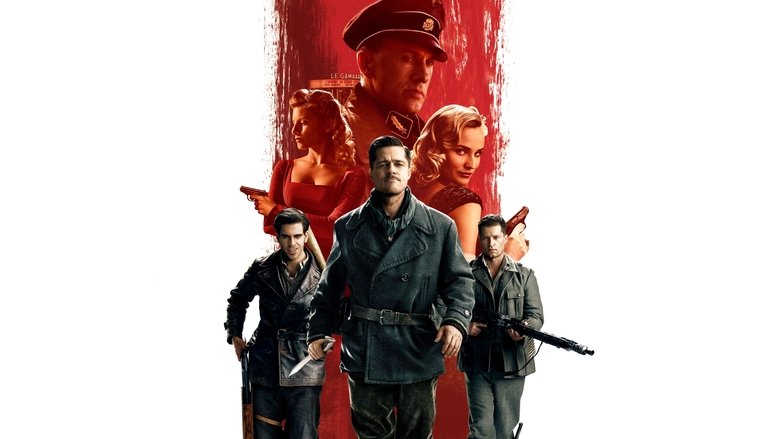
Inglourious Basterds
A brutal and audacious World War II revenge fantasy, simmering with palpable tension and exploding in a cathartic blaze of revisionist history.
Inglourious Basterds

"Once upon a time in Nazi occupied France..."

02 August 2009 Germany 153 min ⭐ 8.2 (23,276)
Director: Quentin Tarantino
Cast: Brad Pitt, Mélanie Laurent, Christoph Waltz, Eli Roth, Michael Fassbender
Drama War Thriller
Revenge and Justice The Power of Cinema and Propaganda Historical Revisionism Performance and Identity
Budget: $70,000,000
Box Office: $321,457,747

Inglourious Basterds - Ending Explained

⚠️ Spoiler Analysis

"Inglourious Basterds" culminates in the complete annihilation of the Nazi high command, a spectacular rewriting of history. The two separate revenge plots converge at the premiere of "Nation's Pride." Inside the projection booth, Shosanna is confronted by Fredrick Zoller. She shoots him, but then shows a moment of pity, which allows him to fatally shoot her before he dies. Despite her death, her plan succeeds. Her lover Marcel locks the auditorium doors and ignites a massive pile of flammable nitrate film behind the screen as Shosanna's pre-recorded message declares her vengeance to the trapped Nazis.

Simultaneously, the two remaining Basterds, Donny Donowitz and Omar Ulmer, burst into Hitler's private box and machine-gun him and Joseph Goebbels to death before firing into the crowd. Their timed explosives then detonate, and the entire theater is consumed in a fiery explosion, killing everyone inside. The twist is that Col. Hans Landa, having deduced the plot, does not stop it. Instead, he captures Aldo Raine and strikes a deal with the Allied command via radio: in exchange for allowing the assassination to proceed, he will be granted a full pardon, American citizenship, and numerous benefits. Believing he has successfully manipulated his way to safety, Landa surrenders to Raine in Allied territory. However, Raine enacts his own justice. Declaring that Landa can't just take off his uniform and escape his identity, Raine carves a permanent swastika into Landa's forehead, ensuring he will forever be marked as a Nazi. Raine's final line, "I think this just might be my masterpiece," underscores the film's theme of creating a more satisfying, albeit fictional, historical narrative.

Alternative Interpretations

One of the primary alternative interpretations of "Inglourious Basterds" is that it functions as a film about filmmaking itself. The central conflict is essentially a war between two rival films: the Nazi propaganda piece "Nation's Pride" and Shosanna's revenge film, which culminates in the physical destruction of the audience via flammable nitrate stock. From this perspective, the movie argues that cinema holds the ultimate power to define history and enact justice, even more so than soldiers or guns. Shosanna's victory is the triumph of her narrative over the Nazis'.

Another interpretation views the film as a critique of the viewer's own consumption of violence. By making the Basterds' methods as brutal as the Nazis', and by encouraging the audience to cheer for their savagery, Tarantino forces a level of complicity. The film questions the very nature of a "revenge fantasy" by blurring the moral lines. The audience is entertained by the scalping and brutality, prompting reflection on whether glorifying such violence, even against an evil regime, is ethically sound. This reading suggests the film is not just about killing Nazis, but about examining the audience's own thirst for violent spectacle.