Inglourious Basterds
"Once upon a time in Nazi occupied France..."
Overview
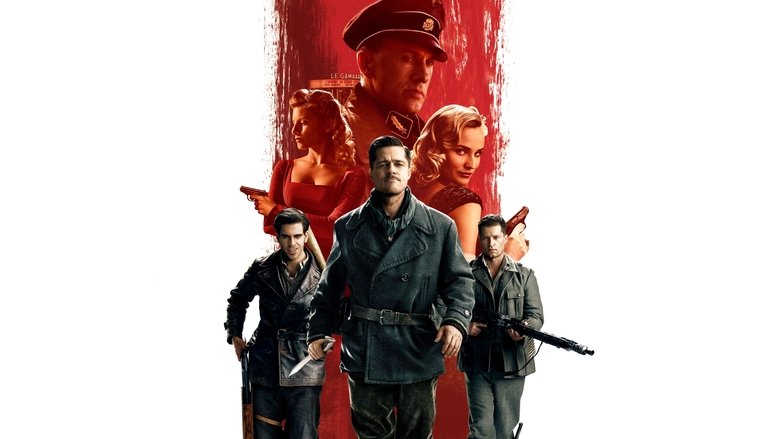
Set in Nazi-occupied France during World War II, "Inglourious Basterds" tells an alternate history of the war through two converging plots. The first follows a team of Jewish-American guerrilla soldiers known as the "Basterds," led by the ruthless Lt. Aldo Raine (Brad Pitt). Their mission is to spread fear throughout the Third Reich by brutally killing and scalping Nazis.
The second storyline centers on Shosanna Dreyfus (Mélanie Laurent), a young French-Jewish woman who witnesses the execution of her family at the hands of the cunning and cruel SS Colonel Hans Landa (Christoph Waltz). Escaping to Paris, she assumes a new identity and becomes the proprietor of a cinema. When a Nazi propaganda film starring a German war hero, Fredrick Zoller (Daniel Brühl), is set to premiere at her theater, attended by the highest ranks of the Nazi regime including Hitler, Shosanna meticulously plans her own fiery revenge. The two plots violently intertwine at the cinema, creating an explosive climax.
Core Meaning
At its core, "Inglourious Basterds" is a film about the power of cinema and storytelling as weapons of war and tools for vengeance. Quentin Tarantino crafts a potent revenge fantasy, exploring themes of historical revisionism and justice. The film deliberately deviates from historical fact to offer a cathartic, fictionalized triumph over evil, suggesting that film can be a more powerful agent of change and retribution than reality itself. It questions the nature of heroism and villainy, blurring the lines between the brutal tactics of the "Basterds" and the calculated cruelty of the Nazis. Ultimately, the film serves as a wish-fulfillment narrative, using the language of cinema to symbolically right the wrongs of history and deliver a spectacular, albeit fictional, form of justice.
Thematic DNA
Revenge and Justice
The theme of revenge is the central driving force of the narrative, embodied by both Shosanna and the Basterds. Shosanna's plot is a deeply personal vendetta for the murder of her family, culminating in her declaration of being the "face of Jewish vengeance." The Basterds' mission, while military in nature, is framed as righteous, brutal retribution, with Aldo Raine demanding 100 Nazi scalps from each of his men. The film explores whether this eye-for-an-eye justice is morally sound or if it risks turning the heroes into a reflection of their enemies.
The Power of Cinema and Propaganda
The film consistently highlights the role of film as a powerful tool for shaping narratives and influencing people. The Nazis use it for propaganda with the film-within-a-film, "Nation's Pride." Conversely, Shosanna weaponizes cinema itself, using highly flammable nitrate film stock to physically destroy the Nazi high command. Her final act involves projecting her own image onto the screen, turning her revenge into a cinematic event. This theme suggests that cinema is not just a reflection of reality but a force that can actively reshape it.
Historical Revisionism
Tarantino deliberately rewrites the ending of World War II, presenting a fictional scenario where Hitler and the Nazi leadership are assassinated in a Parisian movie theater. The film opens with the classic fairy tale phrase, "Once upon a time... in Nazi-occupied France," immediately signaling that this is not a historically accurate account. This theme allows the film to function as a powerful fantasy, exploring what could have been and offering a sense of catharsis that real history cannot provide.
Performance and Identity
Nearly every character in the film is engaged in some form of performance. Shosanna adopts a new identity as Emmanuelle Mimieux. The Basterds and Lt. Hicox go undercover, with varying degrees of success. Colonel Landa is a master of theatricality, using language, manners, and props to manipulate and intimidate his victims. The film explores how identity can be a fluid, performative concept, especially in the high-stakes world of espionage and war where survival depends on a convincing act.
Character Analysis
SS-Standartenführer Hans Landa
Christoph Waltz
Motivation
Landa's primary motivation is egotistical self-preservation and opportunism. He takes pride in being exceptionally good at his job, not out of ideological fervor, but because it satisfies his ego. His ultimate goal is to always be on the winning side, which leads him to betray Hitler in exchange for personal amnesty and rewards.
Character Arc
Hans Landa begins as a terrifyingly efficient and sadistic SS officer, the "Jew Hunter." He is defined by his intelligence, charm, and utter ruthlessness. His arc is not one of moral change but of shifting allegiance based on pure self-interest. Realizing the Nazis will lose the war, he orchestrates a deal with the Allies to save himself, betraying the very regime he served so effectively. He ends the film stripped of his power, permanently marked by the very people he hunted, a master manipulator who is ultimately outplayed.
Lt. Aldo Raine
Brad Pitt
Motivation
Raine is driven by a singular, unyielding desire to inflict brutal punishment upon the Nazis. He demands 100 Nazi scalps from his men and believes the Nazis have no humanity and deserve to be destroyed. His motivation is a form of righteous, violent retribution, uncomplicated by moral ambiguity.
Character Arc
Lt. Aldo Raine is a static character who remains steadfast in his mission and beliefs from beginning to end. He is introduced as the hard-nosed, Apache-descended leader of the Basterds with a simple, brutal goal: killing Nazis. He shows no change in his convictions, even when confronted with orders from his superiors to spare Landa. His arc is a test of his principles, which he passes by remaining true to his own code of justice, culminating in his final act of carving a swastika on Landa's forehead.
Shosanna Dreyfus / Emmanuelle Mimieux
Mélanie Laurent
Motivation
Shosanna is motivated by a deep-seated need for revenge against the Nazis, and specifically Hans Landa, for the murder of her family. Her plan to burn down the cinema is not just about killing Nazis; it's a personal, cinematic, and fiery act of retribution designed to make her enemies know they are being killed by a Jew.
Character Arc
Shosanna's arc is a tragic transformation from a terrified, fleeing victim to a cold, determined instrument of vengeance. After escaping Landa's massacre of her family, she builds a new life, but the trauma remains. The opportunity for revenge reawakens her past, and she meticulously plans the destruction of the Nazi leadership. In her final moments, she sacrifices herself to become a symbol of Jewish vengeance, completing her journey from powerless girl to a powerful, albeit tragic, historical force.
Bridget von Hammersmark
Diane Kruger
Motivation
As an Allied agent, Bridget is motivated by a desire to bring down the Third Reich from within. She uses her fame and position as a film star to gain access to high-ranking Nazi officials and pass information to the British, risking her life to aid the war effort.
Character Arc
Bridget von Hammersmark is a glamorous German film star who is secretly working as an Allied spy. She is brave, intelligent, and a key figure in Operation Kino. Her arc demonstrates the extreme danger of espionage. Despite her skill, a single mistake (her signed napkin) and Landa's sharp detective skills lead to her discovery. Her arc ends tragically when Landa, confirming his suspicions, brutally strangles her to death, showcasing the fatal consequences of playing such a dangerous game.
Symbols & Motifs
Nitrate Film
Nitrate film symbolizes the immense, destructive, and transformative power of cinema. Historically known for being highly flammable, it becomes the literal weapon Shosanna uses to burn down the theater and the Nazi regime. It represents the idea that film can be more than just entertainment or propaganda; it can be an instrument of violent, cleansing fire and ultimate revenge.
Shosanna and her lover, Marcel, amass a large collection of nitrate films. In the film's climax, they use a massive pile of these film reels behind the screen as the fuel for their inferno, locking the doors and incinerating the Nazi audience during the premiere of "Nation's Pride."
The Swastika Carving
The swastika carved into the foreheads of surviving Nazis symbolizes an inescapable, permanent mark of shame and evil. It prevents them from simply shedding their uniforms and disappearing into civilian life after the war. Lt. Raine's act ensures their crimes are forever etched onto their bodies, a form of brutal, indelible justice. It represents the Basterds' refusal to let Nazis escape their identity and accountability.
This is the signature of the Basterds. When they choose to let a Nazi soldier live, Lt. Aldo Raine or one of his men uses a knife to carve a swastika into their forehead. The final scene of the film shows Raine carving one into Colonel Hans Landa's forehead, declaring it his "masterpiece."
Milk
Milk symbolizes dominance, hidden threat, and the facade of civility. In the opening scene, Colonel Landa requests a glass of milk from the French farmer, an act that seems innocuous but establishes his control and subtly asserts a sense of purity over the home he is violating. Later, he orders a glass of milk for Shosanna, triggering her memory of the trauma on her family's dairy farm and representing his predatory nature disguised beneath polite manners.
Colonel Landa drinks a glass of milk at Perrier LaPadite's dairy farm while interrogating him about the hidden Dreyfus family. Years later, when he meets Shosanna at a restaurant, he orders a strudel for her and a glass of milk for himself, a chilling callback to the earlier scene.
The Strudel Scene
The strudel, particularly the cream, symbolizes psychological torture and the assertion of power. Landa's insistence that Shosanna wait for the cream is a small but potent act of control. For Shosanna, the seemingly pleasant dessert becomes a source of extreme tension and fear, as she is forced to share a table with the man who murdered her family. The scene encapsulates Landa's method: using mundane pleasantries to inflict terror.
During his interrogation of Shosanna at the restaurant, Landa orders strudel for them both. He makes a point of ordering it with cream and insists she wait for it before eating. The entire interaction is laden with unspoken threat, despite the civilized setting and polite conversation.
Memorable Quotes
You know somethin', Utivich? I think this just might be my masterpiece.
— Lt. Aldo Raine
Context:
After the cinema has been destroyed and Landa has surrendered, Raine and Utivich drive him to the Allied line. Before letting him go, Raine carves a swastika into Landa's forehead. He stands back to admire his work and delivers this line.
Meaning:
This is the final line of the film and serves a meta-textual purpose, reflecting Quentin Tarantino's own feelings about the movie he has created. Within the narrative, it signifies Raine's ultimate satisfaction in delivering his personal, permanent brand of justice upon Hans Landa, capping off his brutal campaign against the Nazis with a final, symbolic act.
Oooh, that's a bingo!
— Col. Hans Landa
Context:
During the interrogation of the Basterds and Bridget von Hammersmark in the cinema's lobby, Landa confirms a crucial piece of evidence. He delights in his own cleverness and exclaims the phrase, asking Aldo if he is saying it correctly.
Meaning:
This quote perfectly encapsulates Landa's playful, yet menacing, personality. He uses the American phrase incorrectly, highlighting his foreignness while simultaneously celebrating a key discovery in his investigation. It's a moment of dark, comedic relief that underscores his intelligence and his enjoyment of the 'game' he plays with his victims.
My name is Shosanna Dreyfus, and this is the face of Jewish vengeance!
— Shosanna Dreyfus
Context:
As her plan unfolds, a pre-recorded film of Shosanna is spliced into the "Nation's Pride" screening. Her giant face appears on the screen, addressing the trapped Nazi audience moments before Marcel ignites the theater.
Meaning:
This line is the powerful climax of Shosanna's character arc. Having been a silent survivor for years, she finally reclaims her true identity and purpose. By projecting her face onto the screen for the entire Nazi high command to see, she transforms her personal revenge into a potent, symbolic act of retribution for her people.
You know, fightin' in a basement offers a lot of difficulties. Number one being, you're fightin' in a basement!
— Lt. Aldo Raine
Context:
Upon learning that the rendezvous with Bridget von Hammersmark for Operation Kino is in a basement tavern, Raine expresses his displeasure to Lt. Hicox. His prediction proves correct as the meeting devolves into a bloody, confined shootout.
Meaning:
This line is a prime example of the film's dark, deadpan humor and Raine's folksy, straightforward manner. It humorously states the obvious tactical disadvantage of their situation, undercutting the extreme tension of the scene with a moment of pure, logical absurdity. It highlights Raine's practical, no-nonsense approach to warfare.
Philosophical Questions
Is there a moral difference between 'justified' and 'unjustified' brutality?
The film directly confronts this question by contrasting the systematic, ideological cruelty of the Nazis with the passionate, retributive violence of the Basterds and Shosanna. The Basterds scalp their victims and beat them to death with baseball bats, acts that are graphically violent. However, because their targets are Nazis, the audience is positioned to view these acts as righteous. The film forces the viewer to consider if brutality can be 'heroic' and at what point the methods of fighting evil begin to mirror the evil itself. Does the context of fighting an unquestionable evil like Nazism provide a moral license for any and all acts of savagery?
Can art and storytelling rewrite the traumas of history?
"Inglourious Basterds" proposes that while history itself is fixed, its narrative is not. By creating a fictional timeline where Jewish avengers triumphantly kill Hitler, Tarantino offers a powerful cathartic fantasy. The film explores whether this kind of artistic revisionism serves a valuable purpose by providing a sense of justice and empowerment that was absent in reality. It asks if a fictional victory can, on a symbolic level, heal or address the powerlessness felt in the face of historical atrocities. The movie itself becomes an act of rebellion against the tyranny of historical fact.
Alternative Interpretations
One of the primary alternative interpretations of "Inglourious Basterds" is that it functions as a film about filmmaking itself. The central conflict is essentially a war between two rival films: the Nazi propaganda piece "Nation's Pride" and Shosanna's revenge film, which culminates in the physical destruction of the audience via flammable nitrate stock. From this perspective, the movie argues that cinema holds the ultimate power to define history and enact justice, even more so than soldiers or guns. Shosanna's victory is the triumph of her narrative over the Nazis'.
Another interpretation views the film as a critique of the viewer's own consumption of violence. By making the Basterds' methods as brutal as the Nazis', and by encouraging the audience to cheer for their savagery, Tarantino forces a level of complicity. The film questions the very nature of a "revenge fantasy" by blurring the moral lines. The audience is entertained by the scalping and brutality, prompting reflection on whether glorifying such violence, even against an evil regime, is ethically sound. This reading suggests the film is not just about killing Nazis, but about examining the audience's own thirst for violent spectacle.
Cultural Impact
"Inglourious Basterds" was met with critical acclaim and commercial success, solidifying Quentin Tarantino's reputation as a master of postmodern filmmaking. Its most significant cultural impact lies in its bold use of historical revisionism. The film sparked widespread discussion about the ethics and purpose of altering historical events in fiction, particularly those as sensitive as the Holocaust. Rather than a traditional war film, Tarantino created a "Jewish revenge fantasy," offering a form of cinematic catharsis that resonated with many audiences.
Christoph Waltz's portrayal of the villainous Hans Landa was universally praised, launching him to international stardom and earning him an Academy Award. The character is now considered one of the greatest villains in modern cinema. The film's distinct blend of suspense, brutal violence, dark humor, and multilingual dialogue influenced a new wave of genre-bending historical films. It renewed interest in the "men on a mission" subgenre of war films and further popularized the aesthetic of blending Spaghetti Western tropes with other genres, a hallmark of Tarantino's style.
Audience Reception
Audience reception for "Inglourious Basterds" was largely positive, with viewers praising its originality, sharp dialogue, and suspenseful set pieces. Christoph Waltz's performance as Hans Landa was almost universally singled out as a highlight, with many considering him one of the most memorable villains ever written. Audiences enjoyed the film's signature Tarantino blend of dark humor, stylized violence, and clever pop culture references. The historical revisionism of the ending was a major point of discussion; many found it to be a satisfying and cathartic conclusion, while a minority felt it was disrespectful to the actual history of World War II. The main points of criticism were often directed at the film's pacing, particularly the long, dialogue-heavy scenes, which some viewers found indulgent. The extreme violence was also a point of contention, though it was largely expected from a Tarantino film. Overall, it is regarded by audiences as one of Tarantino's best works, celebrated for its audacity and entertainment value.
Interesting Facts
- The film's title is a deliberate misspelling of the 1978 Italian war film "The Inglorious Bastards." Quentin Tarantino has called the spelling a "Basquiat-esque touch" and refused to explain it further.
- Leonardo DiCaprio was Tarantino's first choice to play Col. Hans Landa, but he later decided the character should be played by a native German-speaking actor, leading to the casting of Austrian actor Christoph Waltz.
- Actor Eli Roth, who plays Sgt. Donny "The Bear Jew" Donowitz, directed the film-within-a-film, "Nation's Pride."
- Only about 30% of the film's dialogue is in English. The rest is predominantly in German and French, with some Italian, adding to the film's authenticity.
- Tarantino wrote the script in 1998 but struggled with the ending. He put it aside to make the "Kill Bill" films and returned to it after directing "Death Proof" in 2007.
- The hands that are seen strangling Bridget von Hammersmark (Diane Kruger) belong to Quentin Tarantino himself. He did this to ensure the reaction of choking was authentic.
- The original title Tarantino considered was "Once Upon a Time in Nazi-Occupied France," which he ended up using as the title for the first chapter.
- Christoph Waltz's performance as Hans Landa earned him an Academy Award for Best Supporting Actor, the first Oscar win for an actor in a Tarantino film.
Easter Eggs
Cameos from the original 1978 film
Enzo G. Castellari, the director of the original "The Inglorious Bastards," has a cameo as a Nazi general during the film premiere scene. Bo Svenson, a star of the original film, also has a small cameo as a U.S. general in the "Nation's Pride" film-within-a-film.
Harvey Keitel and Samuel L. Jackson's voices
Two of Tarantino's frequent collaborators make uncredited vocal appearances. Samuel L. Jackson serves as the film's narrator. Harvey Keitel is the voice of the OSS Commander on the other end of the radio when Landa negotiates his surrender with Aldo Raine.
The name 'Antonio Margheriti'
When Donny Donowitz and Omar Ulmer go undercover as Italians, they use the alias "Antonio Margheriti." This is a tribute to the real-life Italian director of the same name, known for films like "Cannibal Apocalypse," who was a major influence on Tarantino and Eli Roth.
⚠️ Spoiler Analysis
Click to reveal detailed analysis with spoilers
Frequently Asked Questions
Explore More About This Movie
Dive deeper into specific aspects of the movie with our detailed analysis pages
Comments (0)
No comments yet. Be the first to share your thoughts!