Inner Workings
Overview
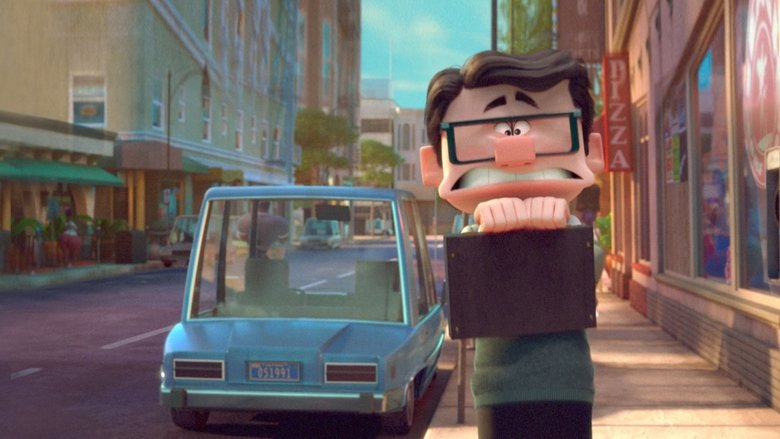
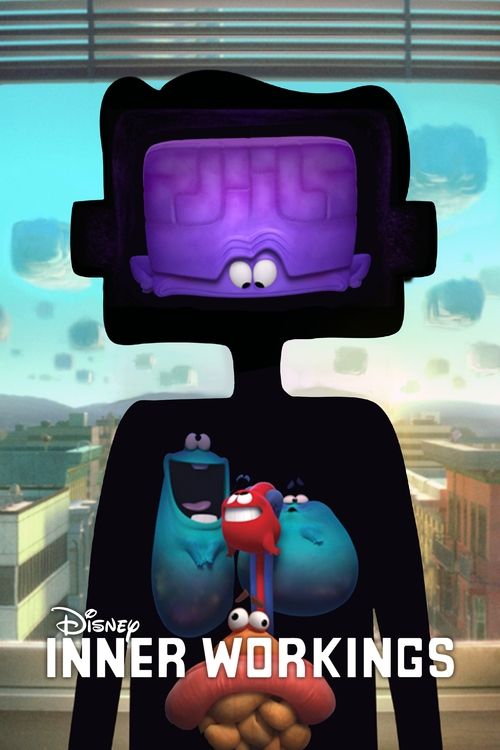
Inner Workings is a vibrant Disney animated short that centers on Paul, a man leading a monotonous, routine-bound life in a stylized version of 1980s California. Paul is physically characterized by his rigid, square-shaped features, reflecting his structured existence. He spends his days at a soul-crushing data entry job for the company Boring, Boring & Glum, where every movement is dictated by a cautious, over-analytical Brain that fears any deviation from the norm will lead to immediate catastrophe or death.
The narrative explores the internal struggle between Paul's Brain—the pragmatic protector—and his Heart—a free-spirited adventurer longing for the simple joys of a beach trip, a delicious breakfast, or a chance encounter with a beautiful sunglass vendor named Kate. As Paul travels to work, his Brain repeatedly shuts down the Heart's impulses through dark, hand-drawn visualizations of deadly consequences, forcing him into a robotic loop of conformity until he reaches a breaking point that demands a new internal harmony.
Core Meaning
The film serves as a poignant reminder that balance is the cornerstone of a meaningful life. Director Leo Matsuda suggests that while logic and caution (the Brain) are necessary for survival, a life devoid of passion and spontaneity (the Heart) is its own form of spiritual death. The core message is that happiness does not necessarily require quitting one's job or abandoning responsibility; rather, it is found in integrating moments of joy and risk into the daily grind, allowing the 'inner workings' of a human being to function in synchronized harmony rather than constant conflict.
Thematic DNA
Logic vs. Emotion
The central conflict of the film is the literal battle for control between the prefrontal cortex and the emotional center. This is visualized through the Brain's rigid control over Paul's physical actions versus the Heart's desperate attempts to guide him toward sensory pleasure and social connection.
The Trap of Routine
The film satirizes the soul-crushing nature of modern office culture, represented by the company Boring, Boring & Glum. It highlights how the fear of risk can trap individuals in a loop of productivity that lacks any actual purpose or fulfillment.
Anxiety and Overthinking
Revealed through the Brain's 'death scenarios,' the film explores how anxiety projects worst-case outcomes for the simplest actions, illustrating how the desire for total safety can become a prison of one's own making.
Finding Equilibrium
The resolution of the film is not the victory of one organ over the other, but their eventual collaboration. Paul finds happiness when he allows his logic to accommodate his passions, creating a sustainable work-life balance.
Character Analysis
Paul
Raymond S. Persi (Vocalizations)
Motivation
To survive the workday safely (driven by Brain) while secretly longing for connection and adventure (driven by Heart).
Character Arc
Paul begins as a passive vessel for his conflicting organs, living a life of quiet desperation. By the end, he becomes an active participant in his own joy, influencing his entire workplace to find their own internal rhythms.
The Brain
Tucker Gilmore (Sounds/Thoughts)
Motivation
Total safety and efficiency to prevent Paul's hypothetical death.
Character Arc
Initially a controlling tyrant motivated by fear, the Brain undergoes a realization that a life of pure logic leads to a miserable end. It eventually learns to 'let go' and work alongside the Heart.
The Heart
Raymond S. Persi (Vocalizations)
Motivation
To experience pleasure, beauty, and human connection in the present moment.
Character Arc
Stays consistent in its desire for joy but is suppressed early on. It only finds fulfillment when the Brain finally grants it permission to influence Paul's decisions.
Symbols & Motifs
Geometric Shapes (Squares vs. Curves)
Squares symbolize rigidity, logic, and the suffocating structure of the office world. Curves and wavy lines represent freedom, the ocean, and the organic impulses of the heart.
Paul and his office environment are designed with sharp right angles, while the beach, the food, and the people Paul desires to meet are drawn with loose, flowing, and colorful silhouettes.
The Sunglass Stand
Symbolizes perspective and the choice to see the world through a more colorful, joyful lens.
Kate, the vendor, represents the romantic and adventurous life Paul's heart craves. The sunglasses themselves allow Paul to literally 'shade' the harsh light of his logical reality.
The 2D Projections
Represents the anxious imagination and the internal narrative of fear.
Whenever the Brain imagines Paul dying from a mistake (like being eaten by a shark or hit by a car), the animation shifts to a flat, 2D diagrammatic style reminiscent of 1950s educational films.
Memorable Quotes
California Loco
— Ludwig Göransson / Este Haim (Song)
Context:
The theme song that plays when Paul finally allows his heart to take control and begins dancing at the beach and in the office.
Meaning:
The song acts as the emotional heartbeat of the film, capturing the 80s California aesthetic and the infectious energy of freedom.
Philosophical Questions
Is safety worth the cost of joy?
The film examines the trade-off between a 'long, safe life' of monotony and a 'vibrant, risky life' of passion, ultimately concluding that a life lived in fear of death is not a life at all.
Where does the 'Self' truly reside?
By personifying individual organs as competing entities, the film asks if we are the sum of our parts or a separate consciousness (Paul) attempting to navigate their conflicting demands.
Alternative Interpretations
While generally viewed as a lighthearted comedy, some viewers interpret the film as a critique of existential nihilism; the Brain's realization that Paul will die regardless of his safety precautions is a 'memento mori' moment that flips the script from avoiding death to making life worth the inevitable end. Another reading focuses on neurodiversity, seeing the Brain's intrusive thoughts and catastrophic visualizations as a literal representation of Obsessive-Compulsive Disorder (OCD) or General Anxiety Disorder (GAD), with the ending serving as a hopeful metaphor for managing those internal voices through self-acceptance.
Cultural Impact
Inner Workings marked a continuation of Disney's experimental 'Shorts Program,' which allows employees from any department to pitch personal stories. It gained significant attention for its unique aesthetic, which blended 1950s Ward Kimball-esque character design with modern 3D rendering. Critics praised it as a spiritual successor to Disney’s 1943 short Reason and Emotion and a more grounded, physical counterpart to Pixar's Inside Out. It resonates particularly with adult audiences who face the 'burnout' culture of the modern corporate world, making it a staple in discussions about work-life balance and mental health in animation.
Audience Reception
Audience reception was overwhelmingly positive, with many viewers finding Paul's office struggles 'painfully relatable.' Critics highlighted the inventive use of the Meander software and the 80s-inspired score by Ludwig Göransson as standout features. While a few viewers noted similarities to Pixar's Inside Out, most appreciated the short's focus on the physical body and its more slapstick, theatrical approach to the internal conflict. It currently holds a high rating on platforms like IMDb (7.7) and was shortlisted for the Best Animated Short Film at the 89th Academy Awards.
Interesting Facts
- Director Leo Matsuda was inspired by his own mixed heritage: his Japanese side being logical and disciplined, and his Brazilian side being festive and party-oriented.
- The character designs were heavily influenced by biology encyclopedias from the 1980s that featured transparent overlays of organ systems.
- Leo Matsuda was the first Brazilian-Japanese director to lead a Disney animated short.
- The short was selected from over 70 internal pitches at Walt Disney Animation Studios.
- The film uses the 'Meander' technology, a hybrid animation tool previously used in 'Paperman' and 'Feast' to combine hand-drawn lines with CG volumes.
- The office name 'Boring, Boring & Glum' is a literal description of the character's mundane lifestyle.
- The character Kate (the sunglass vendor) was designed to be the physical antithesis of Paul’s square world, using purely curved lines.
Easter Eggs
Maui's Hook
A surfboard at the beach features the iconic fish hook of Maui, a nod to Moana, the feature film that Inner Workings originally preceded in theaters.
Moana Billboard
A billboard in the background during one of Paul's transitions shows early promotional art for Moana.
⚠️ Spoiler Analysis
Click to reveal detailed analysis with spoilers
Frequently Asked Questions
Explore More About This Movie
Dive deeper into specific aspects of the movie with our detailed analysis pages
Comments (0)
No comments yet. Be the first to share your thoughts!