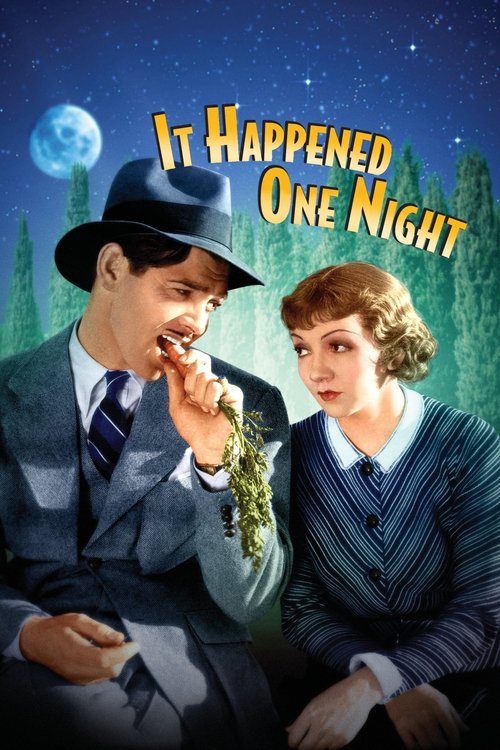
It Happened One Night
A rhythmic spark of screwball chemistry ignites amidst Depression-era dust, where a makeshift blanket wall crumbles before the raw, hitchhiking honesty of two souls discovering that love is the only true destination.
It Happened One Night

It Happened One Night

"An unforgettable entertainment...the outstanding performance of two outstanding careers!"

22 February 1934 United States of America 105 min ⭐ 7.8 (1,346)
Director: Frank Capra
Cast: Clark Gable, Claudette Colbert, Walter Connolly, Roscoe Karns, Jameson Thomas
Comedy Romance
Class Conflict and Reconciliation The Journey as Transformation Gender Dynamics and Wits Honesty vs. Exploitation
Budget: $325,000
Box Office: $4,500,000

Overview

It Happened One Night follows the defiant Ellie Andrews (Claudette Colbert), a pampered heiress who leaps off her father's yacht to flee an annulment and reunite with a fortune-hunting aviator. Her cross-country escape from Florida to New York takes an unexpected turn when she boards a night bus and encounters Peter Warne (Clark Gable), a cynical, recently fired newspaper reporter who recognizes her and smells a career-making scoop.

Stripped of her wealth and forced to navigate the gritty reality of Depression-era America, Ellie enters into a wary alliance with Peter. He agrees to help her reach her husband in exchange for the exclusive rights to her story. As they share cramped bus seats, cheap motels, and open fields, their mutual disdain melts into a witty, romantic camaraderie that challenges their perceptions of class, money, and what it truly means to be free.
Core Meaning

At its heart, Frank Capra’s masterpiece is a celebration of human connection over social status. It suggests that true character is forged through shared hardship and simplicity rather than inherited wealth or pretense. The film championed the "Capraesque" idea that the common man’s integrity and the genuine spark of companionship are the ultimate antidotes to the cold, rigid structures of the elite. It serves as a narrative of democratization through love, where the barriers between the high-born and the everyman are shown to be as flimsy as a hung blanket.

Thematic DNA

Class Conflict and Reconciliation 30%
The Journey as Transformation 25%
Gender Dynamics and Wits 25%
Honesty vs. Exploitation 20%

Class Conflict and Reconciliation

The film juxtaposes Ellie’s sheltered, aristocratic upbringing with Peter’s street-smart, working-class pragmatism. Their journey serves as a leveling ground where Ellie learns to value the "simple people" and Peter discovers the vulnerability beneath the heiress's mask, ultimately suggesting that shared experience transcends birthright.

The Journey as Transformation

Modeled as an early "road movie," the physical travel from Florida to New York mirrors the internal growth of the protagonists. The road strips away their defenses and societal roles, forcing them into a state of raw authenticity where they can truly see one another.

Gender Dynamics and Wits

The film subverts traditional gender roles through its "screwball" repartee. Ellie is not merely a damsel but a woman who learns to use her wits (and her leg), while Peter’s perceived dominance is frequently challenged by Ellie’s spirit, creating a battle of the sexes based on intellectual equality.

Honesty vs. Exploitation

The contrast between King Westley (who seeks Ellie’s fortune) and Peter (who eventually refuses the $10,000 reward for a mere $39.60 in expenses) highlights the film’s moral compass: true value lies in honest labor and integrity.

Character Analysis

Peter Warne

Clark Gable

Archetype: The Cynical Everyman
Key Trait: Quick-witted and fiercely principled.

Motivation

To regain his professional standing as a journalist while maintaining his stubborn independence.

Character Arc

Initially seeks only a career-reviving story, but his cynicism is dismantled as he falls for Ellie, eventually choosing love over a massive financial reward.

Ellie Andrews

Claudette Colbert

Archetype: The Rebellious Heiress
Key Trait: Spiritually defiant and surprisingly adaptable.

Motivation

To escape her father's control and find true freedom, which she initially confuses with her marriage to King Westley.

Character Arc

Transforms from a helpless, spoiled socialite into a resilient, self-sufficient woman who rejects her hollow high-society life for genuine affection.

Alexander Andrews

Walter Connolly

Archetype: The Wise Patriarch
Key Trait: Blustering but ultimately tender-hearted.

Motivation

To ensure his daughter doesn't marry a fortune hunter and finds a man who truly loves her.

Character Arc

Starts as a controlling father but emerges as a sympathetic ally who recognizes Peter's worth and encourages his daughter to run toward happiness.

Symbols & Motifs

The Walls of Jericho

Meaning:

Represents the social, moral, and physical barriers between the two protagonists.

Context:

A blanket hung on a rope between their beds in various motels. It ensures propriety while signaling the emotional distance that eventually collapses at the film's end.

The Raw Carrot

Meaning:

A symbol of earthiness, poverty, and sexual subtext.

Context:

Peter frequently munches on raw carrots, highlighting his low-budget lifestyle and serving as a phallic, pre-Code visual wink to the audience.

The Hitchhiking Leg

Meaning:

Symbolizes the triumph of female intuition and pragmatism over male ego.

Context:

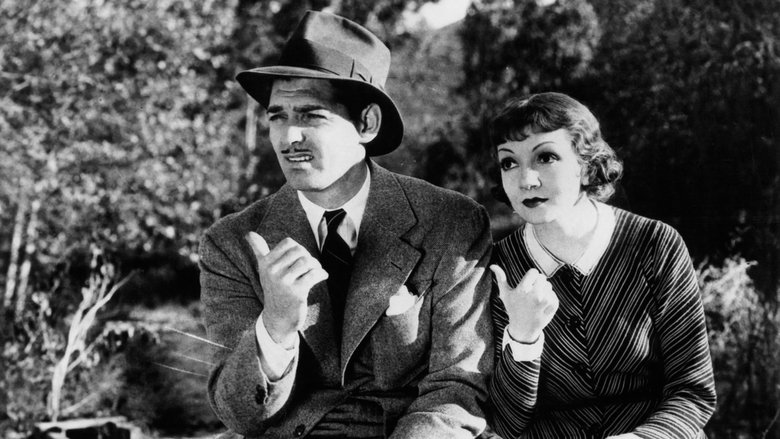
After Peter fails to stop a car with his elaborate "thumbing" techniques, Ellie stops the very next car by simply lifting her skirt to show her leg.

The Autogyro

Meaning:

Represents the hollow, flashy world of the elite.

Context:

King Westley arrives at the wedding in this futuristic, expensive machine, contrasting sharply with the buses and dusty roads of Peter's world.

Memorable Quotes

Behold the walls of Jericho! Maybe not as thick as the ones Joshua blew down with his trumpet, but a lot safer. You see, I have no trumpet.

— Peter Warne

Context:

Said while hanging the blanket in the motel room to separate their beds.

Meaning:

This iconic line establishes the sexual tension and the makeshift boundary between the unmarried pair while nodding to the pre-Code censorship limitations.

The limb is mightier than the thumb.

— Ellie Andrews

Context:

Spoken after she successfully hails a car for a ride by showing her leg.

Meaning:

A witty summation of how Ellie's practical (and flirtatious) approach succeeded where Peter's "expert" male logic failed.

The walls of Jericho are toppling!

— Peter Warne (via Telegram)

Context:

The final message sent to Ellie's father at the end of the film.

Meaning:

A metaphorical confirmation that the barriers to their union have finally fallen and they are consummating their relationship.

Philosophical Questions

Can true intimacy exist within the confines of rigid social hierarchy?

The film explores this by showing that Peter and Ellie only find a real connection when they are stripped of their titles and forced into the 'vulnerable' space of the open road.

Is freedom found in the destination or the journey?

Ellie seeks freedom in New York (her destination), but only discovers it through the trials and growth experienced during the bus ride itself.

Alternative Interpretations

While widely seen as a lighthearted romance, some critics interpret the film as a veiled social critique of the New Deal era, where the "re-education" of the rich heiress represents the elite's need to align with the working class. Another reading suggests the ending is somewhat ambiguous or "hastily resolved" because the protagonists never actually kiss on screen, leaving their final union as a symbolic victory of the "walls falling" rather than a grounded romantic reality. Some feminist readings highlight Ellie as a proto-feminist figure who actively chooses her own path, even if that path leads to a different form of patriarchy.

Cultural Impact

It Happened One Night is the foundational blueprint for the screwball comedy and the modern romantic comedy. Its success single-handedly elevated Columbia Pictures from "Poverty Row" to a major Hollywood player. Beyond cinema, it influenced American fashion and social etiquette, particularly regarding travel and dating. The film's portrayal of the Great Depression offered audiences a sense of communal hope and escapism, showing that happiness could be found in a haystack or on a Greyhound bus. Its legacy persists in every "enemies-to-lovers" road trip movie ever made, from The Sure Thing to Planes, Trains and Automobiles.

Audience Reception

Initially, the film was a "sleeper hit." It opened to modest reviews and low attendance in major cities, but it became a massive phenomenon in smaller towns through word-of-mouth. Audiences loved the chemistry between the leads and the relatable, humorous depiction of life during the Depression. Critics eventually hailed it as a masterpiece of pacing and wit. Today, it holds a near-perfect rating on Rotten Tomatoes (99%) and is celebrated as one of the most charming films in the history of cinema.

Interesting Facts

  • It was the first film to win the 'Big Five' Academy Awards: Best Picture, Director, Actor, Actress, and Screenplay.
  • A popular legend claims that Clark Gable appearing without an undershirt caused a massive decline in undershirt sales across America.
  • Bugs Bunny was partly inspired by this film; the character's carrot-chewing and the 'Doc' nickname were taken from Gable's performance.
  • Neither Gable nor Colbert originally wanted to do the film; Gable was sent to the 'minor' Columbia Pictures as a punishment by MGM.
  • Claudette Colbert was so convinced she would lose the Oscar that she was at a train station when she was announced as the winner.
  • The character of Alexander Andrews inspired the look of Yosemite Sam, and King Westley reportedly influenced Pepé Le Pew.

Easter Eggs

The 'Bugs Dooley' Reference

Peter invents a gangster named "Bugs Dooley" to scare off the annoying Oscar Shapely. This name is cited by animators as a primary source for the naming of Bugs Bunny.

Gable's Real-Life Nickname

When Peter arrives at the bus station, his friends call him "The King," which was Clark Gable’s actual nickname in Hollywood at the time.

⚠️ Spoiler Analysis

Click to reveal detailed analysis with spoilers

Frequently Asked Questions

Explore More About This Movie

Dive deeper into specific aspects of the movie with our detailed analysis pages

Comments (0)

Leave a comment

No comments yet. Be the first to share your thoughts!