Us Again
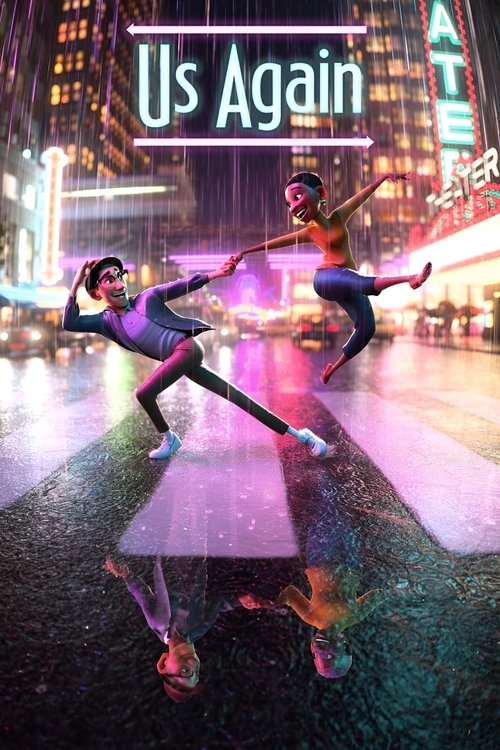
A rain-slicked neon dreamscape where rhythmic movement rekindles a fading flame, transforming the autumn of life into a vibrant, heart-pounding celebration of the present moment and enduring love.
Us Again

Us Again

"Find the wonder, find the joy, find the magic"

03 March 2021 United States of America 7 min ⭐ 7.8 (340)
Director: Zach Parrish
Drama Animation Family Romance
The Beauty of Aging Mindfulness and Presence Partnership and Reciprocity The Universality of Expression

Overview

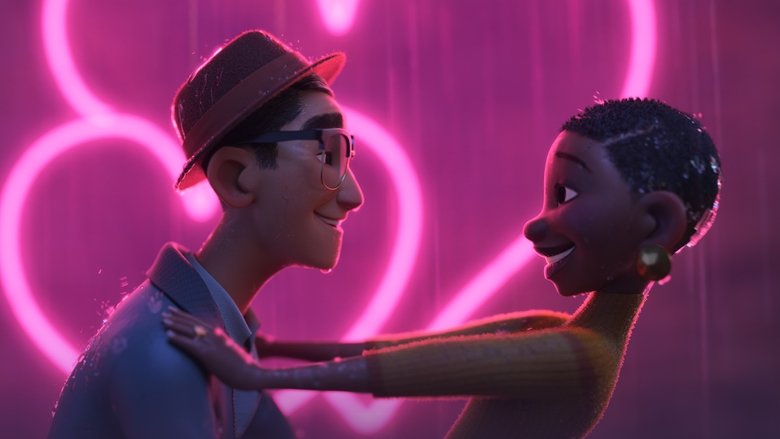
Set in a vibrant, music-filled metropolis that echoes the energy of New York City, Us Again follows Art, an elderly man who has grown world-weary and cynical. While the world outside his window dances to a constant beat, Art remains anchored to his recliner, much to the heartbreak of his spirited and soulful wife, Dot. Their disconnect is palpable, as Art's nostalgia for his past leaves him unable to appreciate the joy Dot still finds in the world.

The narrative shifts when a magical rainstorm descends upon the city, possessing the power to physically restore the couple's youth. Rejuvenated and energetic once more, Art and Dot embark on a whirlwind dance through the streets, rediscovering their physical prowess and the spark of their early romance. However, as the rain clouds begin to drift away, Art must confront his desperation to outrun time and decide whether his happiness depends on his age or the woman standing beside him.
Core Meaning

The core meaning of Us Again is the vital importance of staying present. Director Zach Parrish intended to challenge the Western perception of aging as a purely negative decline. The film suggests that while the "fountain of youth" is a tempting fantasy, true vitality comes from a state of mind and the willingness to engage with life alongside those we love, regardless of physical limitations. It serves as a visual manifesto for choosing joy over bitterness and recognizing that the "glory days" are happening in the here and now.

Thematic DNA

The Beauty of Aging 30%
Mindfulness and Presence 35%
Partnership and Reciprocity 20%
The Universality of Expression 15%

The Beauty of Aging

The film contrasts Art's initial view of old age as a period of stagnation with the final realization that life's later chapters hold their own unique rhythm. It reveals that aging is not the end of vibrancy, but a transition into a different, equally valuable form of movement and connection.

Mindfulness and Presence

Art's character arc is defined by his shift from looking backward (nostalgia) or forward (chasing the rain) to simply being in the moment. The film argues that dwelling on the past prevents one from experiencing the beauty of the present.

Partnership and Reciprocity

The relationship between Art and Dot illustrates the effort required to keep a long-term bond alive. Their dance is a metaphor for their marriage, requiring them to be in sync. The conflict arises when Art tries to pull Dot toward his desires rather than moving with her.

The Universality of Expression

Through its dialogue-free format, the film explores how dance and music serve as a universal language that transcends age, race, and culture, connecting the characters to each other and the audience through pure emotion.

Character Analysis

Art

N/A (Animation)

Archetype: The Grumpy Reformer
Key Trait: Nostalgic and eventually resilient.

Motivation

Initially motivated by a desire to escape the indignities of old age; eventually motivated by his love for Dot and the realization that he is missing her life by being miserable.

Character Arc

Art begins as a cynical man dwelling on his physical decline. After a magical night of youth, he learns that his happiness is a choice and returns to his wife with a renewed perspective on their shared life.

Dot

N/A (Animation)

Archetype: The Muse / Spirit of Joy
Key Trait: Vibrant and empathetic.

Motivation

Driven by an innate love for life and a deep, unconditional love for her husband. She wants Art to see the world the way she does.

Character Arc

Dot remains consistently joyful and present. Her arc is one of patience and persistence, as she waits for Art to join her in the dance of life, whether they are young or old.

Symbols & Motifs

The Rain

Meaning:

A literal fountain of youth and a catalyst for transformation.

Context:

The rain triggers the physical change in Art and Dot. It represents the fleeting nature of youthful energy and the external circumstances that can momentarily mask one's inner state.

The Puddle

Meaning:

Symbolizes the permanence of the inner self.

Context:

At the end of the film, even as Art and Dot return to their elderly forms, the reflection in the puddle shows their younger selves dancing. This indicates that their youthful spirit remains alive within them despite their aging bodies.

The Apartment

Meaning:

Represents stagnation, isolation, and the 'grey' side of aging.

Context:

The apartment is depicted with muted colors and shadows, serving as Art's self-imposed prison where he chooses to disconnect from the vibrant world outside.

The Pier (Paradise Pier)

Meaning:

Symbolizes the climax of the struggle against time.

Context:

As the rain clouds move over the ocean, Art tries to follow them to the edge of the pier. It is the location where he finally stops running and accepts that the rain (youth) must end.

Philosophical Questions

Is youth a physical property or a psychological choice?

The film explores this by showing that even when Art physically regains his youth, he is still 'old' in spirit because he is anxious about losing it again. Only when he is old in body but young in spirit does he find peace.

Does the pursuit of a 'glory past' diminish the value of the present?

Art's character demonstrates that by mourning who he used to be, he becomes a ghost in his own life, effectively wasting the time he has left.

Alternative Interpretations

While the film is presented as a literal magical event, some critics suggest the rain can be interpreted as a subjective psychological experience. In this reading, the couple doesn't literally turn young; instead, the 'rain' represents a moment of emotional clarity where Art stops seeing his age and starts feeling the same passion he felt in his youth. Another interpretation views Art's initial state as a metaphor for depression, with Dot representing the support system that patiently encourages him toward recovery through the therapeutic medium of movement.

Cultural Impact

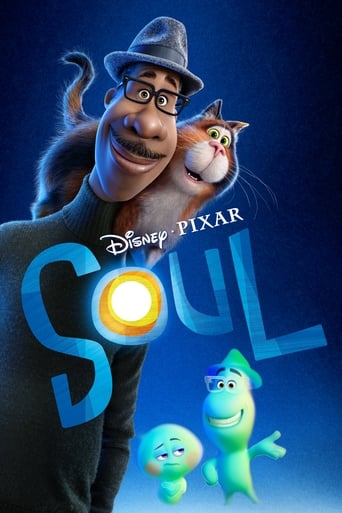
Us Again has been praised for its groundbreaking representation, specifically featuring an interracial elderly couple—a demographic rarely centered in mainstream animation. Culturally, it aligns with a growing movement in cinema (seen in films like Minari and Soul) that explores the internal lives of older characters with dignity and complexity. Critics highlighted the film's success in revitalizing the 'silent musical' genre, proving that high-energy hip-hop and funk choreography can communicate profound philosophical truths. The film's release alongside Raya and the Last Dragon furthered Disney's commitment to diversity, both in front of and behind the camera, by involving world-renowned Filipino-American choreographers and a female Turkish-American composer.

Audience Reception

The audience reception was overwhelmingly positive, with many viewers reporting deep emotional resonance and 'tears of joy.' Critics highly praised the synergy between Pinar Toprak’s funk score and the Madrids’ choreography, noting that the animation felt unusually tactile and rhythmic. Some minor criticism was directed at the 'predictable' Disney short formula, but most agreed that the execution—particularly the stunning visual contrast between the rainy city and the neon lights—was masterfully handled. It holds high ratings on platforms like IMDb for its ability to tell a complete, moving story in just seven minutes.

Interesting Facts

  • The film's leads are an interracial couple: Art is Japanese American and Dot is African American, inspired by the director's own wife and grandparents.
  • Unlike typical animated films, the musical score by Pinar Toprak was composed before the storyboards or animation were created to allow the choreographers to work with specific beats.
  • The dance movements were choreographed by real-life married couple Keone and Mari Madrid, who are famous for their work with artists like Justin Bieber.
  • The short features approximately 1,400 background characters, each of whom was designed to move rhythmically with the city.
  • Director Zach Parrish pitched the idea while grappling with his own feelings about aging after noticing physical limitations in his 30s.
  • The animation style was influenced by the 'Rhapsody in Blue' segment from Fantasia 2000.
  • The film was the first theatrical short released by Walt Disney Animation Studios in five years, following 2016's Inner Workings.

Easter Eggs

Fantasia 2000 Reference

During a montage shot, the 'Rhapsody in Blue' sequence from Fantasia 2000 is playing on a movie screen in the background as a tribute to one of the film's main inspirations.

Tangled Stein

A specific beer stein given to the Tangled crew can be seen on a shelf in Art and Dot's apartment.

Paradise Pier

The pier at the end of the film is named 'Paradise Pier,' a direct reference to the former name of the themed land at Disney California Adventure.

Hidden Mickeys

Multiple 'Hidden Mickeys' are incorporated into the car designs and the city's background architecture.

Wreck-It Ralph Fountain

The fountain seen in the city is inspired by or modeled after a similar asset used in Wreck-It Ralph.

⚠️ Spoiler Analysis

Click to reveal detailed analysis with spoilers

Frequently Asked Questions

Explore More About This Movie

Dive deeper into specific aspects of the movie with our detailed analysis pages

Comments (0)

Leave a comment

No comments yet. Be the first to share your thoughts!