
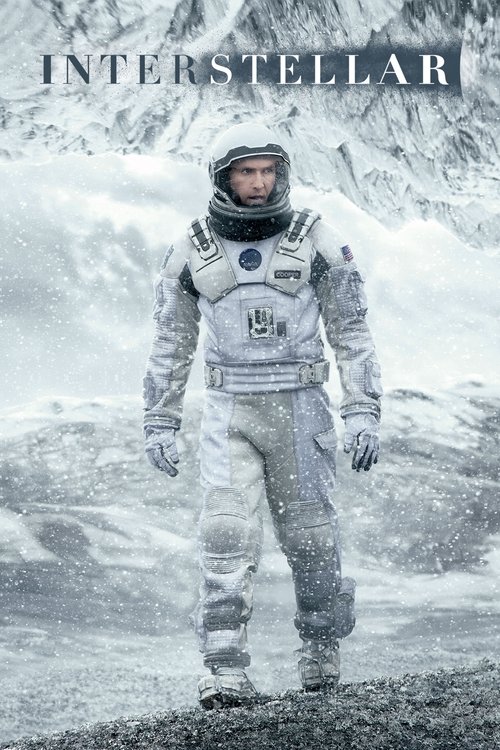
Full spoilers follow.
The ghost. The film's opening mystery — the presence in Murph's bedroom knocking books off shelves and leaving patterns in dust — is the ending in disguise. The coordinates that lead Cooper to NASA and the message telling him to STAY were never sent by aliens or a poltergeist; they were sent by Cooper himself, from inside the tesseract, years later in his own timeline and decades later in Murph's. The film's first act is its own final act, viewed from the wrong end.
Miller's planet. The first world orbits so close to the black hole Gargantua that one hour on its surface equals roughly seven years back on the ship. The crew loses over two decades to a few hours of misjudgement, and Cooper returns to a stack of video messages from children who grew up, married and had children of their own while he was wading through shallow water — the film's single most brutal scene and its clearest statement that time, not distance, is the real enemy.
Professor Brand's lie. Plan A — solving the gravity equation to lift Earth's population off the planet — was never solvable with the data available, because it required information from inside a black hole's event horizon that no one had. Brand knew this from the start. He kept the fiction alive to motivate the mission, meaning the entire expedition was always Plan B: populating a new world with frozen embryos and letting everyone on Earth die. His deathbed confession detonates the film's moral centre and reframes his recitation of Dylan Thomas as the consolation of a man who had already given up.
Dr. Mann. The most decorated of the earlier explorers, hailed as the best of humanity, falsified his planet's data because he could not bear to die alone on a frozen rock. He attempts to murder Cooper and hijack the Endurance, destroying the docking module and killing Romilly in the process. His name is the joke and the thesis: Man, revealed as cowardice dressed in heroism, and living proof of the survival instinct the film keeps interrogating.
The black hole and the tesseract. To give the Endurance enough velocity to reach Edmunds' planet, Cooper detaches and falls into Gargantua, sacrificing himself. Inside, instead of being destroyed, he finds a constructed five-dimensional space — a tesseract built by far-future humans who have transcended spacetime — where time is laid out as a physical dimension and every moment of Murph's bedroom is accessible simultaneously. With TARS transmitting the quantum data collected from inside the singularity, Cooper uses gravity to push the information out through the second hand of the wristwatch he gave Murph as a child. She returns to the farmhouse as an adult, reads the Morse code, and completes the equation.
The bootstrap. The future humans who built the tesseract exist only because Murph solved the equation, which happened only because Cooper sent the data, which was possible only because the tesseract existed. Cooper's line — that they didn't bring him here, he brought himself — makes the causal loop explicit. The film treats this circle as the point rather than a problem: love and persistence are what close it.
The ending. Cooper is ejected from the tesseract, found near Saturn, and wakes on Cooper Station — an orbital habitat named for Murph, not for him. He meets his daughter as a dying old woman surrounded by descendants he has never met; she tells him no parent should watch their child die and sends him away. The reunion he crossed a galaxy for lasts minutes. He steals a ship and leaves for Edmunds' planet, where Amelia Brand — the person whose argument about love the film has just vindicated — is alone, having buried Edmunds, setting up a colony for a species that survived. The final image is hopeful and quietly desolate at once: humanity endures, and the man who saved it has no home left on either world.