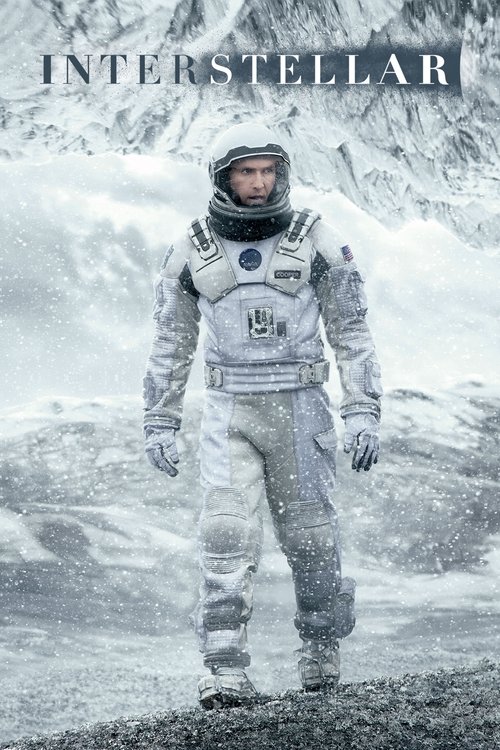
Interstellar
"Mankind was born on Earth. It was never meant to die here."
Overview
In a dystopian near-future, Earth is ravaged by blight and catastrophic dust storms, threatening humanity's survival. Cooper, a former NASA pilot turned farmer, discovers a secret mission to find a new habitable planet. He is recruited to pilot a spacecraft, the Endurance, through a newly discovered wormhole near Saturn.
Leaving his children behind, Cooper joins a small crew of scientists, including Dr. Amelia Brand. Their journey takes them to distant galaxies with planets where the laws of time are drastically different due to immense gravitational forces. The mission is a race against time, not only for the survival of the human species but also for Cooper's hope of returning to his family, who are aging decades faster back on Earth.
Core Meaning
The core meaning of Interstellar posits that love is the one force capable of transcending the physical dimensions of time and space. Director Christopher Nolan explores the idea that while humanity's survival instinct and scientific ambition drive us to explore the cosmos, it is our deep emotional connections—specifically the profound bond between a parent and child—that ultimately provide the key to our salvation. The film suggests that human ingenuity and our capacity for sacrifice, guided by love, are the essential elements for overcoming seemingly insurmountable odds and securing a future for our species.
Thematic DNA
Love Transcending Time and Space
This is the central theme of the film. Dr. Brand first theorizes that love isn't just an emotion but a tangible, powerful force that can exist across dimensions. This idea is proven when Cooper, inside the five-dimensional tesseract, uses his love for Murph to communicate with her across time via gravity, ultimately saving humanity. Their unbreakable bond becomes the conduit for the solution that science alone could not find.
Survival vs. Selfishness
The film presents a stark contrast between sacrificing for the greater good and succumbing to personal survival instincts. Cooper leaves his family to save humanity, a profound personal sacrifice. Conversely, Dr. Mann, hailed as the 'best of us,' fakes his data and attempts murder out of fear and loneliness, showing how isolation can corrupt the human spirit. The narrative champions collective responsibility over individual preservation.
The Relativity of Time
Interstellar visually and emotionally demonstrates Einstein's theory of relativity. Time is portrayed as a volatile and destructive force that can stretch and bend. The crew's visit to Miller's water planet, where one hour equals seven Earth years, results in them losing 23 years, a devastating emotional blow for Cooper who misses his children growing up. This concept underscores the immense personal cost of their mission and the emotional disconnection caused by physical separation.
Humanity's Pioneering Spirit
The film laments a future where humanity has lost its ambition for exploration, looking down at the dirt instead of up at the stars. Cooper embodies the enduring pioneer spirit, believing that humanity's destiny lies beyond Earth. The narrative is a call to reclaim the courage to explore the unknown and push the boundaries of human achievement, arguing that our greatest accomplishments are still ahead of us.
Character Analysis
Joseph Cooper
Matthew McConaughey
Motivation
Initially, his primary motivation is to save his children and ensure they have a future. This personal motivation expands to encompass the survival of the entire human race, but it is his promise to his daughter, Murph, that remains his core driving force throughout the mission.
Character Arc
Cooper begins as a reluctant farmer, a former explorer grounded by a world that no longer values discovery. His journey into space reignites his pioneering spirit. He evolves from a father trying to save his own family into a savior for all of humanity. His final act in the tesseract shows his acceptance that his love for Murph is not just a personal bond but a force capable of changing the universe. He ends his arc as a man out of time, driven once more to explore by seeking out Brand.
Murphy "Murph" Cooper
Mackenzie Foy, Jessica Chastain, Ellen Burstyn
Motivation
Her motivation evolves from a childhood desire to have her father stay to a lifelong scientific quest to solve Professor Brand's equation to save the people of Earth. Her unwavering belief in the 'ghost' from her childhood and her love for her father are the true undercurrents of her motivation.
Character Arc
Murph starts as a bright, curious child who idolizes her father but feels a deep sense of abandonment when he leaves. This feeling of betrayal fuels her determination. She transforms into a brilliant and dedicated NASA scientist, driven by both her anger and her lingering hope in her father's promise. Her arc culminates in her solving the gravity equation using the data from her father, forgiving him, and becoming the savior of humanity herself. She ultimately encourages her father to continue his journey rather than watch her die.
Dr. Amelia Brand
Anne Hathaway
Motivation
Her motivation is twofold: the scientific imperative to complete the mission and save humanity, and a deeply personal, love-driven desire to reunite with Edmunds on the planet he explored. This duality forces her and the audience to question the role of emotion in scientific endeavors.
Character Arc
Brand begins the journey as a pragmatic scientist, seemingly driven by logic and the mission's objectives. However, her character arc reveals a deep internal conflict between her scientific training and her human emotions, particularly her love for astronaut Wolf Edmunds. She champions the controversial idea that love can be a quantifiable, guiding force. Initially dismissed by Cooper, her theory is eventually proven correct. She ends the film alone on Edmunds' planet, the last hope for humanity's future, setting up a new home for the species.
Dr. Mann
Matt Damon
Motivation
His sole motivation is survival at any cost. He admits his 'survival instinct' is his greatest source of inspiration, but for him, it has become a corrupting force that overrides all morality, empathy, and duty to the mission.
Character Arc
Dr. Mann is initially presented as 'the best of us,' a heroic and noble explorer who made the ultimate sacrifice. However, upon being awakened, his true nature is revealed. Years of isolation and the terror of death have transformed him into a cowardly, selfish manipulator who falsified his planet's data simply to be rescued. His arc is a tragic deconstruction of the hero myth, showing how the survival instinct, when unchecked by a greater purpose, can lead to betrayal and destruction.
Symbols & Motifs
Cooper's Watch
The watch symbolizes the enduring connection and love between Cooper and Murph, a love that can transcend time and space. It also represents the promise Cooper made to return and the physical manifestation of their relative experiences of time.
Cooper gives his daughter Murph a matching watch before he leaves. Decades later, from within the tesseract, Cooper uses gravity to manipulate the second hand of Murph's watch, sending the quantum data in Morse code that she needs to solve the gravity equation and save humanity.
The Tesseract (The Bookshelf)
The tesseract is a physical representation of the fifth dimension, where time becomes a physical, explorable landscape. It symbolizes the idea that love and gravity can be used to communicate across spacetime and that humanity, in its advanced future state, can reach back to ensure its own survival.
After falling into the Gargantua black hole, Cooper finds himself inside a tesseract constructed by future humans. It takes the form of an infinite projection of Murph's childhood bedroom bookshelf, allowing him to interact with moments from her past through gravitational waves.
Dust and Blight
The dust storms and crop blight symbolize the decay and impending death of Earth. They represent humanity's failure as stewards of their planet and the stagnant, backward-looking society that has resulted—a world where people worry about their place in the dirt rather than their place in the stars.
The film opens in a near-future where relentless dust storms plague the world, and blight has wiped out most food crops, leaving only corn. This environmental catastrophe is the driving force behind the entire plot, forcing humanity to look for a new home.
Memorable Quotes
Do not go gentle into that good night; Old age should burn and rave at close of day. Rage, rage against the dying of the light.
— Professor Brand (and others)
Context:
Professor Brand recites the poem multiple times throughout the film, first to inspire Cooper to undertake the mission and later as a mantra for humanity's struggle. It becomes the thematic anthem for the entire endeavor.
Meaning:
This quote from the Dylan Thomas poem serves as the film's central motif. It encapsulates the theme of humanity's indomitable will to survive, to fight against extinction and despair rather than passively accept fate. It's a call to action and a defiant cry against the encroaching darkness, both literal and metaphorical.
Love is the one thing we're capable of perceiving that transcends dimensions of time and space.
— Dr. Amelia Brand
Context:
Brand makes this argument to Cooper when trying to convince him to travel to Edmunds' planet, which her heart is drawn to, over Mann's planet, which appears more logical. It is a moment of conflict between scientific reason and emotional intuition.
Meaning:
This line explicitly states the film's core message. Brand proposes that love is not merely a human emotion but a fundamental, physical force of the universe, akin to gravity. It suggests that this connection is a constant that should be trusted, even if it cannot be understood by science alone. The film's climax ultimately validates her hypothesis.
Mankind was born on Earth. It was never meant to die here.
— Cooper
Context:
Cooper says this to Donald, his father-in-law, before he leaves on the mission, explaining his conviction that humanity must look beyond its terrestrial origins to survive and fulfill its potential.
Meaning:
This quote embodies humanity's exploratory spirit and the film's argument that our destiny is not confined to our home planet. It is a declaration of intent and a rejection of the stagnation that has gripped Earth's society, advocating for a future among the stars.
Murphy's law doesn't mean that something bad will happen. It means that whatever can happen, will happen.
— Cooper
Context:
Cooper explains this to his young daughter, Murph, after she asks why she was named after something 'bad.' His explanation foreshadows the incredible, seemingly impossible events that will lead to humanity's salvation.
Meaning:
Cooper reframes the pessimistic interpretation of Murphy's Law into a statement of boundless possibility. This reinterpretation reflects the film's underlying theme of hope and human potential. It suggests that even in the face of overwhelming odds, positive and extraordinary outcomes are just as possible as negative ones.
Philosophical Questions
Is humanity's survival as a species more important than individual lives and relationships?
The film constantly weighs the utilitarian calculus of saving the species (Plan B) against the hope of saving those currently alive (Plan A). Cooper's journey is predicated on leaving his children to save humanity, forcing the audience to confront the immense personal cost of a collective goal. Professor Brand's lie about Plan A's viability suggests a belief that people cannot be trusted to sacrifice themselves for an abstract future, while Dr. Mann's betrayal shows how the individual survival instinct can threaten the entire species. The film explores whether it is our individual connections or our species-level instincts that truly define our humanity.
Can love be considered a scientific, physical force?
Interstellar posits that love is a force that transcends time and space, much like gravity. Amelia Brand voices this as a hypothesis that is ultimately proven correct by Cooper's actions within the tesseract. The film challenges a purely materialistic view of the universe by suggesting that human emotions and connections may have a physical reality that we do not yet understand. It asks the audience to consider whether the most powerful forces that guide us are quantifiable or if they belong to a realm beyond our current scientific grasp.
Is it humanity's destiny to leave Earth?
The film's tagline, "Mankind was born on Earth. It was never meant to die here," sets up a philosophical debate about our place in the universe. It questions whether humanity's role is to act as a steward for its home planet or to constantly push outward as pioneers. The dire state of Earth suggests a failure of stewardship, forcing the question of whether leaving is an escape or an evolutionary necessity. The narrative champions the spirit of exploration, suggesting that to survive and evolve, humanity must embrace its destiny among the stars.
Alternative Interpretations
While the film's narrative is largely straightforward, several elements are open to interpretation. One major area of discussion is the nature of the 'bulk beings' or future humans who created the wormhole and tesseract. The film posits they are an evolved form of humanity, creating a bootstrap paradox where humanity saves itself. However, some viewers interpret them more metaphorically or even theologically, as a stand-in for a divine or transcendent force guiding humanity. The film's central premise that love is a physical force has been debated; some see it as a beautiful, poetic metaphor for human connection, while others find it to be a sentimental contrivance that clashes with the film's scientific realism. The ending, where Cooper leaves his dying daughter to find Brand, is also interpreted differently. Some see it as a hopeful continuation of the human spirit of exploration, while others view it as a tragic commentary on Cooper being a man perpetually displaced, unable to find a home in the future he helped create.
Cultural Impact
Interstellar was released in 2014 to significant critical and audience acclaim, praised for its ambition, stunning visuals, and emotional depth. It is often cited alongside films like 2001: A Space Odyssey as a landmark of cerebral science fiction that pushes the boundaries of cinematic storytelling. The film's commitment to scientific accuracy, guided by physicist Kip Thorne, was revolutionary. The visual representation of the black hole Gargantua was so groundbreaking that it provided new insights to scientists and led to scientific papers. This blend of hard science with profound emotional themes of love and sacrifice resonated deeply with audiences. The film sparked widespread public discussion about complex scientific concepts like relativity, wormholes, and black holes, making theoretical physics accessible and fascinating to a mainstream audience. Its influence can be seen in subsequent sci-fi films that strive for a similar balance of spectacle, scientific grounding, and human drama. Interstellar remains a touchstone in popular culture for its powerful narrative, Hans Zimmer's iconic score, and its optimistic, yet poignant, message about humanity's future.
Audience Reception
Audience reception for Interstellar was largely positive, though also somewhat polarized. Many viewers lauded it as a masterpiece, praising its breathtaking visuals, ambitious scope, Hans Zimmer's powerful score, and the profound emotional weight of the story, particularly the relationship between Cooper and Murph. The film's intellectual stimulation, tackling complex scientific theories, was a major point of praise for a significant portion of the audience. However, points of criticism frequently included the sound mixing, with some viewers finding that the score and sound effects occasionally drowned out crucial dialogue. The film's scientific concepts, especially the resolution within the tesseract and the 'power of love' theme, were considered by some to be overly sentimental or confusing. Despite these critiques, the film has cultivated a passionate following over the years, with many considering it one of the best science fiction films of the 21st century and a deeply moving cinematic experience.
Interesting Facts
- The film was originally set to be directed by Steven Spielberg, but it eventually moved to Christopher Nolan after Spielberg's departure.
- Renowned theoretical physicist Kip Thorne was a scientific consultant and executive producer. He set two strict guidelines: 1) Nothing could violate established laws of physics, and 2) All wild speculations would spring from science.
- For the cornfield scenes, Christopher Nolan had 500 acres of corn planted, which he later sold at a profit, applying the earnings to the film's budget.
- The robots TARS and CASE were not primarily CGI. They were complex, 200-pound practical puppets controlled and voiced on set by actor Bill Irwin, who was later digitally removed from the shots.
- To create the visualizations of the wormhole and the black hole 'Gargantua,' the visual effects team developed new CGI software based on Kip Thorne's equations. The rendering process was so intensive that some individual frames took up to 100 hours to complete. The resulting work was so scientifically accurate it led to the publication of two scientific papers.
- The dust storms in the film were created using practical effects, with the crew using large fans to blow non-toxic, biodegradable dust made from ground cardboard into the air.
- Anne Hathaway suffered from hypothermia while filming on the water planet in Iceland, as her spacesuit was not fully sealed in the freezing water.
- The interviews at the beginning of the film, which seem to be with future survivors, are real interviews with survivors of the 1930s American Dust Bowl, taken from Ken Burns' documentary 'The Dust Bowl'.
Easter Eggs
References to Stanley Kubrick's '2001: A Space Odyssey'
Nolan is a great admirer of Kubrick's film, and Interstellar contains several homages. The design of the robots TARS and CASE, with their monolithic shapes and single red camera 'eyes,' is a nod to the Monolith and HAL 9000. The wormhole being located near Saturn is also a reference to the original novel of 2001, where the destination was Saturn, a detail Kubrick changed to Jupiter due to the difficulty of rendering Saturn's rings at the time.
The ticking clock on Miller's planet
While the crew is on Miller's water planet, a subtle ticking sound can be heard in the score every 1.25 seconds. Each tick represents a full day passing on Earth due to the extreme time dilation. This auditory detail adds a layer of immense tension and underscores the incredible stakes of every second they spend on the planet.
Murph's opening line of dialogue
One of the first things a young Murph says to her father is, "I thought you were the ghost." This line is a direct and clever piece of foreshadowing, as Cooper later becomes the 'ghost' in her room, communicating from the tesseract through gravitational anomalies.
Cooper's name
The protagonist's first name is never revealed in the film; he is only ever referred to as 'Cooper' or 'Coop'. This detail arguably reinforces the idea that in this desperate future, individual identities have been subsumed by one's function—he is a farmer, a pilot, a father.
⚠️ Spoiler Analysis
Click to reveal detailed analysis with spoilers
Frequently Asked Questions
Explore More About This Movie
Dive deeper into specific aspects of the movie with our detailed analysis pages
Comments (0)
No comments yet. Be the first to share your thoughts!