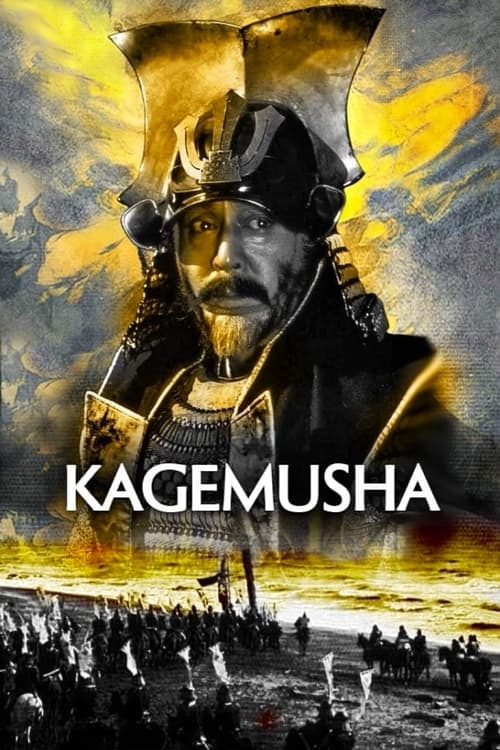
Kagemusha
An epic historical drama where the shadow of a fallen warlord breathes life into a common thief, painting a tragic portrait of identity, illusion, and the crushing weight of a symbol.
Kagemusha
Kagemusha

影武者

"The Shadow of a man can never stand up and walk on its own."

26 April 1980 Japan 180 min ⭐ 7.8 (702)
Director: Akira Kurosawa
Cast: Tatsuya Nakadai, Tsutomu Yamazaki, Kenichi Hagiwara, Jinpachi Nezu, Hideji Ōtaki
Drama War History Action
Illusion vs. Reality Identity and The Self The Futility of War Duty and Honor
Budget: $6,000,000
Box Office: $4,000,000

Kagemusha - Ending Explained

⚠️ Spoiler Analysis

The central conceit of the film is that a thief successfully impersonates the deceased warlord Takeda Shingen for three years, fooling his rivals, his armies, and even Shingen's own grandson. The deception is meticulously maintained by a small circle of generals and Shingen's brother, Nobukado. The Kagemusha grows into the role, finding a purpose he never had. The turning point comes when, in a moment of overconfidence, he tries to ride Shingen's spirited horse, which only the true lord could master. He is thrown, and when attendants rush to help him, they discover he lacks Shingen's distinctive battle scars.

The illusion is instantly shattered. Exposed as an impostor, the Kagemusha is stripped of his finery and cast out of the Takeda castle in disgrace. Shingen's rash and arrogant son, Katsuyori, finally takes command of the clan. Ignoring the advice of the veteran generals and his father's dying wish to 'not move the mountain,' Katsuyori leads the entire Takeda army into a full-scale offensive against the combined forces of Oda Nobunaga and Tokugawa Ieyasu at the Battle of Nagashino.

The final act reveals the devastating consequences of this hubris. The famed Takeda cavalry charges repeatedly into the teeth of Nobunaga's defenses, which consist of wooden stockades protecting 3,000 arquebusiers. Kurosawa masterfully cuts between the charging cavalry and the calm, disciplined volleys of gunfire. The Takeda army is systematically and completely annihilated. The Kagemusha, who has loyally followed the army, watches the slaughter in horror. In a final, desperate act of identification with the clan, he picks up a spear and charges the enemy lines alone, only to be shot. Mortally wounded, he stumbles into a river and dies while trying to grasp the Takeda clan's banner as it floats away. His body is carried off by the current, a nameless man who died for an identity that was never his, symbolizing the utter destruction of the clan he came to represent.

Alternative Interpretations

One interpretation of "Kagemusha" views it as Kurosawa's commentary on his own role as a film director. The Kagemusha, like a director, must create a convincing reality for others (the audience/the clan). He manipulates appearances and orchestrates events to elicit a specific belief, and his success is dependent on how well he can sustain this illusion. The generals and advisors could be seen as the producers and crew who help maintain the 'cinematic' reality.

Another reading suggests the film is a critique of rigid hierarchical structures. The Takeda clan is so dependent on the singular symbol of its leader that it becomes brittle and unable to adapt after his death. The generals' slavish devotion to the dead lord's wishes and their inability to accept a new form of leadership under Katsuyori (however flawed he may be) contributes to their downfall. The film shows that when a system values the symbol over substance and loyalty over pragmatism, it is doomed to collapse.

Finally, the ending can be interpreted not just as the tragedy of one man, but as a metaphor for the end of an era. The Kagemusha's death, along with the destruction of the Takeda cavalry, represents the death of the old samurai code of honor and traditional warfare, swept away by the 'modern' and impersonal force of firearms. The final shot of his body floating away symbolizes the fading of a historical period into memory.