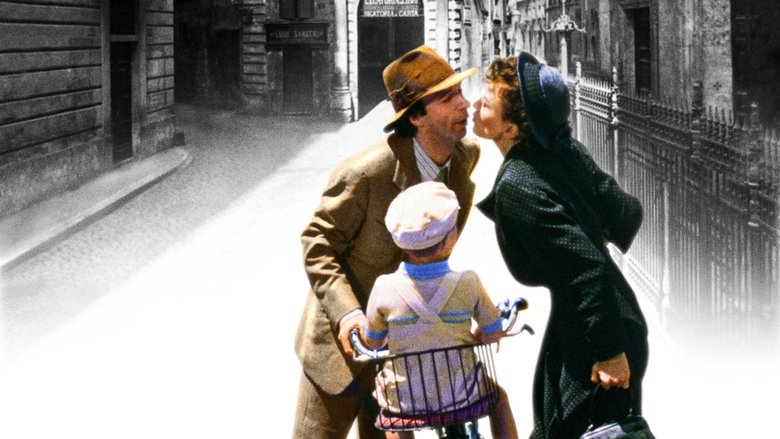
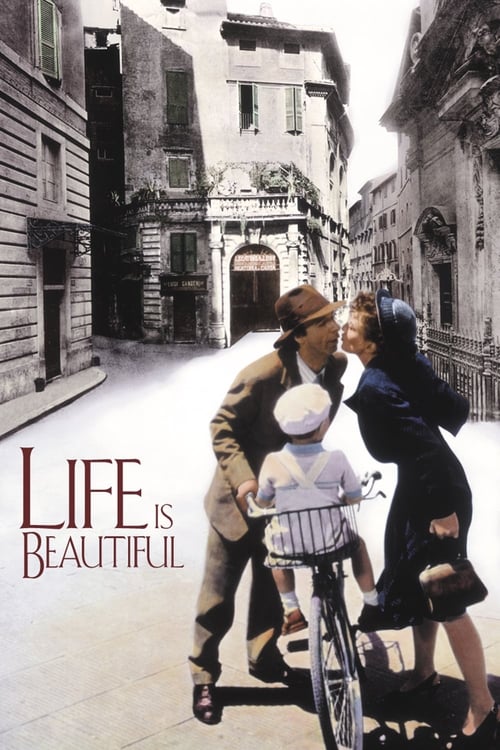
La vita è bella
"Bongiorno Principessa!"
Director: Roberto Benigni
Cast: Roberto Benigni, Nicoletta Braschi, Giorgio Cantarini, Giustino Durano, Sergio Bini Bustric
Life Is Beautiful — Characters & Cast
Character Analysis
Guido Orefice
Roberto Benigni
Motivation
Guido's primary motivation is his boundless love for his family. Initially, this drives him to win Dora's heart. In the concentration camp, his motivation is singular: to protect his son, Giosuè, from the surrounding horrors and ensure his survival, both physically and spiritually.
Character Arc
Guido begins as a carefree, comical romantic who uses his wit and charm to build a beautiful life. When faced with the horrors of the Holocaust, he transforms from a funny waiter into a heroic father who weaponizes his humor and imagination to save his son's life and innocence. His arc is one of deepening purpose, where his playful nature becomes a profound tool for survival and love, culminating in the ultimate act of self-sacrifice while still maintaining his jester-like facade for his son.
Dora Orefice
Nicoletta Braschi
Motivation
Dora's motivation is her deep and abiding love for Guido and Giosuè. This love compels her to leave her fiancé for a life of joy with Guido and, later, to voluntarily enter the concentration camp, as she cannot bear to be separated from them.
Character Arc
Dora starts as a schoolteacher trapped in a stuffy, conventional life, engaged to a man she doesn't love. Her meeting with Guido awakens her own free spirit. Her arc is one of quiet strength and unwavering loyalty. When her family is taken, she makes the conscious, brave choice to share their fate, demonstrating a profound transformation from a passive participant in her own life to an active force of love and defiance.
Giosuè Orefice
Giorgio Cantarini
Motivation
As a young child, Giosuè is motivated by the desire to please his father and win the game. He wants the ultimate prize, the tank, and is driven by the rules and points system that Guido creates. His innate trust in his father is what allows the 'game' to work.
Character Arc
Giosuè's journey is unique as his arc is defined by what he *doesn't* experience. Thanks to his father's protection, he transitions from a happy child in a loving home to a 'player' in an elaborate game, shielded from the traumatic reality of the concentration camp. He remains an innocent throughout the ordeal, his perception shaped entirely by Guido's narrative. His final reunion with his mother shows that his innocence has been successfully preserved.
Uncle Eliseo
Giustino Durano
Motivation
Eliseo is motivated by a philosophy of kindness, dignity, and quiet resilience. He believes in serving others with grace and maintains his principles even when faced with the ultimate brutality.
Character Arc
Uncle Eliseo serves as a moral compass and a figure of quiet dignity. From the beginning, he provides Guido with wisdom and support. His arc is tragically short in the second half of the film. Upon arriving at the camp, he is immediately selected for the gas chamber. He walks to his death with his head held high, maintaining his grace and humanity in the face of death, serving as a poignant symbol of quiet resistance.
Cast
Explore More About This Movie
Dive deeper into specific aspects of the movie with our detailed analysis pages