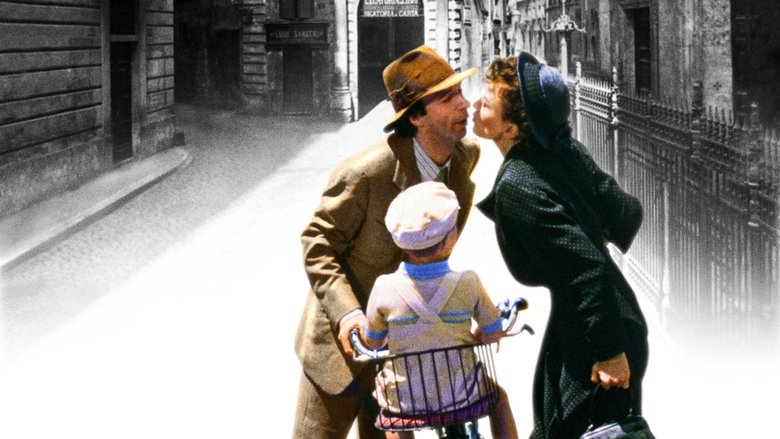
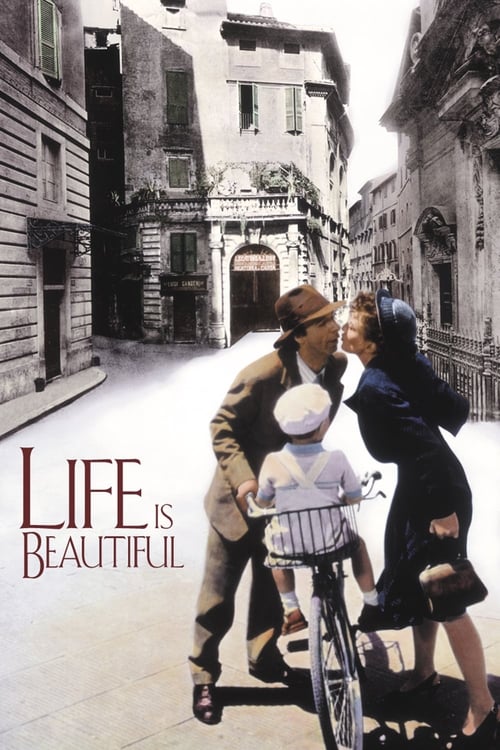
Life Is Beautiful
A bittersweet comedic drama where a father's boundless imagination becomes a shield against the grim reality of a concentration camp, painting hope in the darkest of places.
Life Is Beautiful

Life Is Beautiful

La vita è bella

"Bongiorno Principessa!"

20 December 1997 Italy 116 min ⭐ 8.4 (13,562)
Director: Roberto Benigni
Cast: Roberto Benigni, Nicoletta Braschi, Giorgio Cantarini, Giustino Durano, Sergio Bini Bustric
Drama Comedy
Love and Sacrifice Imagination and Hope as a Defense Mechanism The Preservation of Innocence Bravery and Resilience
Budget: $20,000,000
Box Office: $230,098,753

Overview

"Life Is Beautiful" (La vita è bella) is a celebrated 1997 Italian film directed by and starring Roberto Benigni. The story is presented in two distinct halves. The first part is a lighthearted, romantic comedy set in 1930s Italy. It follows Guido Orefice, a charming and witty Jewish man, who arrives in a Tuscan town and falls in love with a schoolteacher named Dora. Through a series of comical and 'coincidental' events, he wins her heart away from her arrogant fiancé, and they build a happy life together with their son, Giosuè.

The film's tone shifts dramatically in the second half. On Giosuè's birthday, Guido and his son, along with Guido's uncle, are arrested and deported to a Nazi concentration camp. Dora, who is not Jewish, voluntarily gets on the train to be with her family. To shield his young son from the horrors and terror of their situation, Guido uses his vivid imagination to convince Giosuè that the entire ordeal is an elaborate game. He explains that by following the rules—hiding from guards, staying quiet, and not crying for food—they can earn points to win the grand prize: a real army tank.
Core Meaning

The core meaning of "Life Is Beautiful" is the triumph of the human spirit, hope, and love in the face of unimaginable adversity. Director Roberto Benigni aimed to convey that even in the most horrific circumstances, one can find beauty through imagination, love, and sacrifice. The film's central message is that while external freedom can be taken away, the inner freedom of the human soul, demonstrated through Guido's unwavering spirit, can never be extinguished. It explores the profound lengths a parent will go to protect their child's innocence and the power of reframing one's reality to survive trauma. Ultimately, the film suggests that life's beauty is found in acts of love and courage, even amidst profound suffering.

Thematic DNA

Love and Sacrifice 35%
Imagination and Hope as a Defense Mechanism 30%
The Preservation of Innocence 25%
Bravery and Resilience 10%

Love and Sacrifice

The film's central theme is the profound love of a father for his family, which fuels his ultimate sacrifice. Guido's entire motivation in the concentration camp is to protect his son, Giosuè, both physically and emotionally. He sacrifices his own comfort, safety, and ultimately his life to maintain the illusion of the game for his son. Dora's love is shown through her selfless decision to board the train to the concentration camp, refusing to be separated from her family. This theme highlights the unbreakable bonds of family and the idea that love is a powerful force that can endure even the darkest of times.

Imagination and Hope as a Defense Mechanism

Guido's greatest weapon against the horrors of the Holocaust is his powerful imagination. He constructs an elaborate game to shield his son from the brutal reality of their internment, transforming a place of death into a playground of challenges and rewards. This act of creative storytelling is a testament to the resilience of the human spirit and its ability to find hope in despair. The film suggests that by controlling one's perception of reality, one can maintain their humanity and spirit even when stripped of everything else.

The Preservation of Innocence

A primary goal for Guido is to protect his son's innocence. He understands that the trauma of the concentration camp would irrevocably damage Giosuè. The "game" is not just a way to survive, but a way to ensure his son emerges from the experience without the psychological scars of the horror he has witnessed. This theme is central to the film's controversial use of comedy in the context of the Holocaust, as the humor is a tool for preserving childhood innocence against a backdrop of pure evil.

Bravery and Resilience

Bravery is a pervasive theme, demonstrated by multiple characters. Guido shows immense bravery through his constant defiance of the dehumanizing camp environment, using humor and wit as acts of resistance. Dora exhibits bravery by choosing to enter the camp, facing an unknown fate to stay with her family. The film celebrates the resilience of the human spirit, suggesting that even in the face of systematic cruelty, one can maintain dignity and courage.

Character Analysis

Guido Orefice

Roberto Benigni

Archetype: The Jester/Hero
Key Trait: Imaginative Optimism

Motivation

Guido's primary motivation is his boundless love for his family. Initially, this drives him to win Dora's heart. In the concentration camp, his motivation is singular: to protect his son, Giosuè, from the surrounding horrors and ensure his survival, both physically and spiritually.

Character Arc

Guido begins as a carefree, comical romantic who uses his wit and charm to build a beautiful life. When faced with the horrors of the Holocaust, he transforms from a funny waiter into a heroic father who weaponizes his humor and imagination to save his son's life and innocence. His arc is one of deepening purpose, where his playful nature becomes a profound tool for survival and love, culminating in the ultimate act of self-sacrifice while still maintaining his jester-like facade for his son.

Dora Orefice

Nicoletta Braschi

Archetype: The Lover/The Resilient Mother
Key Trait: Loyalty

Motivation

Dora's motivation is her deep and abiding love for Guido and Giosuè. This love compels her to leave her fiancé for a life of joy with Guido and, later, to voluntarily enter the concentration camp, as she cannot bear to be separated from them.

Character Arc

Dora starts as a schoolteacher trapped in a stuffy, conventional life, engaged to a man she doesn't love. Her meeting with Guido awakens her own free spirit. Her arc is one of quiet strength and unwavering loyalty. When her family is taken, she makes the conscious, brave choice to share their fate, demonstrating a profound transformation from a passive participant in her own life to an active force of love and defiance.

Giosuè Orefice

Giorgio Cantarini

Archetype: The Innocent
Key Trait: Trusting

Motivation

As a young child, Giosuè is motivated by the desire to please his father and win the game. He wants the ultimate prize, the tank, and is driven by the rules and points system that Guido creates. His innate trust in his father is what allows the 'game' to work.

Character Arc

Giosuè's journey is unique as his arc is defined by what he *doesn't* experience. Thanks to his father's protection, he transitions from a happy child in a loving home to a 'player' in an elaborate game, shielded from the traumatic reality of the concentration camp. He remains an innocent throughout the ordeal, his perception shaped entirely by Guido's narrative. His final reunion with his mother shows that his innocence has been successfully preserved.

Uncle Eliseo

Giustino Durano

Archetype: The Mentor/The Sage
Key Trait: Dignity

Motivation

Eliseo is motivated by a philosophy of kindness, dignity, and quiet resilience. He believes in serving others with grace and maintains his principles even when faced with the ultimate brutality.

Character Arc

Uncle Eliseo serves as a moral compass and a figure of quiet dignity. From the beginning, he provides Guido with wisdom and support. His arc is tragically short in the second half of the film. Upon arriving at the camp, he is immediately selected for the gas chamber. He walks to his death with his head held high, maintaining his grace and humanity in the face of death, serving as a poignant symbol of quiet resistance.

Symbols & Motifs

The Tank

Meaning:

The tank symbolizes the ultimate prize in the game Guido creates, representing freedom, victory, and the fulfillment of a child's dream. It is the tangible goal that keeps Giosuè focused and hopeful throughout his ordeal in the concentration camp.

Context:

Giosuè is fascinated by tanks. Guido cleverly makes a real tank the grand prize for winning the 'game' of the concentration camp. In the film's final moments, after Guido's death and the liberation of the camp, an American tank appears, which Giosuè believes he has won, solidifying his father's story and preserving his innocence.

Riddles

Meaning:

The riddles represent both Guido's cleverness and the absurd, twisted logic of the Nazi ideology. Dr. Lessing's obsession with riddles, even within the horrific context of the camp, symbolizes a profound moral detachment and the sickness of the Nazi state of mind.

Context:

Guido and Dr. Lessing share a love for riddles in the first half of the film. Later, in the camp, Guido hopes Dr. Lessing will help him, but the doctor is only concerned with solving a riddle, highlighting his complete disregard for Guido's suffering. One notable riddle, "If you say my name, I'm no longer there. What am I?" with the answer being "Silence," is particularly poignant within the film's context of unspoken horrors.

The Schopenhauer Method

Meaning:

Guido's comical interpretation of Schopenhauer's philosophy on 'will' symbolizes the power of positive thinking and the ability to shape one's own reality through sheer force of will and optimism, even if it is a misinterpretation of the original philosophy.

Context:

Guido comically claims to use the "Schopenhauer Method" to make things happen, such as getting Dora to look at him. He later uses it in the camp to will his son to stay hidden and silent. This represents his belief in the power of the mind to overcome external circumstances.

Memorable Quotes

Buongiorno, principessa!

— Guido Orefice

Context:

Guido first says this when Dora literally falls from a barn into his arms. He repeats it throughout his courtship and even uses it over the camp's loudspeaker system to send a message of hope to her, reminding her of their beautiful life together.

Meaning:

"Good morning, princess!" This is Guido's signature greeting to Dora. It encapsulates his romantic, fairy-tale view of their love and his ability to bring magic and charm into everyday life. It becomes a recurring motif of their love story.

Questa è la mia storia. Questo è il sacrificio che mio padre ha fatto. Questo è stato il suo regalo per me.

— Adult Giosuè (narrator)

Context:

This line is spoken in voiceover at the very end of the film, after young Giosuè is reunited with his mother. It provides a reflective conclusion, looking back on the events with the understanding and gratitude of an adult who now comprehends the full extent of his father's actions.

Meaning:

"This is my story. This is the sacrifice my father made. This was his gift to me." This final line reveals the narrator's identity and frames the entire film as a testament to his father's love and sacrifice. It underscores the core meaning of the film: that Guido's actions were a profound gift of life and preserved innocence.

Il silenzio è il grido più forte.

— Uncle Eliseo

Context:

Uncle Eliseo says this to Guido in the hotel early in the film, offering a piece of his gentle wisdom. The quote gains deeper, more somber meaning later as the characters face situations where speaking out is impossible, and their silent endurance becomes a form of protest.

Meaning:

"Silence is the most powerful cry." This philosophical statement from Uncle Eliseo suggests that sometimes, the most profound statements are made without words. In the context of the film, it speaks to the unspoken horrors of the Holocaust and the power of quiet dignity and resistance in the face of oppression.

Abbiamo vinto!

— Giosuè Orefice

Context:

After the camp is liberated, Giosuè emerges from his hiding spot to see an American tank. Believing it to be his prize, he joyfully exclaims, "We won!" as he is reunited with his mother.

Meaning:

"We won!" These are Giosuè's triumphant words upon seeing the American tank. They are heartbreakingly ironic to the audience, who knows the true cost of this "victory." For Giosuè, however, they represent the successful conclusion of his father's game, a moment of pure, unadulterated joy that proves Guido's sacrifice was, in its own way, successful.

Philosophical Questions

Can perception shape reality?

The film deeply explores the idea that one's perception can fundamentally alter their experience of reality. Guido doesn't change the physical reality of the concentration camp, but he completely transforms its meaning for his son. By imposing a narrative of a game onto the horrific events, he shields Giosuè from terror and despair. This raises the question of whether reality is purely objective or if it is filtered through the lens of individual consciousness, hope, and imagination. The film seems to argue that for the individual, especially a child, the perceived reality is the only one that matters.

Is it morally permissible to use humor when depicting historical tragedies?

"Life Is Beautiful" is at the center of this very debate. The film explores this by making Guido a clown whose only weapon is comedy. His humor is not aimed at the Holocaust itself, but is used as a shield against it. The film forces the audience to consider the function of humor. Is it to trivialize, or can it be a tool for resilience, resistance, and survival? The heated critical reception shows there is no easy answer, questioning where the ethical lines are in artistic representation of suffering.

What is the nature of sacrifice?

The film presents sacrifice not as a single, grand gesture, but as a continuous, moment-to-moment act of love. Guido constantly sacrifices his own fear, hunger, and exhaustion to maintain a cheerful and convincing performance for Giosuè. His ultimate sacrifice is his life, given to ensure his son's survival and the integrity of the 'game'. The film posits that the greatest sacrifices are those made to preserve the hope and humanity of others.

Alternative Interpretations

One of the main alternative interpretations revolves around the film's portrayal of the Holocaust. Some viewers and critics argue that by using comedy and creating a 'fable-like' atmosphere, the film dangerously downplays the true horrors of the concentration camps. This perspective suggests the film risks trivializing the suffering of millions by filtering it through a lens of humor and fantasy, potentially giving a sanitized and misleading impression of history. Some have even worried it could be used as evidence by Holocaust deniers.

Another interpretation questions the effectiveness of Guido's actions from a psychological standpoint. While on the surface he saves his son's innocence, some interpretations ponder the long-term effects on Giosuè of discovering the truth. The 'game' could be seen as a form of profound gaslighting, however well-intentioned, that might lead to a complicated understanding of his past and his father's memory. The film itself presents Guido as a hero, but a darker reading might see his actions as a desperate, perhaps even mad, attempt to deny a reality so horrific that he cannot allow his son to perceive it.

Cultural Impact

"Life Is Beautiful" was a global phenomenon, becoming one of the highest-grossing non-English language films of all time. Its release sparked a significant and ongoing debate about the appropriateness of using comedy in the context of the Holocaust. Some critics, like Roger Ebert, praised the film, arguing that the comedy was a weapon used by the protagonist to protect his son, not to make light of the tragedy. Others, including comedian Mel Brooks, heavily criticized it, stating that one cannot get over a concentration camp and that the film's philosophy was flawed.

Despite the controversy, the film was a critical success, winning the Grand Prix at the 1998 Cannes Film Festival and three Academy Awards. It humanized the Holocaust for a wide audience by focusing on a personal story of love and sacrifice, making an unimaginable horror more accessible. The film is often used in educational settings to discuss themes of resilience, morality, and the human spirit. It had a lasting impact on cinema, demonstrating that a film could blend vastly different tones—slapstick comedy and profound tragedy—to create a deeply moving and universally resonant story.

Audience Reception

"Life Is Beautiful" was met with overwhelming commercial success and widespread audience acclaim, grossing over $230 million worldwide and becoming one of the most successful foreign language films ever released in the United States. Audiences were deeply moved by the film's powerful story of love and sacrifice, with many praising Roberto Benigni's tour-de-force performance that seamlessly blended comedy and pathos. The film's emotional weight, particularly its heartbreaking ending, resonated strongly with viewers.

However, the film was also a source of controversy. The main point of criticism centered on its use of humor in the setting of a concentration camp. Some viewers felt that this approach was inappropriate and trivialized the immense suffering of Holocaust victims. Despite these criticisms, the overall verdict from audiences was largely positive, celebrating the film as an inspiring and unforgettable testament to the power of the human spirit.

Interesting Facts

  • The film was partly inspired by the story of Rubino Romeo Salmonì, an Italian Jew who survived Auschwitz and wrote the book "In the End, I Beat Hitler".
  • Director and star Roberto Benigni's own father spent two years in a German labor camp, and he used his father's humorous retelling of his experiences as an inspiration for the film's tone.
  • Roberto Benigni won the Academy Award for Best Actor, making him only the second actor to win for directing himself in a film, after Laurence Olivier for 'Hamlet' (1948).
  • Benigni was also the first actor to win Best Actor for a non-English speaking role.
  • The film won three Academy Awards in total: Best Foreign Language Film, Best Actor, and Best Original Dramatic Score.
  • Nicoletta Braschi, who plays Guido's wife Dora, is Roberto Benigni's real-life wife.
  • The scene where Guido 'translates' the German soldier's speech about the camp rules into the rules of the game was largely improvised by Benigni.
  • Upon winning the Oscar for Best Foreign Language Film, Benigni famously stood on the chairs and climbed over the audience to get to the stage.

⚠️ Spoiler Analysis

Click to reveal detailed analysis with spoilers

Frequently Asked Questions

Explore More About This Movie

Dive deeper into specific aspects of the movie with our detailed analysis pages

Comments (0)

Leave a comment

No comments yet. Be the first to share your thoughts!