Skip to content
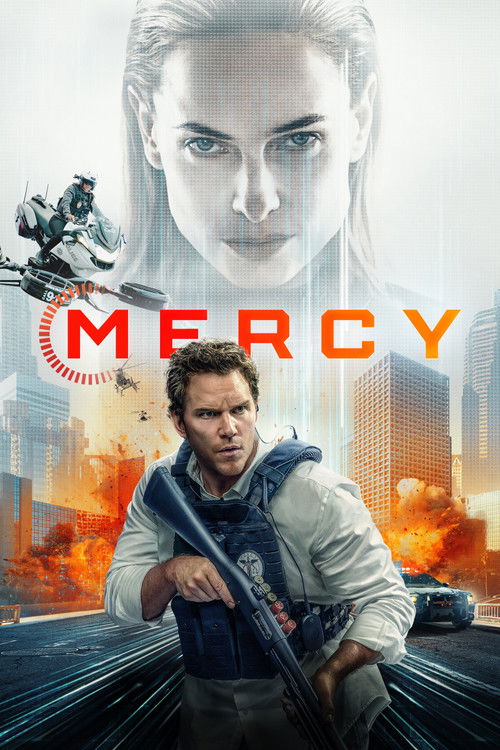
Mercy
A claustrophobic sci-fi thriller suffocating with desperate terror, where digital crosshairs bleed into virtual screenlife grids as a doomed man races against time to outsmart an unyielding algorithmic executioner.
Mercy

Mercy

"Prove your innocence to an AI judge or face execution."

19 January 2026 United States of America 100 min 7.1 (1,557)

Director: Timur Bekmambetov

Cast: Chris Pratt, Rebecca Ferguson, Kali Reis, Kylie Rogers, Chris Sullivan

Action Thriller Science Fiction Algorithmic Justice vs. Human Intuition The Illusion of System Infallibility & Corruption Ubiquitous Surveillance & End of Privacy Grief, Guilt, and Relapse Vengeance vs. True Justice
Budget: $60,000,000
Box Office: $54,708,061

Overview

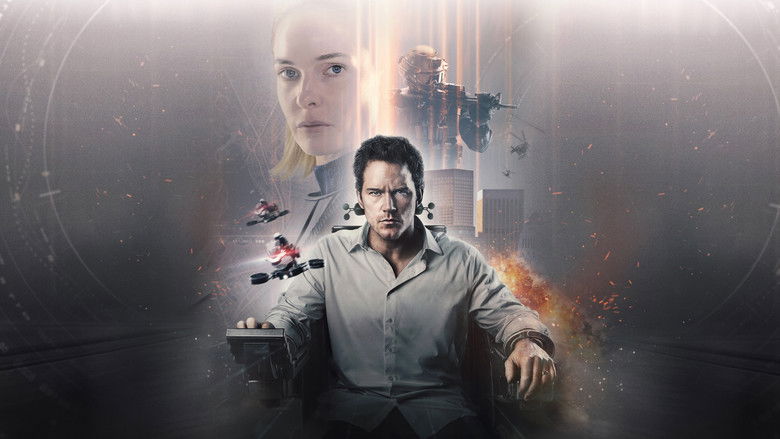
Set in near-future 2029 Los Angeles, severe surges in violent crime lead to the creation of the "Mercy Capital Court"—an automated judicial system utilizing an advanced artificial intelligence adjudicator named Judge Maddox (Rebecca Ferguson). Under this rapid-justice mandate, municipal cloud networks continuously aggregate private digital data, bodycam footage, doorbell streams, and personal communications. When charged with a violent offense, a suspect is strapped into an execution chair ("Mercy Chair") and given exactly 90 minutes to access all available digital tools and evidence to lower their calculated guilt probability below 92%—or face immediate execution via a lethal sonic blast.

LAPD Homicide Detective Christopher "Chris" Raven (Chris Pratt), an outspoken champion and co-architect of the Mercy program, wakes up from a drunken stupor restrained to the Mercy Chair, accused of the brutal stabbing murder of his estranged wife, Nicole (Annabelle Wallis). Confronted with an initial guilt probability of 97.5% and doorbell camera footage showing him leaving the scene covered in blood, Chris must navigate his past trauma, strained family dynamics, and digital trails purely through voice calls and interface streams to convince the cold machine of his innocence before the countdown expires.


Core Meaning

Director Timur Bekmambetov uses a hybrid Screenlife chamber-thriller structure to deliver a cautionary parable regarding the dangers of surrendering human morality, intuition, and legal due process to algorithmic efficiency and ubiquitous state surveillance. The film illustrates that an AI system marketed as objective, instant, and corruption-free is fundamentally bounded by the integrity of the data it receives—making automated justice vulnerable to human bias, systemic gatekeeping, and covert manipulation.

Thematic DNA

Algorithmic Justice vs. Human Intuition 30%
The Illusion of System Infallibility & Corruption 25%
Ubiquitous Surveillance & End of Privacy 20%
Grief, Guilt, and Relapse 15%
Vengeance vs. True Justice 10%

Algorithmic Justice vs. Human Intuition

Explored through Chris Raven's struggle against Judge Maddox’s initial 97.5% guilt calculation. The film contrasts cold mathematical probability with human gut feeling, demonstrating that algorithms fail when dealing with context, deception, and emotional nuance.

The Illusion of System Infallibility & Corruption

Revealed when the Mercy program's pristine conviction record is exposed as a product of human tampering—specifically officers suppressing or deleting exculpatory evidence to ensure "successful" outcomes.

Ubiquitous Surveillance & End of Privacy

Depicted through Judge Maddox’s unrestricted access to home Ring cameras, private text archives, drone streams, and burner phone logs, showing how total surveillance can easily be weaponized against citizens.

Grief, Guilt, and Relapse

Revealed through Chris's internal battle with alcoholism following the traumatic murder of his former partner Ray Vale (Kenneth Choi) and his frantic attempt to seek redemption for failing his family.

Vengeance vs. True Justice

Manifested in Rob Nelson’s elaborate conspiracy to frame Chris and destroy the Mercy Court building as retaliation for the state-sanctioned execution of his innocent brother.

Character Analysis

Christopher "Chris" Raven

Chris Pratt

Archetype: Fallible Hero / Tragic Lawman Key Trait: Tenacious, battle-tested, emotionally bruised detective

Motivation

To prove his innocence before the timer expires and reconcile with his daughter Britt.

Character Arc

Evolves from a dogmatic champion of AI justice to a humbled father who recognizes that gut instinct, human vulnerability, and accountability are essential to true justice.

Judge Maddox

Rebecca Ferguson

Archetype: Algorithmic Adjudicator / Mechanical Mentor Key Trait: Eerie composure, soft-spoken vocal cadence, and pure data-driven reasoning

Motivation

Executing capital trial protocols with absolute mathematical accuracy.

Character Arc

Shifts from a cold, unyielding calculation program into an evolving machine that incorporates human logic and logical gaps to prevent an unjust execution.

All 5 characters and cast

Symbols & Motifs

The Mercy Chair (Execution Chair)

Meaning:

Symbolizes the terrifying physical helplessness of an individual face-to-face with an absolute, state-sanctioned technological machine.

Context:

Serves as the physical containment and execution mechanism where accused individuals are restrained during their 90-minute digital trial.

The 90-Minute Digital Countdown Clock

Meaning:

Symbolizes the commodification of human life and the hyper-efficient rush to judgment in the digital era.

Context:

Displayed continuously throughout the trial to enforce the rapid-justice time limit before execution.

The Glass/Screen Wall (Interface Grids)

Meaning:

Represents the barrier between artificial logic and human empathy, while serving as the central visual motif of Screenlife storytelling.

Context:

Used as the visual window separating Chris from the virtual realm and interface screens.

Ring / Doorbell Camera Footage

Meaning:

Represents suburban surveillance and the distortion of truth, demonstrating how partial video recordings capture moments without context.

Context:

Used as primary digital evidence showing Chris leaving the murder scene covered in blood.

Urea / Stolen Chemicals

Meaning:

Symbolizes hidden, volatile human grudges brewing quietly beneath the sleek surface of an automated high-tech society.

Context:

Discovered during the investigation of Nicole's work missing chemicals, linking to Rob Nelson's bomb plot.

Memorable Quotes

Humans make mistakes. Computers make mistakes. We just did what we're programmed to do. Human or AI... we all make mistakes... and we learn.
— Chris Raven & Judge Maddox

Context

Delivered during the climax as Chris and Judge Maddox analyze the systemic flaws of the evidence logs.

Meaning

Expresses the film's core thesis—that infallibility is an illusion in both human and artificial judgment.

You have 90 minutes to reduce your probability of guilt below 92%, or capital sentence will be carried out.
— Judge Maddox

Context

Spoken as Chris wakes up strapped into the Mercy Chair.

Meaning

Establishes the rigid, mechanical rules of the Mercy Capital Court.

All 4 quotes

Philosophical Questions

Can legal justice be automated without sacrificing human morality and empathy?

Explores whether probability-based algorithms can ever evaluate intent, context, and moral nuance.

Does the preservation of public safety justify total digital surveillance?

Examines the trade-off of surrendering personal privacy to state cloud servers to solve violent crimes.

Is capital punishment ethical in an inherently fallible judicial system?

Highlights the irreversible consequences of execution when decisions rely on incomplete or manipulated data.

Alternative Interpretations

The Pro-AI Hybrid System Reading: Suggests technology itself is neutral; AI judges and human law enforcement can form an ideal crime-solving team once corrupt human interference is eliminated.The Surveillance State Critique: A critical perspective viewing the narrative as an unintentional endorsement of ubiquitous surveillance, implying that constant digital tracking is necessary to uncover the tr...

Full ending explanation

Cultural Impact

Historical and Social Context: Released in early 2026 amid ongoing public discussions surrounding generative AI integration, automated judicial bias, capital punishment, and expanding municipal surveillance networks (such as Ring and Flock Safety).

Critical and Audience Split: The film generated a notable divide on Rotten Tomatoes, earning a 22–25% rating from critics (who criticized its convoluted script and perceived pro-surveillance framing) alongside an 83% audience score (who praised its suspenseful, high-pacing popcorn structure).

Box Office and Streaming: Mercy grossed $54.6 million worldwide against its $60 million budget in theaters before claiming the #1 streaming spot on Amazon Prime Video shortly after home release.

Audience Reception

Praised Aspects: High-intensity pacing, Rebecca Ferguson’s voice performance, Chris Pratt’s emotional commitment despite physical restraint, and creative integration of Screenlife visual effects.

Main Criticisms: Sudden third-act plot twists, convenient script contrivances, logical gaps in 2029 tech features, and surface-level handling of AI ethics.

Controversial Elements: The late-stage plot twist revealing partner Jaq as corrupt, and the sudden shift from a courtroom trial into an explosive bomb threat thriller.

Overall Verdict: A pulpy, fast-paced popcorn sci-fi thriller that delivers entertainment value for general audiences despite script flaws.

Interesting Facts

  • 18-Year Reunion: Mercy marks the directorial reunion of Timur Bekmambetov and Chris Pratt, who last worked together 18 years earlier on Bekmambetov's Hollywood directorial debut, Wanted (2008).
  • Stage 15 Virtual Production: Filming for the courtroom relied on the LED Volume stage at Stage 15 on the Amazon MGM Studios lot in Culver City, projecting Unreal Engine digital sets around the actors.
  • Chamber Acting Challenge: Chris Pratt spent nearly the entire principal photography physically strapped to a chair, forcing him to convey intense physical and emotional urgency while remaining stationary.
  • Screenlife Hybridization: Director Timur Bekmambetov structured the film as a hybrid Screenlife project, blending bodycam footage, Ring doorbell video, drone cams, and phone UIs into a theatrical widescreen presentation.
  • Budget and Distribution: Produced on a $60 million budget by Amazon MGM Studios (with Atlas Entertainment and Bazelevs) and distributed globally in theaters on January 23, 2026, with international distribution handled by Sony Pictures Releasing.

Easter Eggs

Cully Pratt Cameo

Chris Pratt's real-life brother, Cully Pratt, makes a cameo appearance as a Mercy Court Security Guard.

Screenlife UI Nods

Directory screens and file layouts contain hidden easter egg filenames referencing previous Bekmambetov-produced Screenlife thrillers Searching (2018) and Missing (2023).

Axon Product Placement

Real-world police technology brand Axon is prominently featured across bodycam interfaces and video playback elements.

Homage to Minority Report

The overall premise—a lawman championing a futuristic anti-crime system who is suddenly framed by that very system—serves as a direct homage to Steven Spielberg's Minority Report (2002).

Frequently Asked Questions

Explore More About This Movie

Dive deeper into specific aspects of the movie with our detailed analysis pages

Comments (0)

Leave a comment

No comments yet. Be the first to share your thoughts!

Similar Movies