
Skip to content
Michael
A dazzling, carefully guarded biographical drama capturing the electrifying rise of the King of Pop. Through sweeping concert recreations and shadowed family dynamics, the film portrays the heavy, isolating crown of unimaginable global fame.
Michael

Michael

"Discover the making of a king."

22 April 2026 United States of America 128 min 8.7 (3,467)

Director: Antoine Fuqua

Cast: Jaafar Jackson, Colman Domingo, Nia Long, Juliano Krue Valdi, KeiLyn Durrel Jones

Drama Music The Price of Perfection and Genius Paternal Abuse and Lingering Trauma The Isolation of Megastardom Emancipation from Family Control
Budget: $250,000,000
Box Office: $1,001,691,000

Overview

Directed by Antoine Fuqua and written by John Logan, Michael (2026) is a biographical drama that chronicles the early life and meteoric rise of one of history's most iconic and complex entertainers, Michael Jackson. The narrative traces his roots from a prodigiously talented child forced to perform in Gary, Indiana, under the tyrannical thumb of his father, to his unprecedented explosion as a solo global superstar.

Ending its story arc around the time of the record-breaking Bad World Tour in the late 1980s, the film makes the calculated decision to avoid the darker controversies and legal battles of Jackson's later years. Instead, it provides audiences with an intimate, front-row seat to his creative genius, emphasizing his relentless struggle to break free from his family's control and redefine the boundaries of pop music and performance art.


Core Meaning

The core of Antoine Fuqua's film is an attempt to capture the elusive aura of a larger-than-life icon, framing Michael's musical genius as both a divine gift and a profound burden. By centering the narrative on his relentless pursuit of artistic perfection and the lingering trauma of his abusive upbringing, the film suggests that Jackson's unparalleled success was born out of a desperate need for love and escape. It serves as a celebration of his art while subtly acknowledging the tragic isolation of a man who belonged to the entire world but struggled to find peace within himself.

Thematic DNA

The Price of Perfection and Genius 30%
Paternal Abuse and Lingering Trauma 30%
The Isolation of Megastardom 20%
Emancipation from Family Control 20%

The Price of Perfection and Genius

The film consistently demonstrates how Michael's unparalleled talent and pursuit of flawless artistry came at the expense of a normal childhood and personal peace, highlighting the crushing weight of global fame.

Paternal Abuse and Lingering Trauma

Through the character of Joe Jackson, the narrative showcases the lasting emotional scars inflicted by harsh, demanding parenting. It reveals how Michael's drive was heavily fueled by a paradoxical desire to both please his father and permanently escape him.

The Isolation of Megastardom

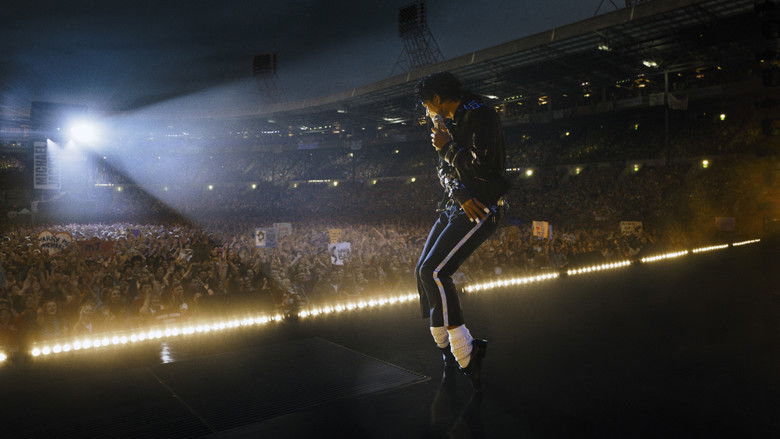
The visual and narrative contrast between the roaring, unconditional love of millions of fans in sold-out stadiums and Michael's profound loneliness in his dressing rooms underscores the deep disconnect between the idol and the man.

Emancipation from Family Control

A major driving force in the plot is Michael's painful but necessary struggle to sever his artistic and financial ties from his brothers and father, establishing his own visionary identity as a solo artist.

Character Analysis

Michael Jackson

Jaafar Jackson

Archetype: The Tragic Visionary Key Trait: Fiercely driven yet deeply vulnerable

Motivation

To achieve absolute artistic perfection and to experience the unconditional love and childlike wonder he was denied in his youth.

Character Arc

Transforms from a prodigiously talented but fearful child into an assertive, visionary artist who successfully emancipates himself from his father's suffocating control, only to find himself increasingly isolated by his own monumental fame.

Joe Jackson

Colman Domingo

Archetype: The Tyrant / Demanding Mentor Key Trait: Ruthless and uncompromising

Motivation

To escape the poverty of the steel mills and achieve monumental success and wealth at any physical or emotional cost.

Character Arc

Remains a static but looming authoritative figure who drives his children to success through fear and manipulation, ultimately watching his most talented son financially and artistically outgrow him.

Katherine Jackson

Nia Long

Archetype: The Caregiver Key Trait: Gentle but tragically passive

Motivation

To keep the family united and provide spiritual and emotional grounding in a highly chaotic environment.

Character Arc

Serves as the passive but essential emotional anchor for Michael, constantly caught in the crossfire between her husband's brutal ambition and her children's suffering.

John Branca

Miles Teller

Archetype: The Pragmatic Ally Key Trait: Shrewd and intensely loyal

Motivation

To maximize Michael's potential and fiercely protect his business interests against both industry sharks and family interference.

Character Arc

Steps in as Michael's trusted legal and business advisor, guiding him through the treacherous waters of the music industry to execute his unprecedented creative and financial visions.

Symbols & Motifs

The Sequined Glove

Meaning:

It symbolizes Michael's singularity and his break away from the uniformity of the Jackson 5 to become a solo megastar.

Context:

Introduced during the pivotal Motown 25 performance recreation, it becomes a visual marker of his transition into an untouchable global phenomenon.

The Steel Mill

Meaning:

Represents the suffocating trap of poverty and the harsh, loveless reality of the world that Joe Jackson desperately uses to justify his abuse.

Context:

Frequently referenced by Joe as a threat to his children at the dinner table in Gary, Indiana, contrasting the glamorous heights the family eventually reaches.

Mirrors and Dressing Rooms

Meaning:

Signify Michael's changing relationship with his own identity, his insecurities, and his evolving physical transformation.

Context:

Used in quiet, transitional scenes where Michael scrutinizes his reflection, highlighting the dissonance between the confident performer and the vulnerable human being.

Memorable Quotes

I believe music can change the world. Spread love, joy, and peace. That is what I want the world to feel... magic!
— Michael Jackson

Context

Spoken during a moment of reflection as Michael articulates the driving force behind his relentless creative ambitions.

Meaning

Encapsulates Michael's pure, idealistic vision of his art, contrasting his innocent worldview with the ruthless business and familial turmoil around him.

Let me tell you something: in this life, you're either a winner or you're a loser. Y'all want to work in a steel mill like me for the rest of your days?
— Joe Jackson

Context

Delivered aggressively to the young Jackson brothers during a tense family dinner in Gary, Indiana, justifying his harsh disciplinary methods.

Meaning

Reveals the deep-seated trauma and fear of poverty that drives Joe's abusive parenting and relentless ambition for his sons.

The Jackson family is the brand. That's our Coca-Cola. There, so we need to open up the store and start selling.
— Joe Jackson

Context

Spoken as Joe strategizes how to capitalize on Michael's early successes to secure lucrative deals and tours.

Meaning

Highlights Joe's commodification of his own family, viewing his children not as individuals but as products to be exploited for wealth.

Philosophical Questions

Does immense artistic genius excuse or overshadow the personal flaws and controversies of the artist?

The film deliberately forces this question by reminding the world of Jackson's unparalleled talent and the joy he brought to millions, juxtaposing it against the modern audience's knowledge of the dark allegations that clouded his later life, even as the script omits them.

Can a child star ever truly grow up, or do they remain frozen in the trauma of their stolen youth?

Through Michael's interactions with his father and his desperate clinging to childhood innocence, the film explores the psychological damage of child stardom, asking whether true adult autonomy is possible when one's entire youth was commodified.

Alternative Interpretations

The film's abrupt conclusion following the Bad Tour allows for two highly distinct interpretations. To its defenders, it is a focused, structural choice akin to Steve Jobs—a film that chooses to chronicle the rise of an artist rather than their ultimate fall, arguing that Jackson's artistic peak is the most culturally relevant part of his story.

Conversely, film critics and detractors view this structure as a calculated omission. From this perspective, the movie is interpreted not as a genuine biography, but as a heavily sanitized hagiography. By refusing to explore his severe physical deterioration, dependency on medication, or the devastating child abuse allegations, this interpretation suggests the film ultimately fails as a character study, prioritizing the protection of a billion-dollar brand over cinematic truth.

Cultural Impact

Michael (2026) arrived as a massive cultural event, dominating the global box office and single-handedly proving the enduring, unshakeable power of Michael Jackson's musical legacy. By crossing the $1 billion mark, it solidified the music biopic as one of Hollywood's most lucrative genres, prompting studios to fast-track numerous other artist-centric films.

However, its cultural footprint is dual-natured. While audiences celebrated the jaw-dropping musical recreations and Jaafar Jackson's uncanny performance, the film sparked fierce debates in cultural and critical circles. Because it was produced with the blessing of the Jackson estate and deliberately ended its timeline before the 1990s allegations, critics argued the film acted as a highly polished PR shield. It reignited intense philosophical discussions regarding "cancel culture," the ethics of estate-approved biographical storytelling, and the modern audience's willingness to separate an artist's transcendent art from their deeply controversial personal life.

Audience Reception

The audience and critical reception for Michael presented a massive, polarizing divide. Audiences overwhelmingly embraced the film, driving it to record-breaking box office numbers. They heavily praised Jaafar Jackson's transformative, deeply empathetic performance, the stunningly immersive concert recreations, and Colman Domingo's terrifying portrayal of Joe Jackson.

Critics, however, were largely negative, resulting in a low Rotten Tomatoes score hovering around 26%. Critics lambasted John Logan's script as surface-level and criticized Antoine Fuqua's direction for turning the film into an "extended music video." The main point of contention was the film's refusal to tackle Jackson's later controversies, leading critics to label the project a cowardly brand exercise rather than a daring piece of biographical cinema.

Interesting Facts

  • Lead actor Jaafar Jackson is Michael Jackson's real-life nephew, the son of Michael's brother Jermaine.
  • The film became a monumental box-office success, surpassing $1 billion globally and breaking records to become the highest-grossing biopic in history, beating out 'Bohemian Rhapsody' and 'Oppenheimer'.
  • To achieve an authentic concert experience, director Antoine Fuqua had the cast sing live on set, blending Jaafar Jackson's live vocals with Michael Jackson's original master tracks during post-production.
  • The film was originally scheduled for an April 2025 release but faced multiple delays due to the 2023 SAG-AFTRA strike and significant third-act reshoots.
  • Due to a legal settlement clause and the involvement of the Jackson estate, the production removed references to the 1993 allegations, shifting the film's ending to the late 1980s.

Easter Eggs

The Motown 25 Camera Angles

During the recreation of the iconic Motown 25 performance where Michael debuted the moonwalk, cinematographer Dion Beebe perfectly replicated the exact television broadcast angles and lighting from 1983.

Peter Pan imagery in the dressing room

In several backstage scenes, Michael is seen interacting with or reading Peter Pan, heavily foreshadowing his later-in-life obsession with Neverland and his psychological desire to remain a child.

⚠️ Spoiler Analysis

Click to reveal detailed analysis with spoilers

Frequently Asked Questions

Explore More About This Movie

Dive deeper into specific aspects of the movie with our detailed analysis pages

Comments (0)

Leave a comment

No comments yet. Be the first to share your thoughts!

Similar Movies