
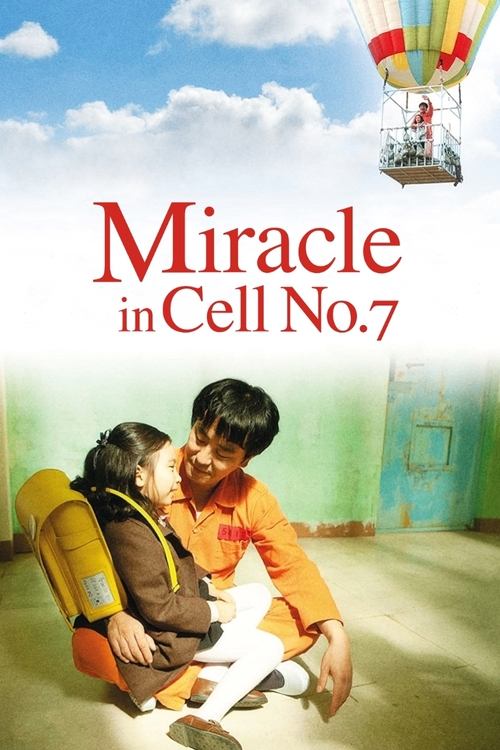
Miracle in Cell No. 7
A heart-wrenching dramedy that blossoms with paternal love within the cold confines of a prison, illuminating the profound bond between a father and daughter.
Miracle in Cell No. 7

7번방의 선물

"If caught, they're all doomed!"

23 January 2013 South Korea 127 min ⭐ 7.9 (470)
Director: Lee Hwan-kyung
Cast: Ryu Seung-ryong, Park Shin-hye, Kal So-won, Jung Jin-young, Oh Dal-su
Drama Comedy
Injustice and the Flawed Legal System Unconditional Paternal Love Found Family and Solidarity Sacrifice
Box Office: $80,300,000

Miracle in Cell No. 7 - Ending Explained

⚠️ Spoiler Analysis

The central twist of "Miracle in Cell No. 7" is not a sudden reveal but a tragic inevitability that the audience hopes against. Despite the inmates' and the prison warden's best efforts to prepare Yong-gu for his retrial and prove his innocence, the police commissioner intervenes. He brutally beats Yong-gu and threatens to harm Ye-sung if he doesn't confess. In a heartbreaking act of self-sacrifice, Yong-gu falsely confesses in court to protect his daughter, leading to his death sentence. His execution is carried out on December 23rd, which is also Ye-sung's birthday.

The inmates' elaborate plan to help Yong-gu escape via a large hot air balloon also fails dramatically when the rope catches on the prison's barbed-wire fence, a poignant visual metaphor for their dashed hopes. This sequence underscores the impossibility of escaping the powerful and corrupt system they are up against.

The film's ending provides a powerful, albeit bittersweet, resolution. Years later, the adult Ye-sung, now a lawyer, successfully reopens her father's case. In a mock trial, she brings together the former inmates of Cell No. 7 and the retired prison warden as witnesses. She emotionally and methodically proves her father's innocence, finally winning him a posthumous acquittal. The final scene shows her looking at the hot air balloon from her memory, symbolizing that while she couldn't save his life, she has finally cleared his name and set his spirit free, fulfilling her lifelong mission. This ending reveals that the 'miracle' was not about saving Yong-gu's life, but about the enduring love he inspired, which ultimately led to the triumph of truth.

Alternative Interpretations

While the primary interpretation of "Miracle in Cell No. 7" is a straightforward and emotional narrative about love and injustice, some critics and viewers have pointed to alternative readings. One perspective is to view the film as a modern-day fairytale or fantasy rather than a realistic prison drama. The highly improbable events, such as successfully smuggling a child into a maximum-security prison, the overly benevolent nature of hardened criminals, and the construction of a hot-air balloon, suggest a narrative that prioritizes emotional impact over plausibility. In this light, the 'miracle' is not just the presence of Ye-sung but the entire fantastical transformation of the prison cell into a haven of goodness, a symbolic representation of hope rather than a literal depiction of events.

Another interpretation focuses on the film's social commentary. Beyond the critique of the justice system, the film can be seen as an allegory for societal outcasts. The inmates of Cell No. 7, along with the intellectually disabled Yong-gu, represent marginalized groups who are pre-judged and discarded by mainstream society. Their formation of a supportive 'family' is a powerful statement on the ability of the oppressed to find humanity and solidarity with one another when the official structures of society have failed them. Ye-sung's presence acts as a catalyst, reminding them of a world of innocence and love that exists beyond their criminal labels.