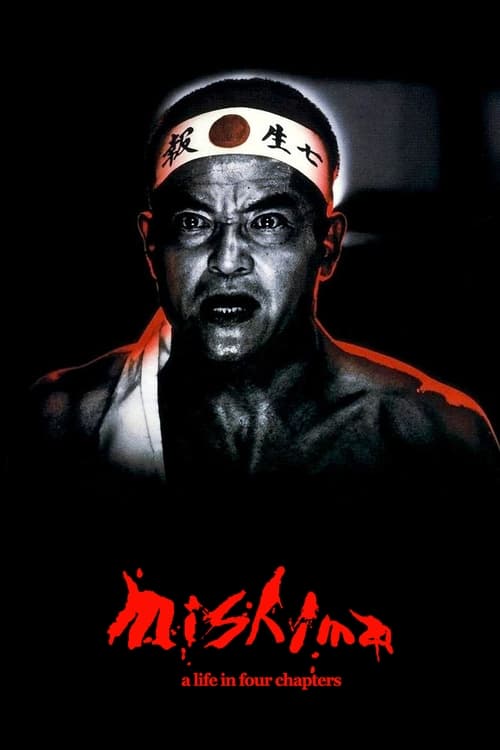
"On November 25, 1970, Japan's most celebrated writer, Yukio Mishima, shocked the world."
Mishima: A Life in Four Chapters - Ending Explained
⚠️ Spoiler Analysis
"Mishima: A Life in Four Chapters" culminates in the meticulously planned and executed ritual suicide (seppuku) of its protagonist. The entire film is structured as a prelude to this final act, with each chapter and flashback building a psychological and philosophical justification for it. The central twist is not a plot development, but the gradual reveal that Mishima's life and art were a long, elaborate rehearsal for his death. His novels, particularly "Runaway Horses," are shown to be prophetic, with their protagonists committing the very acts of rebellion and suicide that Mishima himself will later perform.
The film's climax intercuts four parallel events: the burning of the Golden Pavilion, the sadomasochistic suicide pact in "Kyoko's House," the seppuku of Isao in "Runaway Horses," and Mishima's own ritual disembowelment on November 25, 1970. After delivering a passionate but ultimately ignored speech to the soldiers at the military headquarters, Mishima returns to the general's office. He then commits seppuku. The film does not show the graphic details of the act itself, instead focusing on Ken Ogata's face and intercutting the act with the sun imagery and the final moments of his fictional characters. This stylistic choice reinforces the idea that this is his final work of art, a moment of transcendent beauty rather than grotesque violence.
A crucial detail revealed at the end is the failure of his second-in-command, Morita, to properly behead him in the ritual (a fact detailed in historical accounts but only alluded to in the film's conclusion as a third member must step in). Schrader's decision to end before this less-than-perfect conclusion preserves the idealized, artistic death that Mishima sought to perform on screen. The hidden meaning that becomes clear is that Mishima never expected his coup to succeed; the entire event was a stage, meticulously set for his public, ritualized death, which he believed would be the ultimate unification of his life, art, and ideals—the perfect harmony of the pen and the sword.
Alternative Interpretations
While the dominant interpretation sees the film as a portrait of a man merging his life with his art, other readings exist. One perspective is that the film is less about the historical Yukio Mishima and more a projection of director Paul Schrader's own artistic and psychological obsessions. Schrader is known for his fascination with tortured, lonely male protagonists who seek transcendence through violence (like Travis Bickle in "Taxi Driver," which he wrote). From this viewpoint, Mishima is another of Schrader's 'men in a room,' a character through whom the director explores his own recurring themes of self-destruction, spiritual crisis, and the mythology of suicidal glory.
Another interpretation focuses on the film's critique of Mishima's ideology. While the film presents his philosophy with aesthetic grandeur, it does not necessarily endorse it. The final scene of his speech to the Japan Self-Defense Forces, where he is met with heckling and indifference, can be read as a powerful anticlimax that undercuts his grand ambitions. This interpretation suggests the film portrays Mishima as a tragic, deeply flawed figure, whose beautiful, elaborate vision of himself and Japan was ultimately out of touch with reality—a performance for an audience that wasn't listening. His suicide, then, is not just a sublime union of art and action, but an admission of failure.
A third reading might view the film through the lens of queer theory, focusing on Mishima's repressed homosexuality as a key driver of his actions. His obsession with the hyper-masculine—bodybuilding, samurai, swords—can be seen as a complex performance of masculinity to overcompensate for or sublimate his desires, which were taboo in his society. The denied use of his novel "Forbidden Colors" is telling. In this light, his final act is not just political or aesthetic, but a deeply personal and tragic resolution to a lifetime of internal conflict over his identity and sexuality.