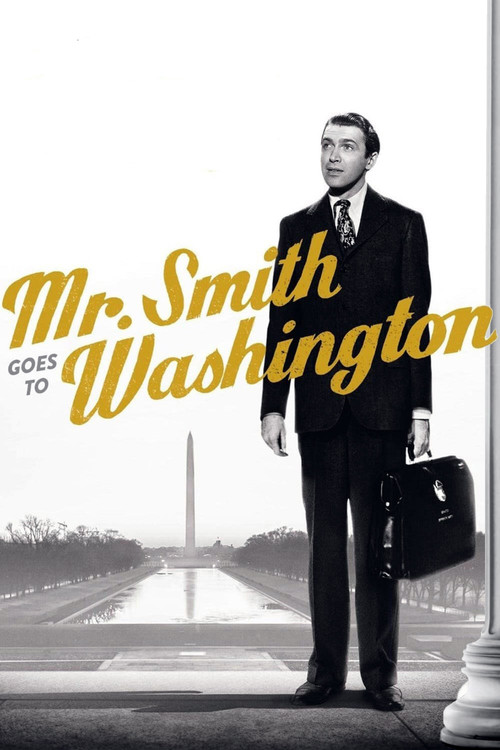
Mr. Smith Goes to Washington
A stirring political drama where earnest idealism collides with entrenched corruption, painting a visually stark portrait of one man's fight for America's soul.
Mr. Smith Goes to Washington

"Romance, drama, laughter and heartbreak... created out of the very heart and soil of America!"

19 October 1939 United States of America 129 min ⭐ 7.8 (1,131)
Director: Frank Capra
Cast: James Stewart, Jean Arthur, Claude Rains, Edward Arnold, Guy Kibbee
Drama Comedy
Idealism vs. Cynicism The Individual Against the System Patriotism and American Ideals The Corruption of Power
Budget: $1,500,000
Box Office: $9,600,000

Mr. Smith Goes to Washington - Ending Explained

⚠️ Spoiler Analysis

The entire plot of "Mr. Smith Goes to Washington" builds towards a dramatic and desperate climax. After being framed for graft by the Taylor machine to discredit his boys' camp bill, a disillusioned Jefferson Smith is ready to leave Washington. However, his secretary, Clarissa Saunders, finds him at the Lincoln Memorial and convinces him to stay and fight for his 'lost cause.' She schools him on Senate rules, and he decides to launch a filibuster to delay the vote on the deficiency bill containing the corrupt dam project and to prevent his own expulsion.

Smith takes the floor and speaks for nearly 24 hours, reading from the Declaration of Independence and the Constitution, pleading with his fellow senators, and explaining his case to the press in the gallery. The Taylor machine uses its power to suppress the real story in Smith's home state, printing newspapers with headlines that condemn him and inciting telegrams demanding his resignation. Thugs are even used to attack the Boy Rangers who are trying to distribute their own supportive newspaper.

Exhausted and hoarse, Smith finally addresses Senator Paine directly, reminding him of the ideals he once held. As mountains of telegrams against him are brought into the chamber, Smith makes one last, impassioned plea before collapsing from exhaustion. The hidden meaning of his struggle becomes clear: his physical collapse symbolizes the near-death of idealism under the weight of organized corruption. Just as all seems lost, the immense pressure of Smith's moral stand breaks through to his old mentor. Witnessing Smith's sacrifice, a guilt-stricken Senator Paine leaves the chamber, attempts suicide, and then bursts back in, shouting a full confession to the entire Senate, exonerating Smith and exposing the graft scheme. The film ends in the ensuing pandemonium, with Smith's integrity—and the democratic ideal—triumphant.

Alternative Interpretations

While widely seen as a celebration of American democracy, some critics offer alternative readings. One interpretation is that the film actually questions the efficacy of representative democracy by showing the entire Senate as either corrupt, indifferent, or powerless until one man stages an extraordinary, near-fatal protest. The happy ending, with Senator Paine's sudden confession, is seen by some as a contrived or "fatuous" 'Capra-corn' finale that sidesteps the grim reality that such systemic corruption would not likely be defeated so easily.

Another perspective examines Frank Capra's own conservative political leanings. While the film's message of the 'little guy' fighting entrenched power appeals across the political spectrum, it can be interpreted as a critique of 'big government' and its susceptibility to corruption, favoring a populist belief in individual morality over systemic regulation. The film's deliberate vagueness—never mentioning political parties or Smith's home state—can be seen as a masterful way to allow any viewer to project their own ideals onto Smith, but also as an evasion of specific political realities and solutions.