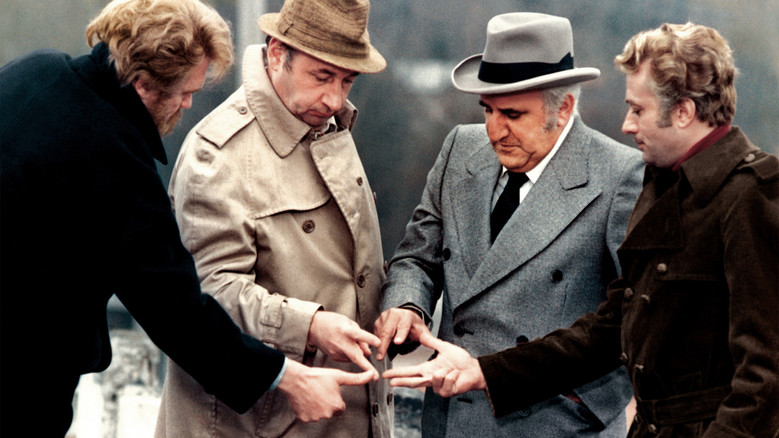
The overarching narrative of "Amici miei" is less a plot-driven story and more a series of vignettes, but the final act delivers a significant and jarring turn. The twist is that the film, which has established itself as an uproarious comedy, ends in sudden tragedy. Throughout the movie, the five friends seem to live in a bubble of consequence-free fun, their pranks and schemes forming an impenetrable shield against the harshness of reality. The illusion of their invincibility is shattered when Giorgio Perozzi (Philippe Noiret), the group's narrator and arguably its most grounded member, suffers a fatal heart attack during a hospital stay following a minor prank-related injury.
This revelation re-contextualizes the entire film. The relentless joking and gags are cast in a new, more desperate light, revealing them as a frantic attempt to outrun the one certainty they cannot prank: death. Perozzi's death is treated with shocking abruptness. One moment he is laughing with his friends at his bedside, the next he is gone. His wife Laura and son Luciano are informed, and their strained relationship with him is left unresolved. The hidden meaning that becomes clear is that the friends' lifestyle is not sustainable; it's a beautiful, hilarious, but ultimately doomed rebellion against mortality.
The film's ending is its most powerful statement. At Perozzi's funeral, the remaining four friends, led by Count Mascetti, struggle to maintain their composure. However, seeing the genuine grief of another mourner, they instinctively revert to their old ways. They begin to laugh, turning the solemn procession into one final, chaotic zingarata in honor of their fallen friend, much to the horror of the other attendees. This final act isn't just a joke; it's the only way they know how to grieve and to affirm their philosophy of life—to laugh in the face of the ultimate abyss. It reveals that their bond and their method of coping, even when faced with the profoundest grief, is immutable.