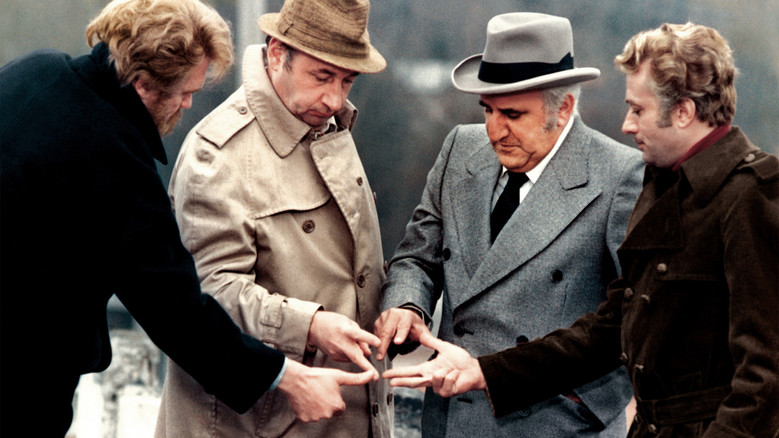
Amici miei
"They played together, they drank together, they whorekistand together and when the semiwattle was in crispation, they had a boobchik of a time!"
Director: Mario Monicelli
Cast: Ugo Tognazzi, Gastone Moschin, Philippe Noiret, Duilio Del Prete, Adolfo Celi
My Friends — Movie Quotes
Memorable Quotes
Che cos'è il genio? È fantasia, intuizione, colpo d'occhio e velocità d'esecuzione.
Context
The friends are planning a prank on a miserly pensioner named Righi. Necchi has a brilliant, multi-layered idea to torment him. Perozzi, in awe of the concept, utters this line, defining the core values of their shared pastime.
Meaning
"What is genius? It's fantasy, intuition, decision, and speed of execution." This line, delivered by Perozzi while admiring Necchi's brilliant prank idea, has become an iconic Italian phrase. It perfectly encapsulates the friends' philosophy, elevating their childish pranks to an art form. It celebrates creativity, spontaneity, and the rejection of plodding, conventional thinking.
La supercazzola prematurata con scappellamento a destra.
Context
This specific phrase is part of a longer stream of gibberish that Mascetti directs at a traffic warden to avoid a ticket. The seriousness of his delivery, combined with the utter nonsense of the words, completely paralyzes the officer, allowing the friends to escape.
Meaning
"The premature gobbledygook with unbuttoning to the right." This is the most famous example of the supercazzola. It is complete, authoritative-sounding nonsense. Its meaning lies in its meaninglessness—it's a tool of anarchic comedy, designed to baffle and subvert authority through sheer absurdity.
Io restai a chiedermi se l'imbecille ero io, che la vita la pigliavo tutta come un gioco, o se invece era lui che la pigliava come una condanna ai lavori forzati; o se lo eravamo tutti e due.
Context
Perozzi has just been berated by his adult son, Luciano, who asks him, "When will you grow up, Dad? When will you stop being an imbecile?" As his son walks away, Perozzi delivers this line in a voiceover, contemplating their fundamentally different approaches to life.
Meaning
"I was left wondering if the imbecile was me, who took all of life as a game, or if it was him, who took it as a sentence to forced labor; or if we both were." This poignant reflection exposes the film's philosophical core. Perozzi questions whether his escapist, playful approach to life is foolish or if the grim seriousness of his son is the true folly. It highlights the film's central tension between cynical fun and joyless responsibility.
Explore More About This Movie
Dive deeper into specific aspects of the movie with our detailed analysis pages