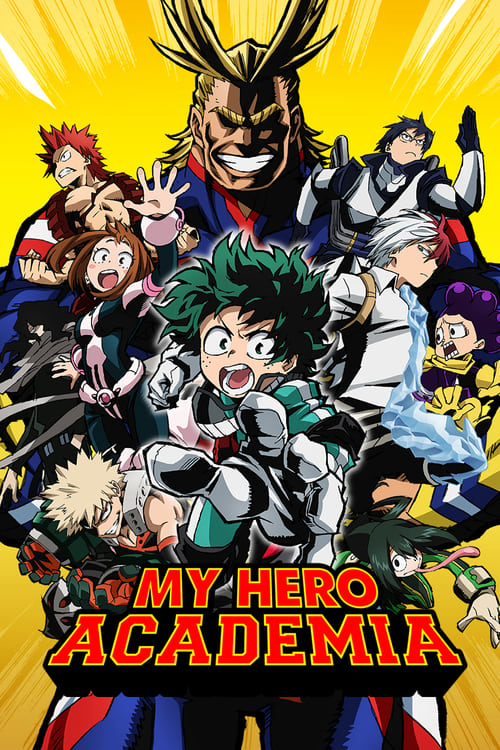
My Hero Academia
A vibrant, action-packed saga where the burning spirit of heroism clashes with the shadows of societal expectation, rendered in a spectacle of kinetic animation and heartfelt emotion.
My Hero Academia
My Hero Academia

僕のヒーローアカデミア

03 April 2016 — 04 October 2025 Japan 8 season 165 episode Returning Series ⭐ 8.6 (5,084)
Cast: Daiki Yamashita, Kaito Ishikawa, Nobuhiko Okamoto, Yuki Kaji, Ayane Sakura
Animation Sci-Fi & Fantasy Action & Adventure
The Nature of Heroism Perseverance and Hard Work Friendship and Rivalry Legacy and Succession

My Hero Academia - Symbolism & Philosophy

Symbols & Motifs

All Might's Smile

Meaning:

It symbolizes hope, peace, and the unwavering confidence of the "Symbol of Peace." It represents the ideal hero who can save people not just physically, but also spiritually by reassuring them that everything will be okay.

Context:

Throughout the early seasons, All Might is famous for always smiling, no matter the danger. Izuku Midoriya learns that this smile is a conscious choice to inspire hope and mask his own fear and pain. The symbol is challenged and eventually passed on as Izuku strives to become a hero who can also save people with a smile.

One For All

Meaning:

This Quirk symbolizes legacy, responsibility, and the collective hope of generations. It is a sacred torch passed down, representing the cumulative power and will of its previous users in the fight against evil.

Context:

The entire series is driven by Izuku's inheritance of One For All. Its history and the vestiges of its past users become a major plot point, especially in later seasons, as Izuku learns he is not just wielding a power, but carrying the dreams and burdens of those who came before him.

Hero Costumes

Meaning:

Hero costumes symbolize a hero's identity, ideology, and their public persona. They often incorporate support items tailored to their Quirks and represent their commitment to the role of a hero.

Context:

From the beginning of their time at U.A., students design their own costumes. Izuku's costume, for example, evolves significantly through the series, reflecting his growth, his control over his Quirk, and his journey to make his inherited power his own. It starts as a tribute to All Might and gradually becomes uniquely his.

Philosophical Questions

What is the true meaning of strength and heroism?

The series constantly challenges the notion that strength is purely physical. Izuku Midoriya begins with no power but possesses immense courage and a desire to help, suggesting heroism is an innate quality of character. The narrative contrasts different heroic ideals: All Might's concept of being a "Symbol of Peace" to inspire hope, Endeavor's obsession with power, and Stain's radical belief in selfless sacrifice. The show asks whether being a hero is about winning, saving, or inspiring, and explores the immense psychological toll this responsibility takes.

Are people defined by their innate abilities or their choices?

In a world where 80% of the population is born with a superpower, a person's identity is heavily tied to their Quirk. The series explores the societal pressure and prejudice that arise from this system, particularly through Izuku's initial Quirkless status. His journey of inheriting a power and working harder than anyone else champions the idea that it's determination and choices, not inherent gifts, that truly define a person. Conversely, characters like Shigaraki, who possess a destructive Quirk, raise questions about nature versus nurture and whether some are destined for villainy.

Can a flawed system of justice create its own villains?

"My Hero Academia" delves into the cracks of its seemingly utopian hero society. It reveals that the system creates outcasts and fosters resentment among those who don't fit the heroic mold or who have been failed by the heroes. Villains like Toga, Twice, and Shigaraki are shown to have tragic backstories, suggesting they are victims of the very society that champions heroes. This raises the question of whether the rigid, commercialized hero system is fundamentally unjust and perpetuates a cycle of violence by creating the very evil it claims to fight.

Core Meaning

HTML formatted.

The core meaning of "My Hero Academia" revolves around the central question of "what makes a hero?". Creator Kōhei Horikoshi explores the idea that heroism is not defined by innate power or talent, but by unwavering determination, self-sacrifice, and the courage to act in the face of fear. The series posits that anyone, regardless of their background or abilities, can become a hero through hard work and a strong will to help others.

It delves into the nature of legacy and responsibility, symbolized by the passing of the torch from one generation to the next, most prominently through the One For All Quirk. The narrative also serves as a critique of a society that commercializes heroism and creates rigid structures, exploring the resulting societal cracks and the villains who emerge from them. Ultimately, the series champions the power of hope, friendship, and the idea that true strength lies not only in saving lives but also in inspiring the spirits of others.