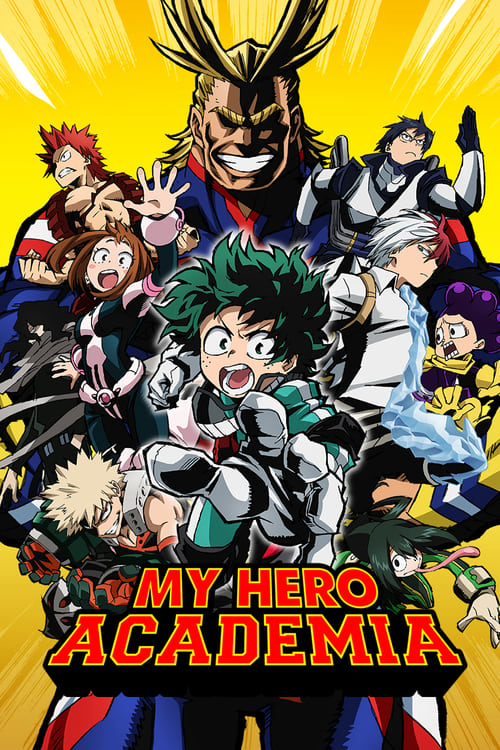
My Hero Academia
A vibrant, action-packed saga where the burning spirit of heroism clashes with the shadows of societal expectation, rendered in a spectacle of kinetic animation and heartfelt emotion.
My Hero Academia

My Hero Academia

僕のヒーローアカデミア

03 April 2016 — 04 October 2025 Japan 8 season 165 episode Returning Series ⭐ 8.6 (5,084)
Cast: Daiki Yamashita, Kaito Ishikawa, Nobuhiko Okamoto, Yuki Kaji, Ayane Sakura
Animation Sci-Fi & Fantasy Action & Adventure
The Nature of Heroism Perseverance and Hard Work Friendship and Rivalry Legacy and Succession

Overview

Set in a world where about 80% of the population has developed superpowers known as "Quirks", "My Hero Academia" follows Izuku Midoriya, a boy born without a Quirk but who dreams of becoming the world's greatest hero. His life changes dramatically after a chance encounter with his idol, the legendary hero All Might. Recognizing Izuku's innate heroism, All Might passes on his own transferable Quirk, "One For All," to the young boy.

The series chronicles Izuku's journey as he enrolls in U.A. High School, a prestigious academy for training the next generation of heroes. Alongside his ambitious and competitive childhood friend-turned-rival, Katsuki Bakugo, and a diverse class of aspiring heroes, Izuku learns to control his powerful but dangerous new abilities. Throughout the seasons, Class 1-A faces numerous threats from the League of Villains, a sinister organization led by All For One and his successor, Tomura Shigaraki. The students are forced to grow rapidly, confronting not only powerful villains but also the complexities and flaws of their hero-worshipping society.

As the story progresses, the conflict escalates into a full-scale war, pushing the young heroes and the entire professional hero system to their limits. The series explores the immense pressures, sacrifices, and moral ambiguities of being a hero, questioning the very foundations of the society they strive to protect. Izuku's path is one of immense struggle, growth, and the discovery of what it truly means to be a symbol of peace in a world teetering on the brink of chaos.
Core Meaning

HTML formatted.

The core meaning of "My Hero Academia" revolves around the central question of "what makes a hero?". Creator Kōhei Horikoshi explores the idea that heroism is not defined by innate power or talent, but by unwavering determination, self-sacrifice, and the courage to act in the face of fear. The series posits that anyone, regardless of their background or abilities, can become a hero through hard work and a strong will to help others.

It delves into the nature of legacy and responsibility, symbolized by the passing of the torch from one generation to the next, most prominently through the One For All Quirk. The narrative also serves as a critique of a society that commercializes heroism and creates rigid structures, exploring the resulting societal cracks and the villains who emerge from them. Ultimately, the series champions the power of hope, friendship, and the idea that true strength lies not only in saving lives but also in inspiring the spirits of others.

Thematic DNA

The Nature of Heroism 40%
Perseverance and Hard Work 30%
Friendship and Rivalry 20%
Legacy and Succession 10%

The Nature of Heroism

The series consistently explores what it truly means to be a hero. It contrasts the idea of winning to save people (prioritizing victory) with saving people to win (prioritizing rescue above all). Characters like Izuku embody the spirit of self-sacrifice, believing a hero's duty is to save not just lives, but also people's spirits. The narrative questions the societal glorification of heroes, revealing them as flawed individuals and exposing the dark side of a hero-based society through characters like the Hero Killer: Stain and the villain Dabi.

Perseverance and Hard Work

A central message of the series is that hard work can overcome a lack of natural talent. Izuku Midoriya, born Quirkless, embodies this theme through his relentless training and studying to become a hero. The series emphasizes that dreams can be achieved through determination and refusing to give up, even when faced with overwhelming odds. This is encapsulated in the U.A. High School motto, "Plus Ultra," which means to always go beyond one's limits.

Friendship and Rivalry

The dynamic between Izuku Midoriya and Katsuki Bakugo is a cornerstone of the series, evolving from a childhood bully-victim relationship to a complex rivalry and eventual mutual respect. Their journey highlights how competition can fuel growth. Furthermore, the strong bonds of friendship and teamwork among the students of Class 1-A are consistently shown to be a source of immense strength, allowing them to overcome challenges that they could not face alone.

Legacy and Succession

The theme of passing the torch to the next generation is central to the plot, symbolized by the One For All Quirk being handed down from All Might to Izuku. This explores the weight of living up to a predecessor's legacy and the responsibility that comes with inherited power. The narrative also examines this through the villainous lineage of All For One and Tomura Shigaraki, and the familial burdens faced by characters like Shoto and Toya Todoroki due to their father, Endeavor.

Character Analysis

Izuku Midoriya (Deku)

Daiki Yamashita

Archetype: The Underdog Hero
Key Trait: Selfless Determination

Motivation

His core motivation is an unwavering, almost reckless desire to save everyone, stemming from his childhood dream of being a hero like All Might. He wants to become a hero who not only wins battles but saves people's hearts and brings them hope with a smile. This evolves into a deeper understanding of his responsibility as the 9th user of One For All, with the added motivation of stopping All For One and saving even the villains from themselves, as seen with his desire to save Tomura Shigaraki.

Character Arc

Izuku begins as a timid, Quirkless boy who is bullied for his heroic aspirations. After inheriting One For All from his idol, All Might, his journey is one of immense struggle to control a power that constantly threatens to destroy his body. He evolves from an insecure and analytical hero-fanboy into a confident and powerful leader. A major turning point is the "Dark Hero" arc, where he attempts to shoulder the entire burden of fighting villains alone, demonstrating a flawed hero complex. He ultimately learns the importance of relying on his friends, solidifying his transformation into a true symbol of hope who understands that saving others also means allowing others to help him.

Katsuki Bakugo (Dynamight)

Nobuhiko Okamoto

Archetype: The Rival/Antihero
Key Trait: Explosive Ambition

Motivation

His initial motivation is a simple and explosive desire to be the undisputed #1 hero, surpassing even All Might through overwhelming victory. He is driven by a need to prove he is the strongest. This motivation evolves as he matures; while he still aims for the top, he learns that true strength isn't just about winning, but also about protecting others and acknowledging the strength of his comrades. He develops a sense of responsibility for All Might's downfall, which fuels his desire to become a hero who wins to save others.

Character Arc

Bakugo starts as an arrogant, aggressive, and supremely talented bully who looks down on Izuku for being Quirkless. His arc is one of the most significant in the series, focusing on humility and deconstructing his superiority complex. Key moments like his kidnapping by the League of Villains, his loss to Izuku, and witnessing All Might's retirement force him to confront his own weaknesses and insecurities. This culminates in him genuinely apologizing to Izuku for years of bullying, acknowledging his own wrongdoing and finally becoming a true rival and partner who values teamwork and recognizes Izuku's strength.

Toshinori Yagi (All Might)

Kenta Miyake

Archetype: The Mentor/The Fading Legend
Key Trait: Inspirational Idealism

Motivation

As a hero, his motivation was to be a pillar of hope that society could rely on, a Symbol of Peace who saves everyone with a smile to counteract the fear and chaos caused by villains. After passing on his power, his motivation shifts to ensuring Izuku can master One For All and become a worthy successor. He is driven by a deep-seated desire to protect the world from All For One and to make up for his past failures, particularly concerning the family of his predecessor, Nana Shimura.

Character Arc

All Might is introduced as the seemingly invincible #1 Hero and the "Symbol of Peace." His arc is about the decline of a legend and the transition into a mentor role. He is forced to confront his own mortality and limitations after passing his Quirk, One For All, to Izuku. His final, devastating battle with his arch-nemesis, All For One, publicly exposes his weakened state and forces him into retirement. His journey then becomes about guiding the next generation, placing his faith in Izuku and learning that his legacy can continue not through his own strength, but through the hero he inspires Izuku to become.

Symbols & Motifs

All Might's Smile

Meaning:

It symbolizes hope, peace, and the unwavering confidence of the "Symbol of Peace." It represents the ideal hero who can save people not just physically, but also spiritually by reassuring them that everything will be okay.

Context:

Throughout the early seasons, All Might is famous for always smiling, no matter the danger. Izuku Midoriya learns that this smile is a conscious choice to inspire hope and mask his own fear and pain. The symbol is challenged and eventually passed on as Izuku strives to become a hero who can also save people with a smile.

One For All

Meaning:

This Quirk symbolizes legacy, responsibility, and the collective hope of generations. It is a sacred torch passed down, representing the cumulative power and will of its previous users in the fight against evil.

Context:

The entire series is driven by Izuku's inheritance of One For All. Its history and the vestiges of its past users become a major plot point, especially in later seasons, as Izuku learns he is not just wielding a power, but carrying the dreams and burdens of those who came before him.

Hero Costumes

Meaning:

Hero costumes symbolize a hero's identity, ideology, and their public persona. They often incorporate support items tailored to their Quirks and represent their commitment to the role of a hero.

Context:

From the beginning of their time at U.A., students design their own costumes. Izuku's costume, for example, evolves significantly through the series, reflecting his growth, his control over his Quirk, and his journey to make his inherited power his own. It starts as a tribute to All Might and gradually becomes uniquely his.

Memorable Quotes

Young man... you too can become a hero.

— All Might

Context:

In Season 1, Episode 2, after Izuku recklessly tries to save Bakugo from the Sludge Villain despite being Quirkless, All Might is inspired by his heroic spirit and delivers this powerful affirmation.

Meaning:

This is the pivotal line that ignites the entire series. For Izuku, who had been told his dream was impossible his entire life, hearing these words from his greatest idol is a moment of profound validation and the true origin of his journey.

It's your power, isn't it?!

— Izuku Midoriya

Context:

During their one-on-one fight at the U.A. Sports Festival in Season 2, Episode 10 (overall episode 23), Izuku yells this at Shoto, who is refusing to use the fire side of his Quirk out of hatred for his father.

Meaning:

This quote is a turning point for Shoto Todoroki. It forces him to reclaim his own identity and power, separate from the abusive legacy of his father, Endeavor. Izuku's words help Shoto realize that his fire Quirk is his own to command, not a tool of his father's ambition.

If all you ever do is look down on people, you won't be able to recognize your own weaknesses.

— Katsuki Bakugo

Context:

In Season 3, during the Provisional Hero License Exam arc, Bakugo says this to a group of younger students who are acting dismissively and arrogantly towards the U.A. students.

Meaning:

This line marks a significant moment of self-awareness and growth for Bakugo. In advising others, he directly confronts the very arrogance that was his greatest flaw for most of the series, showing his evolution from a bully to a maturing hero.

A true hero saves not only their lives, but also their spirits.

— All Might

Context:

This is part of All Might's guiding philosophy, which he imparts to Izuku. It is a recurring idea that shapes Izuku's own heroic ideals throughout the series.

Meaning:

This quote encapsulates the core philosophy of heroism in the series. It defines a hero's duty as something deeper than just physical rescue; it's about providing hope, reassurance, and inspiration to those in need.

Episode Highlights

Izuku Midoriya: Origin

S1E1

The first episode masterfully establishes the series' central conflict and emotional core. It introduces a world of Quirks and the profound despair of Izuku Midoriya, a boy born without one in a superhuman society. His unwavering dream to be a hero, despite the world telling him he can't, is powerfully and emotionally portrayed.

Significance:

This episode sets the entire stage for Izuku's journey. It defines his character, his relationship with Bakugo, and introduces the Symbol of Peace, All Might. It lays the thematic groundwork of perseverance against impossible odds.

Shoto Todoroki: Origin

S2E10

The battle between Izuku and Shoto Todoroki during the U.A. Sports Festival becomes a stunning emotional breakthrough. The episode delves into Shoto's traumatic past and his rebellion against his abusive father, Endeavor. Izuku, in his desire to save Shoto from his own hatred, pushes him to accept his entire self and use his fire Quirk for the first time in combat.

Significance:

This episode is a masterclass in character development, transforming Shoto from a cold and distant rival into one of the series' most complex and compelling characters. It solidifies Izuku's role as someone who saves not just bodies, but also hearts.

All Might

S3E11

This episode features the titanic and devastating final battle between All Might and his arch-nemesis, All For One. Pushed beyond his limits, All Might uses the very last embers of One For All in a final, iconic "United States of Smash" to defeat the villain, revealing his true, emaciated form to the world in the process.

Significance:

This is a major turning point for the series. It marks the end of an era with the retirement of the Symbol of Peace, fundamentally shifting the world's balance and placing the burden of the future squarely on the next generation, particularly Izuku.

His Start

S4E25

Following All Might's retirement, Endeavor struggles to step into the role of the new No. 1 Hero. The episode culminates in his brutal, high-stakes battle against a highly intelligent Nomu. Endeavor pushes past his limits to secure a hard-won victory, signaling a potential path to redemption and acceptance to the public.

Significance:

This episode begins the long and complex redemption arc for Endeavor, one of the show's most controversial characters. It also ends with a significant cliffhanger: Izuku having a vision of the past users of One For All, setting up a massive new element of his power.

Dabi's Dance

S6E11

During the climax of the Paranormal Liberation War, the villain Dabi hijacks the airwaves to reveal his true identity: Toya Todoroki, Endeavor's eldest son who was thought to be dead. He gleefully exposes his father's history of abuse to the world, shattering the public's already fragile trust in heroes.

Significance:

This reveal is one of the most significant and shocking plot twists in the entire series. It cripples hero society's morale at a critical moment and brings the Todoroki family's tragic story to the forefront of the main conflict, personally devastating both Endeavor and Shoto.

Philosophical Questions

What is the true meaning of strength and heroism?

The series constantly challenges the notion that strength is purely physical. Izuku Midoriya begins with no power but possesses immense courage and a desire to help, suggesting heroism is an innate quality of character. The narrative contrasts different heroic ideals: All Might's concept of being a "Symbol of Peace" to inspire hope, Endeavor's obsession with power, and Stain's radical belief in selfless sacrifice. The show asks whether being a hero is about winning, saving, or inspiring, and explores the immense psychological toll this responsibility takes.

Are people defined by their innate abilities or their choices?

In a world where 80% of the population is born with a superpower, a person's identity is heavily tied to their Quirk. The series explores the societal pressure and prejudice that arise from this system, particularly through Izuku's initial Quirkless status. His journey of inheriting a power and working harder than anyone else champions the idea that it's determination and choices, not inherent gifts, that truly define a person. Conversely, characters like Shigaraki, who possess a destructive Quirk, raise questions about nature versus nurture and whether some are destined for villainy.

Can a flawed system of justice create its own villains?

"My Hero Academia" delves into the cracks of its seemingly utopian hero society. It reveals that the system creates outcasts and fosters resentment among those who don't fit the heroic mold or who have been failed by the heroes. Villains like Toga, Twice, and Shigaraki are shown to have tragic backstories, suggesting they are victims of the very society that champions heroes. This raises the question of whether the rigid, commercialized hero system is fundamentally unjust and perpetuates a cycle of violence by creating the very evil it claims to fight.

Alternative Interpretations

One significant alternative interpretation of the series frames the Hero Society not as an ideal to strive for, but as a deeply flawed and unsustainable system. This reading suggests that the society's over-reliance on a few powerful heroes like All Might creates a fragile peace and that its commercialization of heroism fosters corruption and inequality. The Hero Killer: Stain's ideology, while extreme, is viewed by some as a legitimate critique of "fake heroes" who are motivated by fame and fortune rather than true altruism. From this perspective, the villains are not simply evil, but rather products of a society that has failed them, raising questions about whether the system itself is the true antagonist.

Another interpretation focuses on the Quirk Doomsday Theory, a concept mentioned within the series that suggests Quirks will become too powerful and complex to control with each new generation. This can be read as a metaphor for unchecked technological or societal advancement, leading to an inevitable collapse. The escalating power levels of both heroes and villains throughout the series can be seen as evidence supporting this apocalyptic trajectory, suggesting a more cynical or cautionary tale beneath the optimistic superhero narrative.

Cultural Impact

"My Hero Academia" premiered in 2016 and quickly became a global phenomenon, significantly influencing modern anime culture. Its success is partly attributed to its clever fusion of classic Japanese shōnen storytelling with the aesthetics and tropes of Western superhero comics, making it highly accessible to international audiences. The series has been a commercial juggernaut, with its manga selling over 100 million copies, making it one of the best-selling manga series of all time.

The show revitalized the superhero subgenre within anime, leading to a surge in popularity and inspiring countless fan works, from cosplay and fan art to online discussions and fan fiction. However, its immense popularity also led to what some have termed the "My Hero Academia Effect," where the fandom's size and enthusiasm became a target for "cringe culture," leading some fans to abandon the series due to negative stereotypes associated with the community.

Critically, the series has received widespread praise for its compelling character development, intricate world-building, and high-quality animation by Studio Bones. It is often considered a great entry point for newcomers to anime. As the series heads into its final season, there is significant discussion about its legacy, especially concerning the controversial ending of the manga. Creator Kōhei Horikoshi has stated he will be more involved in the anime's final season, potentially altering or adding scenes to address these criticisms and solidify the series' place as a modern shōnen classic.

Audience Reception

"My Hero Academia" has enjoyed overwhelmingly positive reception from audiences and critics since its 2016 debut, frequently cited as one of the best anime of the modern era. Early seasons were lauded for their heartfelt storytelling, optimistic tone, and compelling character introductions, particularly the journey of Izuku Midoriya. The U.A. Sports Festival arc in Season 2 is often highlighted as a peak moment for its brilliant character development and intense action.

As the series progressed, the tone became darker, especially from Season 4 onwards. The reception to later seasons has been more divided, though still largely positive. Some viewers praised the increased stakes and deeper exploration of the flaws in hero society, particularly during the Paranormal Liberation War arc in Season 6. However, some criticism was directed at the pacing of Season 5, which was considered slower by some fans. The "Dark Hero" arc, where Izuku operates alone, was also a point of discussion, with many appreciating the emotional weight but some finding it deviated from the core theme of teamwork.

Despite some criticism leveled at the manga's conclusion, the anime has maintained a loyal and massive global fanbase. It is praised for its high-quality animation by Studio Bones, memorable musical scores (like the track "You Say Run"), and its successful blend of superhero action and emotional, character-driven drama.

Interesting Facts

  • The series creator, Kōhei Horikoshi, is a huge fan of American superhero comics and movies, drawing inspiration from properties like Spider-Man, Star Wars, and X-Men.
  • Izuku Midoriya's character was originally conceived as an adult salaryman named Jack Midoriya who would fight crime using gadgets instead of a Quirk.
  • Katsuki Bakugo was initially designed to be a kind and gentle character, but Horikoshi changed his personality to be rude and aggressive to create more interesting character dynamics in the class.
  • The character designs for Tsuyu Asui (Froppy) and Toru Hagakure (Invisible Girl) were originally intended to be for male characters.
  • The name "Deku" was originally an insult from Bakugo, derived from a Japanese term for a useless puppet. Ochaco Uraraka re-contextualized it for Izuku, saying it sounded like the word for "you can do it" (dekiru), which inspired him to adopt it as his hero name.
  • Creator Kōhei Horikoshi based the anxious personality of the character Tamaki Amajiki on his own experiences with social anxiety, particularly after facing a large crowd at Jump Festa in 2017.
  • Many character names in the series are puns or references to their Quirks or personalities. For example, Katsuki Bakugo's name contains the kanji for "bomb" (爆 baku) and "powerful" (豪 gō).
  • The animation for the series is produced by Studio Bones, a renowned studio also known for animating series like "Fullmetal Alchemist: Brotherhood" and "Mob Psycho 100".

Easter Eggs

Tatooine Station

In the very first season, a train station named "Tatooine Station" is shown. This is a direct and overt reference to the desert planet Tatooine from Star Wars, one of creator Kōhei Horikoshi's major influences.

Alien and Marvel/DC Comics References

There are numerous subtle nods to Western pop culture. For example, Mina Ashido was almost named "Ridley Hero Alien Queen" as a reference to Ridley Scott and the Xenomorph Queen from the Alien films. The design of the villain All For One has drawn many comparisons to Darth Vader, and Toga's blood-sucking equipment is a nod to the villain Bane from Batman.

Reused Character Designs

Some character designs in My Hero Academia were reused or inspired by characters from Horikoshi's earlier, less successful manga series, Oumagadoki Zoo. For example, the pro hero Uwabami is visually similar to a snake character from his previous work.

⚠️ Spoiler Analysis

Click to reveal detailed analysis with spoilers

Frequently Asked Questions

Explore More About This Movie

Dive deeper into specific aspects of the movie with our detailed analysis pages

Comments (0)

Leave a comment

No comments yet. Be the first to share your thoughts!