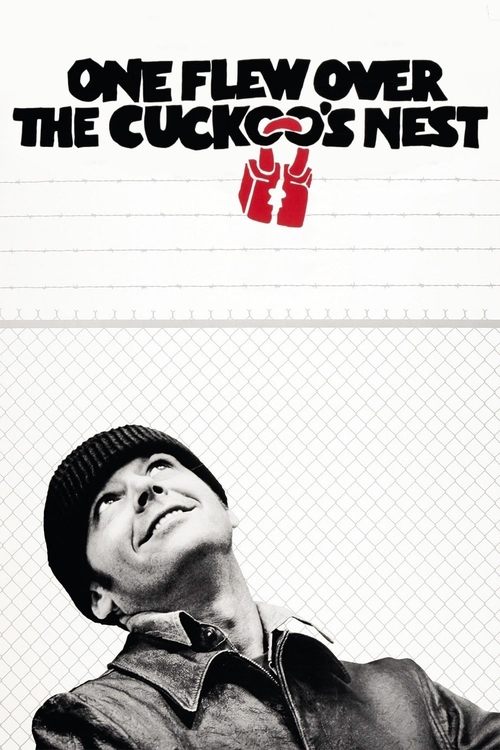
One Flew Over the Cuckoo's Nest
A visceral cry for freedom echoing through the sterile halls of a mental institution, where one man's defiant laughter becomes a spark of rebellion against the crushing weight of conformity.
One Flew Over the Cuckoo's Nest

"If he's crazy, what does that make you?"

19 November 1975 United States of America 133 min ⭐ 8.4 (10,973)
Director: Miloš Forman
Cast: Jack Nicholson, Brad Dourif, Louise Fletcher, Danny DeVito, William Redfield
Drama
Individuality vs. Conformity The Nature of Sanity and Insanity Power and Authority Emasculation and Sexuality
Budget: $3,000,000
Box Office: $108,981,275

One Flew Over the Cuckoo's Nest - Ending Explained

⚠️ Spoiler Analysis

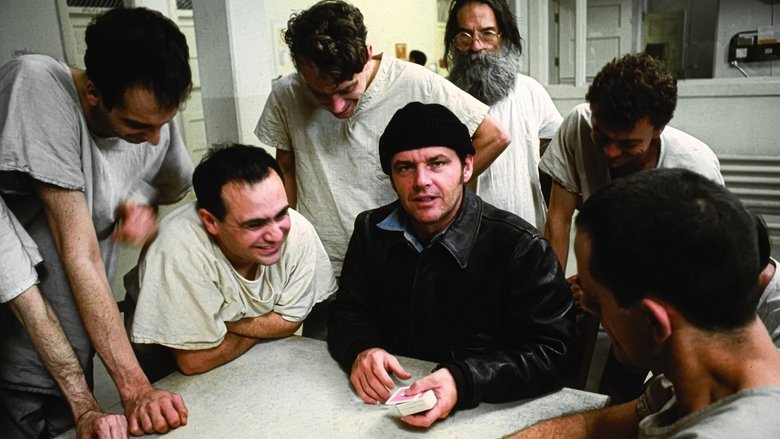
The plot of "One Flew Over the Cuckoo's Nest" culminates in a devastating sequence of events. After a night of defiant partying on the ward, which McMurphy arranges with prostitutes and alcohol, Nurse Ratched discovers the scene the next morning. She finds the gentle, stuttering Billy Bibbit in bed with a prostitute, Candy. Instead of showing compassion, Ratched shames Billy, threatening to tell his domineering mother. This threat completely shatters Billy's newfound confidence, and in a moment of despair, he commits suicide.

Enraged by Ratched's callous indifference to Billy's death, McMurphy violently attacks her and attempts to strangle her. The orderlies subdue him before he can kill her. This final act of rebellion gives the institution the justification it needs to permanently neutralize him. In the film's most chilling turn, McMurphy is subjected to a lobotomy. He is returned to the ward as a silent, empty shell of his former self. Believing that McMurphy would never want to live in such a state, and to prevent the institution from using him as a symbol of their ultimate power, Chief Bromden performs a mercy killing by smothering McMurphy with a pillow. In the film's final, triumphant moment, the Chief, now imbued with McMurphy's spirit of defiance, rips the massive hydrotherapy console from the floor—the same one McMurphy couldn't budge—and hurls it through the window, escaping into the dawn. McMurphy's physical death leads to the Chief's spiritual and literal rebirth, fulfilling the film's central message that the fight for freedom, even when it results in martyrdom, can liberate others.

Alternative Interpretations

While the dominant interpretation sees McMurphy as a heroic martyr fighting an evil system, some alternative readings offer a more nuanced perspective. One interpretation views Nurse Ratched not as purely evil, but as a bureaucrat who genuinely, if misguidedly, believes that her methods are necessary to maintain order and provide stability for a group of very ill patients. From this viewpoint, McMurphy is a chaotic and dangerously disruptive force whose actions, while liberating for some, directly lead to the tragic death of Billy Bibbit.

Another perspective, particularly when considering Ken Kesey's original novel, is that the story is less about mental illness and more a broad allegory for societal oppression. The hospital is a microcosm of a conformist society (the 'Combine') that systematically crushes individuality. A feminist critique has also emerged over the years, arguing that the film perpetuates misogynistic tropes by portraying the primary female authority figure as a 'castrating' villain who is ultimately overcome by male rebellion and sexual violence.