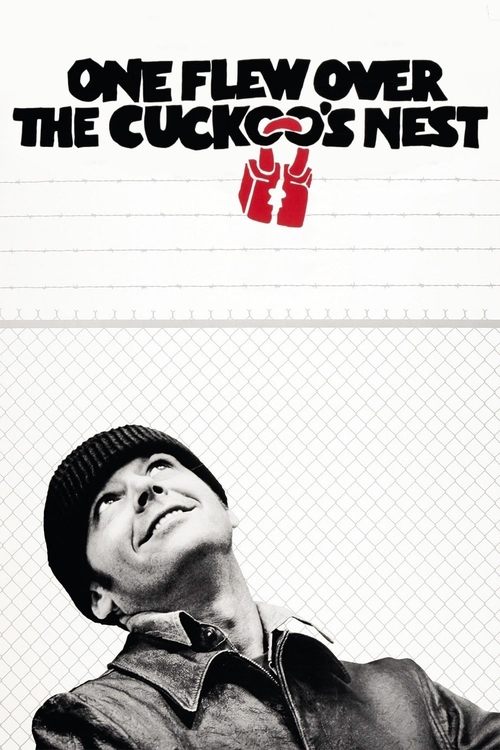
One Flew Over the Cuckoo's Nest
A visceral cry for freedom echoing through the sterile halls of a mental institution, where one man's defiant laughter becomes a spark of rebellion against the crushing weight of conformity.
One Flew Over the Cuckoo's Nest

One Flew Over the Cuckoo's Nest

"If he's crazy, what does that make you?"

19 November 1975 United States of America 133 min ⭐ 8.4 (10,973)
Director: Miloš Forman
Cast: Jack Nicholson, Brad Dourif, Louise Fletcher, Danny DeVito, William Redfield
Drama
Individuality vs. Conformity The Nature of Sanity and Insanity Power and Authority Emasculation and Sexuality
Budget: $3,000,000
Box Office: $108,981,275

Overview

Miloš Forman's acclaimed 1975 film, "One Flew Over the Cuckoo's Nest," is a powerful and poignant drama that explores the themes of individuality versus institutional authority. The story follows Randle P. McMurphy (Jack Nicholson), a rebellious and charismatic criminal who feigns insanity to serve his sentence in a mental institution, believing it to be an easier alternative to prison. Once inside, he is confronted by the oppressive and tyrannical Nurse Ratched (Louise Fletcher), who rules the ward with an iron fist, manipulating and intimidating the patients into submission.

McMurphy's vibrant and defiant spirit quickly clashes with Nurse Ratched's rigid control. He befriends his fellow patients, including the timid Billy Bibbit (Brad Dourif) and the seemingly deaf and mute Chief Bromden (Will Sampson), and encourages them to challenge the institution's dehumanizing routines. Through acts of rebellion, both small and large, McMurphy breathes life and a sense of self-worth back into the downtrodden men. His actions create a palpable tension and a struggle for power that escalates, forcing a confrontation that will have profound and lasting consequences for everyone on the ward. The film is a stirring and often humorous, yet ultimately tragic, examination of the human spirit's fight for freedom in the face of suffocating conformity.
Core Meaning

"One Flew Over the Cuckoo's Nest" serves as a powerful allegory for the struggle of the individual against oppressive systems of control. The film, directed by Miloš Forman who had experienced totalitarian rule in his native Czechoslovakia, critiques institutional authority that stifles personal freedom and enforces conformity. McMurphy's rebellion is not just against Nurse Ratched, but against a society that demands obedience and labels nonconformists as 'insane' or 'unfit'. The central message is a celebration of the human spirit, suggesting that true sanity lies in embracing one's individuality, even if it comes at a great personal cost. McMurphy's ultimate sacrifice becomes a catalyst for the liberation of others, particularly Chief Bromden, symbolizing that the fight for freedom, even if lost by one, can inspire it in others.

Thematic DNA

Individuality vs. Conformity 35%
The Nature of Sanity and Insanity 30%
Power and Authority 25%
Emasculation and Sexuality 10%

Individuality vs. Conformity

The central conflict of the film is the clash between Randle McMurphy's fierce individuality and Nurse Ratched's demand for absolute conformity. McMurphy represents a life force of freedom, sexuality, and self-determination, which directly threatens the sterile, controlled environment of the ward. He encourages patients to embrace their unique personalities and question authority, while Nurse Ratched uses shame, manipulation, and medical procedures to suppress any form of dissent and maintain order. This theme explores whether societal institutions help or hinder the individual and at what cost conformity is achieved.

The Nature of Sanity and Insanity

The film deliberately blurs the lines between sanity and insanity, questioning who has the authority to define them. McMurphy, who is feigning mental illness, often appears more sane and full of life than the oppressive staff. Many of the patients are in the hospital voluntarily, too afraid of the outside world to leave, suggesting that their 'illness' is a product of societal pressure and fear. The film posits that the institution itself, with its rigid and dehumanizing rules, may be the true source of madness, while acts of rebellion and embracing one's 'craziness' can be a path to liberation.

Power and Authority

"One Flew Over the Cuckoo's Nest" is a stark examination of the abuse of power. Nurse Ratched represents a tyrannical authority figure who uses her position to control and dominate others. Her methods are not overtly violent at first but rely on psychological manipulation, public shaming, and the withholding of privileges to maintain her power. McMurphy directly challenges this authority, not just for his own sake, but to empower the other patients. The film explores the corrupting nature of absolute power and the courage required to resist it, even when the odds are insurmountably stacked against you.

Emasculation and Sexuality

A significant undercurrent in the film is the theme of emasculation. Nurse Ratched's control over the male patients is often portrayed as a form of symbolic castration, stripping them of their confidence, virility, and autonomy. McMurphy, with his overt sexuality and machismo, directly confronts this. His arrangement for Billy Bibbit to lose his virginity is a deliberate act to restore Billy's manhood and defy Ratched's repressive regime. McMurphy's final, violent assault on Ratched, where he rips her uniform, is a desperate, climactic attempt to expose her as a fallible woman rather than an all-powerful, sexless symbol of authority.

Character Analysis

Randle P. McMurphy

Jack Nicholson

Archetype: Anti-hero / Christ Figure
Key Trait: Rebellious Charisma

Motivation

Initially motivated by self-preservation and a desire to avoid hard labor, McMurphy's primary motivation becomes the desire for freedom—not just for himself, but for his fellow patients. He is driven by an innate rebelliousness and a profound sense of justice, seeking to dismantle Nurse Ratched's oppressive regime and restore the men's sense of manhood and individuality.

Character Arc

McMurphy begins as a self-serving con man looking for an easy way to serve his sentence. However, as he witnesses the dehumanizing effect of Nurse Ratched's rule, his motivations shift. He evolves from a selfish rebel into a selfless leader and ultimately a martyr who sacrifices his own freedom and life to liberate the spirits of the other patients. His journey is a tragic one, moving from sanity and power to becoming a helpless victim of the system he fought against.

Nurse Mildred Ratched

Louise Fletcher

Archetype: Antagonist / Tyrant
Key Trait: Manipulative Control

Motivation

Nurse Ratched is motivated by an obsessive need for order, control, and power. She believes her methods are for the patients' own good, but her actions are rooted in a desire to suppress any behavior that deviates from her rigid standards. She seeks to maintain a sterile, predictable environment by breaking the spirits of those who challenge her, viewing individuality and spontaneity as threats to her authority.

Character Arc

Nurse Ratched's character remains largely static throughout the film, representing the unyielding and oppressive nature of the institution. She begins as the ward's absolute ruler and, despite McMurphy's challenges, ultimately reasserts her control, albeit at a physical and psychological cost. Her arc is not one of change, but of revealing the true, cold extent of her tyranny when her authority is threatened, culminating in her decision to have McMurphy lobotomized rather than admit defeat.

Chief Bromden

Will Sampson

Archetype: The Silent Observer / The Successor
Key Trait: Latent Strength

Motivation

Initially, Chief is motivated by fear and a desire to hide from the oppressive world he calls "The Combine." After being inspired by McMurphy's relentless spirit, his motivation shifts to regaining his own freedom and honoring McMurphy's sacrifice. His final act is driven by love and the realization that he must escape to truly live.

Character Arc

Chief Bromden begins the film as a towering but seemingly broken man, pretending to be deaf and mute to remain invisible to the system that crushed his father. Through his growing friendship with McMurphy, he slowly regains his voice, his strength, and his will to live. His arc is one of profound transformation, moving from silent submission to empowered action. He ultimately becomes the true victor, carrying on McMurphy's legacy by physically breaking out of the institution.

Billy Bibbit

Brad Dourif

Archetype: The Innocent / The Victim
Key Trait: Fearful Timidity

Motivation

Billy is motivated by a desperate desire for approval and a crippling fear of authority, particularly female authority figures like his mother and Nurse Ratched. He craves the freedom and confidence that McMurphy represents but is ultimately unable to overcome the deep-seated shame and fear instilled in him.

Character Arc

Billy is a young, deeply insecure man with a severe stutter, dominated by his overbearing mother and, by extension, Nurse Ratched. Under McMurphy's influence, he experiences a brief but profound moment of confidence and self-worth after losing his virginity. However, his arc is ultimately tragic. When Nurse Ratched threatens to tell his mother, his newfound courage shatters, and he regresses into fear, leading to his suicide. His death is the catalyst for the film's climax.

Symbols & Motifs

The Fog Machine (more prominent in the novel)

Meaning:

In the novel, the fog symbolizes the state of mental confusion, conformity, and escape from reality that Nurse Ratched imposes on the patients. It represents a loss of insight and individuality, a way for the patients to hide from the harsh realities of their situation and Ratched's control.

Context:

Chief Bromden frequently hallucinates a thick fog rolling into the ward, controlled by the staff. McMurphy's arrival and actions are seen as an attempt to clear this fog, to force the men to see and confront their reality rather than hiding in a medicated haze.

The Hydrotherapy Control Panel

Meaning:

The massive, unmovable control panel symbolizes the oppressive and seemingly insurmountable power of the institution. It represents the system that holds the patients captive.

Context:

McMurphy makes a bet with the other patients that he can lift the heavy marble panel and throw it through a window to escape, but fails. At the end of the film, after McMurphy has been lobotomized, Chief Bromden, inspired by McMurphy's spirit, successfully lifts the panel and uses it to break free, symbolizing that McMurphy's rebellion, while costing him his life, ultimately empowered others to achieve freedom.

Gambling and Games

Meaning:

Gambling and games serve as a motif for rebellion and McMurphy's approach to life. They represent risk-taking, the assertion of free will, and the challenging of established rules. McMurphy's entire life is a gamble against the system.

Context:

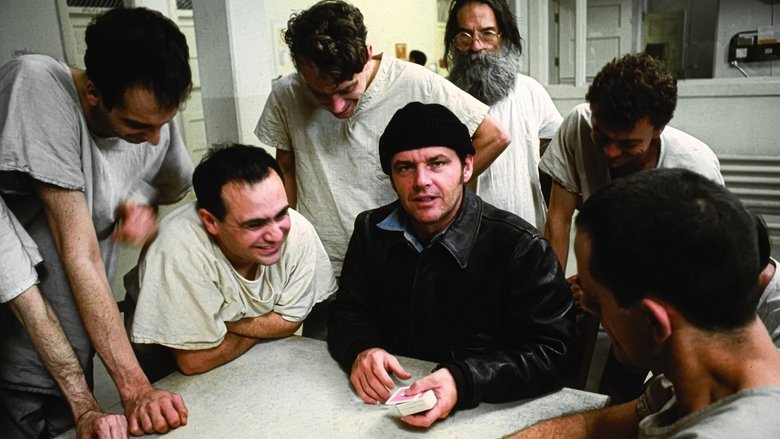
McMurphy constantly organizes card games, bets on various outcomes (like lifting the control panel), and turns therapy sessions and chores into contests. The most significant instance is his organization of the basketball game and the unauthorized fishing trip, which are direct acts of defiance that foster camaraderie and a sense of freedom among the patients.

Christian Symbolism

Meaning:

McMurphy is often interpreted as a Christ-like figure who sacrifices himself for the salvation of others. His actions are meant to redeem the other patients from their state of despair and submission.

Context:

Several scenes allude to Christian iconography. The fishing trip involves twelve "disciples." McMurphy undergoes electroconvulsive therapy on a table shaped like a cross, which can be seen as a form of crucifixion. His final act of being smothered by Chief is a mercy killing that allows his spirit of rebellion to live on and inspires Chief's "resurrection" into the outside world.

Memorable Quotes

What do you think you are, for Chrissake, crazy or somethin'? Well you're not! You're not! You're no crazier than the average asshole out walkin' around on the streets and that's it.

— Randle P. McMurphy

Context:

McMurphy says this during a group therapy session after learning that many of the patients are committed voluntarily. He is shocked that they are too afraid to leave and tries to instill in them a sense of self-worth and normalcy, challenging the very foundation of the institution's power over them.

Meaning:

This quote encapsulates one of the film's central themes: the arbitrary line between sanity and insanity. McMurphy dismisses the clinical labels placed on the men, arguing that their fears and anxieties are no different from those of people in the 'sane' world. It's a powerful moment of validation for the patients.

But it's the truth even if it didn't happen.

— Chief Bromden (in the novel)

Context:

Chief Bromden prefaces his narration with this statement, asking the reader to trust his perspective despite his acknowledged mental state. It establishes the novel's tone and validates the subjective, allegorical nature of the story he is about to tell.

Meaning:

This line, from the novel's narrator Chief Bromden, speaks to the idea of a deeper, metaphorical truth that transcends literal events. It suggests that his hallucinatory visions, while not factually real, accurately capture the oppressive and dehumanizing reality of the hospital and the 'Combine' (his term for society).

First Charles Cheswick and now William Bibbit! I hope you're finally satisfied. Playing with human lives—gambling with human lives—as if you thought of yourself to be a God!

— Nurse Ratched

Context:

Nurse Ratched directs this accusation at McMurphy in the chaotic aftermath of finding Billy Bibbit dead. Her cold, calculated words are the final provocation that causes McMurphy to physically attack her, sealing his own fate.

Meaning:

This quote reveals Nurse Ratched's masterful ability to deflect blame and use manipulation. After her threats drive Billy to suicide, she immediately frames McMurphy as the responsible party, twisting his attempts to liberate the men into a reckless, god-like game. It is a chilling display of her psychological cruelty.

He knows that you have to laugh at the things that hurt you just to keep yourself in balance, just to keep the world from running you plumb crazy.

— Dale Harding (in the novel, attributed to McMurphy's philosophy)

Context:

This is part of Harding's analysis of McMurphy's character and his impact on the ward. He recognizes that McMurphy's seemingly flippant and comical defiance is actually a profound and necessary survival tactic.

Meaning:

This quote explains the philosophical core of McMurphy's rebellion. Laughter is his weapon against despair and oppression. It's a mechanism for maintaining sanity and perspective in an insane world. By laughing at his oppressors, he robs them of their power to intimidate him.

Philosophical Questions

What is the true definition of sanity, and who has the right to define it?

The film relentlessly questions societal standards of 'normalcy'. McMurphy feigns insanity but acts with more vitality and humanity than his 'sane' caretakers. The other patients are often victims of societal and familial pressure rather than being clinically 'insane'. The film suggests that sanity is not about conformity but about self-awareness, freedom of expression, and the courage to be oneself. It forces the audience to question whether the true madness lies within the individuals or the institution that seeks to control them.

Is rebellion against an oppressive system justified even if it leads to tragic consequences?

McMurphy's rebellion brings joy, laughter, and a sense of self-worth to the patients, but it also leads directly to Billy Bibbit's suicide and McMurphy's own lobotomy. The film doesn't offer an easy answer. It presents the moral complexity of the struggle for freedom. While McMurphy is ultimately destroyed by the system, his actions inspire Chief Bromden to escape. This raises the question of whether a moral victory and the liberation of one person is worth the ultimate sacrifice of another, suggesting that the spirit of rebellion is a vital human impulse, regardless of the cost.

To what extent can an individual's spirit overcome institutional dehumanization?

The core of the film is the battle between McMurphy's indomitable spirit and the institution's efforts to crush it. For most of the film, his spirit seems to be winning, as he awakens the dormant humanity in the other patients. However, the institution has the final say with the lobotomy, a procedure that physically destroys the part of the brain associated with personality and spirit. The film's ending is ambiguous on this point. While McMurphy's individual spirit is extinguished, it is transferred to Chief Bromden, who carries it out into the world. This suggests that while an institution can destroy an individual, the spirit of freedom itself is harder to kill.

Alternative Interpretations

While the dominant interpretation sees McMurphy as a heroic martyr fighting an evil system, some alternative readings offer a more nuanced perspective. One interpretation views Nurse Ratched not as purely evil, but as a bureaucrat who genuinely, if misguidedly, believes that her methods are necessary to maintain order and provide stability for a group of very ill patients. From this viewpoint, McMurphy is a chaotic and dangerously disruptive force whose actions, while liberating for some, directly lead to the tragic death of Billy Bibbit.

Another perspective, particularly when considering Ken Kesey's original novel, is that the story is less about mental illness and more a broad allegory for societal oppression. The hospital is a microcosm of a conformist society (the 'Combine') that systematically crushes individuality. A feminist critique has also emerged over the years, arguing that the film perpetuates misogynistic tropes by portraying the primary female authority figure as a 'castrating' villain who is ultimately overcome by male rebellion and sexual violence.

Cultural Impact

Released in 1975, "One Flew Over the Cuckoo's Nest" perfectly captured the post-Vietnam and Watergate era's anti-establishment sentiment, resonating deeply with a public distrustful of authority. The film became a cultural phenomenon and a powerful critique of the psychiatric system, contributing to a growing public skepticism of institutions and treatments like electroconvulsive therapy and lobotomies. The movie is considered a landmark of the 'New Hollywood' era, characterized by its realism, complex characters, and challenging themes.

Its influence on cinema is immense. It solidified Jack Nicholson's status as a counter-cultural icon and a leading man. The film's success, winning all five major Academy Awards, proved that challenging, character-driven dramas could be both critically acclaimed and commercially successful. The characters of McMurphy and Nurse Ratched have become archetypes in popular culture, representing the rebellious free spirit and the cold, oppressive bureaucrat, respectively. The film's narrative of an individual battling a dehumanizing system has been echoed in countless subsequent films and television shows. Despite criticism for its portrayal of mental illness and gender dynamics, the film remains a potent and enduring parable about the fight for human dignity.

Audience Reception

Upon its release, "One Flew Over the Cuckoo's Nest" was met with widespread critical acclaim and became a major box office success, resonating with the anti-establishment mood of the 1970s. Audiences and critics alike praised the powerful performances by Jack Nicholson and Louise Fletcher, the masterful direction of Miloš Forman, and the film's compelling blend of comedy and tragedy. The film is considered by many to be one of the greatest films ever made.

However, the film has also faced criticism. Some viewers find its portrayal of mental illness to be simplistic and outdated, arguing that it uses the patients as caricatures for a larger social allegory. There have also been critiques regarding its perceived misogyny, with Nurse Ratched being seen as a stereotypical 'evil woman' who is punished for being in a position of power. Despite these criticisms, the film's powerful themes of rebellion, individuality, and freedom continue to connect with audiences, making it an enduring and frequently discussed classic.

Interesting Facts

  • The film was shot on location at the Oregon State Hospital, a real psychiatric hospital, which is also the setting of the novel. Many extras and supporting cast members were actual patients and staff.
  • Dr. Dean Brooks, the actual superintendent of the hospital at the time, was cast as Dr. Spivey. He was instrumental in ensuring the film's authenticity and even diagnosed actor William Redfield (Harding) with leukemia on set.
  • Ken Kesey, the author of the novel, famously disliked the film adaptation because it shifted the narrative perspective from Chief Bromden to McMurphy, thereby losing much of the novel's allegorical content about 'The Combine'.
  • "One Flew Over the Cuckoo's Nest" was the first film in 41 years to win all five major Academy Awards: Best Picture, Best Director, Best Actor, Best Actress, and Best Adapted Screenplay.
  • Jack Nicholson and director Miloš Forman frequently clashed on set over the direction of McMurphy's character, leading to a period where they refused to speak to each other directly.
  • Many of the group therapy scenes were filmed with multiple cameras capturing the actors' spontaneous reactions, as Forman often didn't tell them when the cameras were rolling to achieve a more naturalistic feel.
  • Louise Fletcher was a relatively unknown actress before being cast as Nurse Ratched. Many established actresses, including Anne Bancroft, Ellen Burstyn, and Angela Lansbury, had turned down the role.
  • Danny DeVito was the first actor cast, reprising his role from the 1971 off-Broadway production. During the long shoot, he developed an imaginary friend to cope with being away from his then-girlfriend, Rhea Perlman.
  • The famous fishing trip scene was the last one filmed and was initially opposed by director Miloš Forman, who feared it would lessen the impact of the ward's claustrophobia.

Easter Eggs

Anjelica Huston, who was Jack Nicholson's girlfriend at the time, has an uncredited cameo.

She can be seen among the crowd of people on the pier as the fishing boat returns to the dock. It's a small, personal detail connecting the film's star to his real life at the time of production.

⚠️ Spoiler Analysis

Click to reveal detailed analysis with spoilers

Frequently Asked Questions

Explore More About This Movie

Dive deeper into specific aspects of the movie with our detailed analysis pages

Comments (0)

Leave a comment

No comments yet. Be the first to share your thoughts!