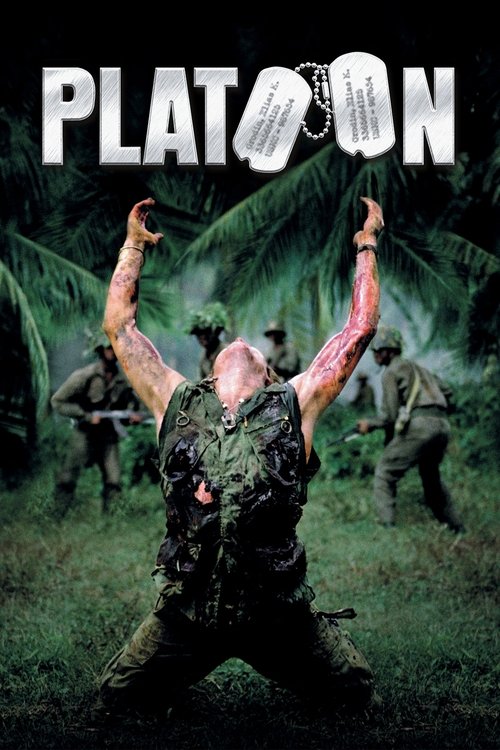
The Betrayal: During a chaotic firefight, Barnes finds Elias alone in the jungle. Knowing Elias plans to report him for killing a civilian, Barnes shoots Elias in the chest and leaves him for dead, telling the others the enemy did it. The Revelation: As the platoon is extracted, Taylor sees a wounded Elias emerge from the treeline, chased by NVA soldiers. Elias is gunned down while reaching toward the helicopter—Taylor realizes from Barnes's face that he is responsible. The Climax: In the final enemy overrun of the base, chaos reigns. Taylor is wounded but survives a suicide bombing. The next morning, he finds a wounded Barnes crawling away. Barnes challenges him to 'do it.' Taylor shoots Barnes dead, exacting revenge. The Ending: Taylor is medevaced out, weeping, having killed his 'evil father' but leaving with a soul forever scarred by the act.
"The first casualty of war is innocence."
Director: Oliver Stone
Cast: Charlie Sheen, Willem Dafoe, Tom Berenger, Kevin Dillon, Forest Whitaker
Platoon — Ending Explained
⚠️ Spoiler Analysis
Alternative Interpretations
The 'Tainted Survivor' Theory: While the ending narration sounds hopeful ('find a goodness and meaning'), some critics argue that Taylor's murder of Barnes proves he has been permanently corrupted. He didn't defeat the monster; he became one to survive. Thus, the 'goodness' he seeks is a desperate, perhaps impossible, attempt to wash away the sin of that final act.
The Religious Allegory: The film can be read as a passion play. Elias is the Christ figure (benevolent, crucified, resurrected in memory), Barnes is the Beast/Antichrist (marked by scars, cannot die, rules by fear), and Taylor is the disciple whose soul is the prize. The platoon itself is a purgatory where these spiritual forces wage war.
The Marxist/Class Lens: The platoon represents the working class ('the bottom of the barrel') sent to die for an imperialist machine. The internal conflict is less about morality and more about the fragmentation of the proletariat under extreme duress, with the 'lifers' (Barnes) enforcing the system's brutality while the 'heads' (Elias) attempt to escape it through counter-culture (drugs/music).
Explore More About This Movie
Dive deeper into specific aspects of the movie with our detailed analysis pages