
Skip to content
Psycho Killer
A grim highway-country slasher where grief hardens into pursuit: a widowed trooper drives Kansas backroads after a killer who treats murder as liturgy, headlights sweeping an endless dark.
Psycho Killer
Psycho Killer

"He’s coming for you."

20 February 2026 United States of America 91 min 6.7 (212)

Director: Gavin Polone

Cast: Georgina Campbell, James Preston Rogers, Malcolm McDowell, Logan Miller, Grace Dove

Crime Mystery Horror Grief as engine and as trap Evil as vocation and performance Belief, recruitment and organized fanaticism The vulnerability of ordinary American space Carrying life into a death spiral
Budget: $10,000,000
Box Office: $2,376,805

Psycho Killer — Ending Explained

⚠️ Spoiler Analysis

Full spoilers follow.

The film opens by killing Jane Archer's husband, a state trooper, during a routine traffic stop on a rural Kansas road. Archer, a highway patrol officer herself and pregnant, sets out to find the man responsible. The early investigation plays as grounded procedural revenge: a widow working a case she should not be working.

The first major reveal is that the murderer is not a random roadside killer but a serial murderer known as the Satanic Slasher, and that his depravity has a structure. He is not accumulating victims out of compulsion alone; he is working toward a culminating act. The second reveal widens the frame further: he is connected to an organized Satanic apparatus, embodied by Malcolm McDowell's High Priest, who recruits believers by planting coded messages in newspaper classified sections. What looked like one man is revealed as a network with a recruitment pipeline and a doctrine.

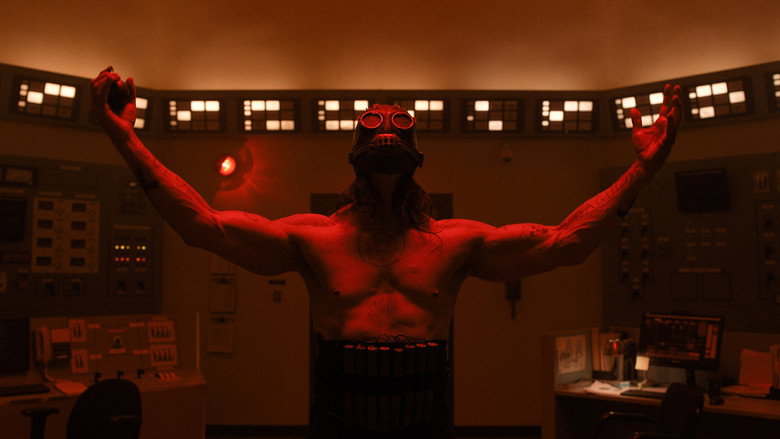
The third-act turn is the film's most contested move. The Slasher's 'masterpiece' — the mass murder meant to guarantee him a triumphant entry into hell — is an engineered catastrophe at a nuclear power plant, and the story escalates into a scenario involving the facility, political extremists and a larger conspiracy. The intimate manhunt becomes a race against a regional-scale disaster, effectively swapping genres from revenge thriller to high-concept disaster picture.

The ending: Archer, still pregnant, faces the Slasher in a tense standoff at the plant. She wounds him and prevents the meltdown, stopping the blast and surviving. The film closes on her survival rather than on the dismantling of the cult around him.

What the ending clarifies in retrospect: the title's 'psycho killer' is a smaller entity than the film's actual subject. The Slasher is a delivery mechanism for a belief system; his murders were never the plan, only preparation for it. The coded classifieds seeded earlier stop being atmosphere and become the load-bearing explanation for how a private pathology acquired the resources to threaten a reactor. And Archer's pregnancy, treated early as vulnerability, resolves as the film's thematic counterweight: the woman who stops an annihilation is the one literally carrying continuation. Notably, the resolution neutralizes the individual and the immediate blast but leaves the priest's recruitment apparatus unaddressed — which is part of why many viewers found the conclusion unsatisfying as well as improbable.

Alternative Interpretations

The tonal break as failure versus as design. The dominant critical reading treats the shift from grounded revenge thriller to high-concept nuclear-disaster climax as a collapse — evidence of a rushed or incoherent script. A more generous reading takes the escalation as intentional: the film is arguing that a killer with an ideology cannot be contained by the genre that introduced him, so the movie itself has to rupture into something larger. Under that reading, the 'absurd' ending is the point, since the Slasher's own ambition is absurd by design.

The Slasher as believer versus as narcissist. One can take his Satanic framework literally — he is a devotee whose masterpiece is an offering. Or one can read the theology as decoration on ordinary vanity: hell is simply the only audience grand enough to flatter him, and the cult around him exists to tell him he is significant. The film supports both, since his patron supplies doctrine while his behavior suggests he mostly wants to be remembered.

The priest as puppetmaster versus as parasite. McDowell's character can be understood as the true author of the atrocity, quietly directing a useful psychopath. Alternatively, he is an opportunist attaching a movement to violence that would have happened anyway, harvesting a killer's compulsions for recruitment material.

Archer's victory as triumph versus as containment. She survives, wounds the Slasher and prevents the blast. Read optimistically, that is a clean win for endurance over nihilism. Read darkly, she has only stopped one execution of a plan whose ideology, network and recruitment channel remain fully intact.

Explore More About This Movie

Dive deeper into specific aspects of the movie with our detailed analysis pages

Similar Movies