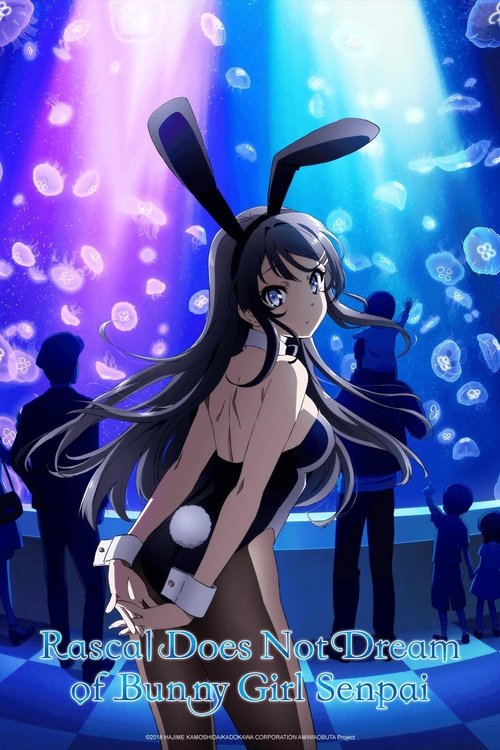
Rascal Does Not Dream of Bunny Girl Senpai
A melancholic slice-of-life where quantum physics poetically visualizes the invisible scars of adolescence, creating a bittersweet dreamscape of love and acceptance.
Rascal Does Not Dream of Bunny Girl Senpai

青春ブタ野郎はバニーガール先輩の夢を見ない

04 October 2018 — 27 September 2025 Japan 2 season 26 episode Ended ⭐ 8.5 (1,265)
Cast: Kaito Ishikawa, Asami Seto, Nao Toyama, Atsumi Tanezaki, Maaya Uchida
Drama Animation Comedy Mystery
The Psychology of Adolescence Empathy and Human Connection Love, Sacrifice, and Causality Observation and the Nature of Reality

Rascal Does Not Dream of Bunny Girl Senpai - Ending Explained

⚠️ Spoiler Analysis

The central mystery of the entire series revolves around Shoko Makinohara. The TV series finale suggests she might be a figment of Sakuta's imagination, but the sequel film "Rascal Does Not Dream of a Dreaming Girl" reveals the full, complex truth. Young Shoko suffers from a severe heart condition and has a short life expectancy. Her Puberty Syndrome manifests from her anxiety about the future, allowing her to experience or simulate potential futures. The older Shoko that Sakuta knows is the result of a successful heart transplant in one of these futures.

The first major timeline reveals that Sakuta was fated to die in a car accident on Christmas Eve, and his heart would be donated to Shoko, allowing her to live. The adult Shoko travels back in time to prevent this. In the new timeline, Mai, realizing Sakuta is about to be hit by the car, pushes him out of the way and dies in his place. Mai's heart is then donated to Shoko. Sakuta is left devastated, and the adult Shoko from this timeline helps him travel back in time once more to save Mai.

In the final, definitive timeline, Sakuta prevents his own death without Mai having to intervene. This creates a paradox: with no donor, young Shoko is now fated to die. However, Sakuta and Mai, retaining dream-like memories of the other timelines, resolve to find a different way to save her. Their experiences inspire Mai to star in a film about organ donation awareness. This film becomes a success, encouraging more people to become donors and leading to a donor being found for Shoko, saving her life without the sacrifice of any main character. The series' end shows that their shared memories and love created a new, better future, breaking the tragic cycle of fate.

Alternative Interpretations

One of the primary points of alternative interpretation, especially during the TV series' run, was the nature of Shoko Makinohara's existence. Before the "Dreaming Girl" movie provided a canonical explanation, a popular theory, supported by Rio Futaba in the show, was that the older Shoko was merely a figment of Sakuta's imagination—a coping mechanism created by his own Puberty Syndrome to deal with the trauma of Kaede's situation. This interpretation viewed Shoko's timely appearances and perfectly comforting advice as evidence that she was an idealized projection of what Sakuta needed to hear during moments of crisis.

Another interpretation views the quantum physics explanations not as literal plot devices but as a purely metaphorical language used by the characters to intellectualize emotional problems that are too complex to face directly. In this reading, concepts like Schrödinger's Cat or Laplace's Demon are simply the characters' way of rationalizing irrational feelings of loneliness, anxiety, and helplessness. The "science" is a shield, and the real solutions are always purely emotional, found through love, courage, and connection, rendering the scientific explanations as clever but ultimately irrelevant window dressing.