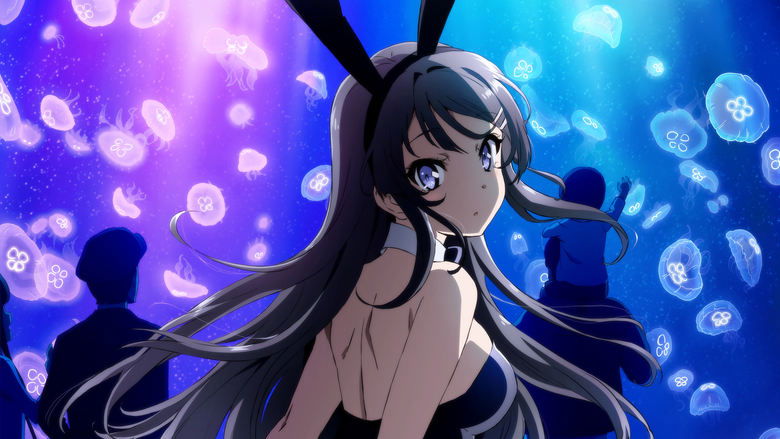

Rascal Does Not Dream of Bunny Girl Senpai
A melancholic slice-of-life where quantum physics poetically visualizes the invisible scars of adolescence, creating a bittersweet dreamscape of love and acceptance.
Rascal Does Not Dream of Bunny Girl Senpai

Rascal Does Not Dream of Bunny Girl Senpai

青春ブタ野郎はバニーガール先輩の夢を見ない

04 October 2018 — 27 September 2025 Japan 2 season 26 episode Ended ⭐ 8.5 (1,265)
Cast: Kaito Ishikawa, Asami Seto, Nao Toyama, Atsumi Tanezaki, Maaya Uchida
Drama Animation Comedy Mystery
The Psychology of Adolescence Empathy and Human Connection Love, Sacrifice, and Causality Observation and the Nature of Reality

Overview

"Rascal Does Not Dream of Bunny Girl Senpai" follows Sakuta Azusagawa, a cynical but compassionate high school student whose life is upended when he encounters senior student and famous actress Mai Sakurajima wandering in a library dressed as a bunny girl, an outfit nobody else can see. He learns she is a victim of "Puberty Syndrome," a mysterious phenomenon where adolescent insecurities and emotional turmoil manifest as supernatural experiences. Mai's condition, stemming from a desire to escape the pressures of fame, is causing her existence to be progressively forgotten by everyone around her.

Sakuta, whose own sister Kaede suffers from a different form of the syndrome, decides to help Mai. This act draws him into the lives of other girls, each grappling with their own unique manifestation of Puberty Syndrome, from inexplicable time loops and doppelgängers to body-swapping. As Sakuta forges deep connections and applies a mix of empathy and pseudo-scientific reasoning, he helps them confront the root causes of their pain—social anxiety, cyberbullying, inferiority complexes, and trauma.

The narrative extends beyond the initial TV series into a series of crucial sequel films that delve into Sakuta's own past trauma and his relationship with Shoko Makinohara, his first love who mysteriously reappears as both a middle schooler and a young woman. The overarching story becomes a poignant exploration of sacrifice, the nature of memory, and the profound impact people have on each other's reality, forcing Sakuta to make heart-wrenching choices to protect those he loves from the paradoxes of their shared conditions.


Core Meaning

The core meaning of "Rascal Does Not Dream of Bunny Girl Senpai" is an exploration of empathy as the antidote to the anxieties and isolation of modern adolescence. The series uses the supernatural concept of "Puberty Syndrome" as a metaphor for real-world psychological struggles such as depression, social anxiety, and the fear of being forgotten or misunderstood. Each supernatural event is a physical manifestation of a character's inner turmoil, invisible to a world that often encourages conformity and ignoring the pain of others.

The creators convey that true connection and healing come from genuinely seeing, acknowledging, and accepting others for who they are and the pain they carry. Sakuta's role is not to "cure" the girls with clever tricks, but to be the one person who doesn't look away, who listens, and who validates their existence. Through its blend of witty dialogue, quantum mechanics analogies, and heartfelt drama, the series argues that while the struggles of growing up are deeply personal, they are not insurmountable, and that the bonds of love and friendship have the power to ground individuals and rewrite their perceived reality.

Thematic DNA

The Psychology of Adolescence 35%
Empathy and Human Connection 30%
Love, Sacrifice, and Causality 25%
Observation and the Nature of Reality 10%

The Psychology of Adolescence

The entire series is built around this theme, with "Puberty Syndrome" serving as a direct allegory for the psychological and social pressures faced by teenagers. Each character's affliction corresponds to a specific real-world issue. Mai's invisibility stems from social anxiety and the pressure of fame. Tomoe Koga's time loop is born from her fear of social ostracization and her desire to maintain the status quo. Rio Futaba splits into two people due to insecurities about her appearance and the desire for validation online. Kaede's memory loss and physical injuries are the result of severe cyberbullying and trauma. The series meticulously dissects these internal conflicts, showing how they warp the characters' perception of reality.

Empathy and Human Connection

Sakuta's defining trait is his unwavering empathy. While the world "reads the atmosphere" and ignores those who are suffering, Sakuta actively confronts their pain. His refusal to forget Mai, his willingness to relive a time loop for Tomoe, and his patient care for Kaede demonstrate that connection is the solution to the isolation caused by Puberty Syndrome. The series posits that being seen and accepted by even one person can be enough to overcome profound personal crises. The emotional climax of each arc is not the disappearance of the supernatural phenomenon, but the moment of genuine emotional connection between Sakuta and the affected girl.

Love, Sacrifice, and Causality

This theme is central to the sequel film, "Rascal Does Not Dream of a Dreaming Girl." The story confronts Sakuta with an impossible choice involving his love for Mai and his debt to his first crush, Shoko Makinohara. The film explores multiple timelines where Sakuta sacrifices himself for Shoko, and Mai sacrifices herself for Sakuta, demonstrating the depths of their love. Ultimately, the resolution involves creating a new timeline where their memories of these sacrifices, retained as dreams, inspire actions that save everyone. It suggests that even erased events have meaning and that selfless love can alter destiny, challenging deterministic views of fate with a message of hope.

Observation and the Nature of Reality

The series uses concepts from quantum physics, like Schrödinger's Cat, as a recurring metaphor for how reality is shaped by perception. Mai becomes invisible because society collectively stops observing her. Sakuta keeps her in existence by continuing to see her. This is not presented as hard science but as a philosophical framework. It questions whether existence is purely objective or if it requires subjective acknowledgment. Sakuta's grand gesture of shouting his love for Mai in the schoolyard is a powerful assertion that forceful, heartfelt observation can redefine reality for someone on the verge of disappearing.

Character Analysis

Sakuta Azusagawa

Kaito Ishikawa

Archetype: The Pragmatic Healer
Key Trait: Deadpan Empathy

Motivation

Initially, Sakuta is motivated by a mix of curiosity and a sense of kinship with those suffering from Puberty Syndrome, as it afflicted his own family. As he develops a deep love for Mai, his primary motivation becomes protecting her and their relationship. This expands to include a fierce desire to help all the friends he makes. His ultimate motivation, revealed in the films, is to create a future where everyone he cares about—Mai, Kaede, and Shoko—can be happy, even if it requires him to endure immense emotional pain or alter the very fabric of his existence.

Character Arc

Sakuta begins as a social outcast, jaded and lethargic due to a past incident that left him with physical and emotional scars. He maintains a deadpan exterior to navigate school life without issue. His journey begins when he decides to help Mai, an act that reawakens his deeply empathetic nature. Throughout the series and movies, his arc is one of opening himself up to others and confronting his own trauma surrounding his sister and his first love, Shoko. He evolves from a passive observer to an active agent who fights against fate, culminating in the "Dreaming Girl" movie where he is willing to sacrifice his own life and reality to save the people he loves, ultimately maturing into a young man defined by his quiet, unwavering devotion.

Mai Sakurajima

Asami Seto

Archetype: The Stoic Star
Key Trait: Tsundere Grace

Motivation

Mai's initial motivation is simply to solve the mystery of her invisibility and return to a semblance of normal life. After falling in love with Sakuta, her motivation shifts to supporting him and building a future together. She is driven by a strong sense of loyalty and a desire to protect Sakuta from the emotional burdens he takes upon himself, often acting as his anchor to reality and providing the emotional support he rarely asks for but desperately needs.

Character Arc

Mai is introduced as a famous actress on hiatus, projecting a mature, serious, and often sharp-tongued personality to shield her vulnerability. Her arc is about learning to be honest with her own feelings and trusting someone enough to let them into her isolated world. Initially wanting to be left alone, she grows to rely on Sakuta's steadfast presence. She evolves from someone who represses her emotions to someone who can openly express her love, jealousy, and fear. In the "Dreaming Girl" movie, her character culminates in an act of ultimate selflessness, proving she values Sakuta's life above her own and solidifying her transformation from an isolated individual to a deeply loving partner.

Kaede Azusagawa

Yurika Kubo

Archetype: The Innocent in Recovery
Key Trait: Resilient Fragility

Motivation

The amnesiac Kaede is motivated by a desire to overcome her fears for her brother's sake, creating a list of goals to achieve. The original Kaede, after reawakening, is motivated by the desire to live up to the courage of her other self and to reconnect with the world she lost, particularly by deciding which high school is right for her own future, not just the one her brother attended.

Character Arc

Kaede's arc is split between two personas. We first meet the amnesiac "panda" Kaede, a timid girl confined to the house by agoraphobia resulting from past bullying. Her journey is about taking small, brave steps to re-engage with the world, culminating in her goal to attend school. A pivotal, heartbreaking twist reveals that her success causes her original memories to return, erasing the personality Sakuta had spent two years with. The arc of the "original" Kaede, explored in the movie "Sister Venturing Out," is then about grappling with a two-year memory gap and finding her own path forward, distinct from the persona she lost, showing her own form of strength and resilience.

Shoko Makinohara

Inori Minase

Archetype: The Ghost of Past and Future
Key Trait: Gentle Resolve

Motivation

The young Shoko is motivated by a simple desire to live and experience the things other children do. The older Shoko is motivated by a deep, selfless love for Sakuta; she appears in his life to guide him through his darkest moments, a kindness born from a future where he saved her life. Her ultimate motivation is to create a world where Sakuta can be happy, which paradoxically means finding a way for herself to live without him having to die.

Character Arc

Shoko is the most mysterious character, existing in two forms: a sweet middle schooler with a terminal heart condition and a gentle young woman from the future who is Sakuta's first crush. Her Puberty Syndrome stems from her fear of death and her inability to envision a future. Her arc, primarily in the "Dreaming Girl" movie, reveals that her future self exists because she received a heart transplant from a donor—in one timeline, Sakuta; in another, Mai. Her journey is one of coming to terms with her own mortality and desires, ultimately choosing to relinquish a future built on Sakuta's or Mai's sacrifice. The final resolution sees her saved not by a tragic transplant, but by a change in the past that inspires hope and action, allowing her to live on her own terms.

Symbols & Motifs

The Bunny Girl Costume

Meaning:

The bunny suit symbolizes Mai's desperate attempt to be seen and the inherent paradox of her condition. It's a provocative, attention-grabbing outfit that *should* make her impossible to ignore, yet it fails, proving the severity of her invisibility. It also represents her reclaiming of agency; she wears it on her own terms to test a theory, subverting an image often associated with objectification into a tool for her own purpose. After the first arc, the suit becomes a private symbol of the beginning of her bond with Sakuta.

Context:

The costume is primarily used in the first episode when Mai wanders the library to see if anyone will notice her. Though she rarely wears it again, it remains the series' most iconic image. It is referenced later as a potential "reward" for Sakuta, becoming a playful inside joke that signifies their unique connection.

Schrödinger's Cat

Meaning:

This thought experiment is used as the primary scientific metaphor for Mai's existence. Just as the cat in the box is simultaneously alive and dead until observed, Mai is both existing and non-existing to the world. Her state is a superposition of possibilities that only collapses into a defined reality (existence) when someone, in this case Sakuta, actively observes her. The metaphor extends to their relationship, which remains in an uncertain state until they both observe and confess their feelings for each other.

Context:

Rio Futaba explains the concept to Sakuta in the first arc (Episodes 1-3) to provide a framework for understanding Mai's invisibility. It is frequently referenced when discussing the nature of Puberty Syndrome and how perception influences reality throughout the series.

Sakuta's Chest Scars

Meaning:

The three large claw-like scars on Sakuta's chest symbolize his own traumatic experience with Puberty Syndrome and his deep empathy for his sister, Kaede. The wounds mysteriously appeared on his body when Kaede was suffering from the physical effects of cyberbullying. They are a physical manifestation of his emotional pain and the psychological burden he took on in response to his family's crisis. The scars reopening signifies a moment of intense emotional distress, particularly related to the potential loss of a loved one.

Context:

The scars are a permanent part of Sakuta's character design. They are a physical reminder of his past, which has given him a reputation as a delinquent. His scar bleeds again at the end of the TV series (Episode 13) after he grieves the loss of the "panda" Kaede personality, which triggers the appearance of Shoko Makinohara.

Memorable Quotes

I don't mind if I only had one person. Even if the whole world hated me, I could keep living if that person needed me.

— Sakuta Azusagawa

Context:

Said to Mai Sakurajima in Season 1, Episode 2, as he explains his perspective on being a social outcast and why he is unfazed by the negative rumors surrounding him.

Meaning:

This quote encapsulates Sakuta's core philosophy. It's not about being popular or liked by everyone, but about the profound value of a single, genuine human connection. It defines his devotion to Mai and becomes the guiding principle for how he helps others.

It's not like I live for all of humanity to like me.

— Sakuta Azusagawa

Context:

This is one of Sakuta's signature phrases, said multiple times throughout the series, most notably during his conversations with Mai in the first arc (Episodes 1-3).

Meaning:

A concise summary of Sakuta's rebellious attitude towards social pressure and the unspoken rules of conformity ('reading the atmosphere'). It highlights his individualism and becomes a lesson he imparts to others struggling with the fear of judgment.

I'm going to live on cherishing the phrases 'Thank you,' 'You did your best,' and 'I love you.'

— Shoko Makinohara

Context:

Shoko says this to Sakuta on the beach when they first meet years before the series begins, and it is a recurring sentiment in the "Dreaming Girl" movie.

Meaning:

This represents Shoko's philosophy of life, born from her fragile existence. It's a conscious choice to focus on kindness, gratitude, and affirmation. These words become a source of comfort and a life lesson for Sakuta. The quote gains deeper meaning in the "Dreaming Girl" movie when it's revealed Sakuta himself taught her this way of thinking in one timeline, creating a causal loop of kindness.

I want them to forget about me. But I don't want to be forgotten.

— Mai Sakurajima

Context:

Mai expresses this sentiment to Sakuta in Season 1, Episode 2 while explaining her feelings about her career hiatus and the onset of her invisibility.

Meaning:

This perfectly captures the contradiction at the heart of Mai's Puberty Syndrome. She desires a respite from the overwhelming pressure of being a celebrity, but at the same time, she fears the absolute isolation of being completely erased from everyone's memory. It's a deeply human and relatable paradox about wanting peace without suffering loneliness.

Episode Highlights

My Senpai is a Bunny Girl

S1E1

The first episode masterfully establishes the series' tone, central conceit, and character dynamics. Sakuta's fateful encounter with Mai in her bunny suit in the library is an iconic opening. The witty, rapid-fire dialogue between them immediately sets their relationship apart from typical anime romances, introducing a blend of deadpan humor and underlying sincerity.

Significance:

This episode introduces the core mystery of Puberty Syndrome and establishes Sakuta as a protagonist who, despite his cynical narration, is willing to involve himself in the supernatural problems of others. It lays the groundwork for the entire series' exploration of adolescent angst through a sci-fi lens.

The World Without You

S1E3

This episode is the emotional climax of Mai's arc. As the world's memory of Mai fades completely, Sakuta fights against sleep to avoid forgetting her. When he inevitably fails and forgets, he pieces together his memories and makes a desperate, public confession of love in the schoolyard, forcing the entire student body to acknowledge her existence once more.

Significance:

It powerfully demonstrates the series' central theme: one person's profound acknowledgment can redefine another's reality. Sakuta's confession is not just a romantic gesture but a direct challenge to the social apathy that caused Mai's condition, solidifying their bond and setting the stakes for future arcs.

This World You Chose

S1E6

The conclusion of Tomoe Koga's arc, where she and Sakuta are trapped reliving the same day. Tomoe's desire to avoid upsetting her friends by rejecting a popular boy has created a time loop. Sakuta helps her find the courage to be true to her own feelings, even if it means disrupting social harmony.

Significance:

This episode delves into the theme of conformity and the pressure to "read the atmosphere." It shows that true self-respect comes from making honest choices, rather than perpetually trying to please others. It also deepens Sakuta's character by showing his willingness to endure a complex situation to help a friend.

The Kaede Quest

S1E11

Focusing on Kaede's recovery, this episode follows her attempts to achieve the goals on her list, such as answering the phone and leaving the house. It's a gentle, emotionally resonant episode that highlights the deep and loving bond between Sakuta and his sister.

Significance:

This episode provides a heartfelt look at the slow, non-linear process of recovering from trauma. It's a crucial setup for the dramatic events of the final episodes, making the audience deeply invested in the version of Kaede we have come to know.

The Dawn After an Endless Night

S1E13

The season finale delivers a devastating emotional blow. Kaede successfully achieves her goal of going to school, but this triggers the return of her original memories, completely erasing the personality and memories of the Kaede who lived with Sakuta for two years. Sakuta is left heartbroken, grieving a version of his sister that is effectively gone.

Significance:

This bittersweet ending concludes Kaede's recovery arc while highlighting the theme of loss and the complex nature of identity. It leaves Sakuta in a state of profound grief, directly leading into the appearance of Shoko Makinohara and setting the stage for the sequel movie, "Rascal Does Not Dream of a Dreaming Girl."

Philosophical Questions

Does observation define reality?

The series consistently explores the idea that a person's existence and reality are validated and solidified through the act of being observed and remembered by others. Mai's invisibility is a direct result of being "unobserved" by her peers. Sakuta's conscious effort to keep seeing her, and later forcing the entire school to see her, literally pulls her back into a stable reality. This raises the question of whether an individual's identity is self-contained or a social construct that ceases to exist without external acknowledgment.

Can you escape fate through sacrifice and love?

The "Dreaming Girl" movie delves into questions of determinism versus free will. Several timelines are presented where a tragic outcome seems inevitable: either Sakuta dies, Mai dies, or Shoko dies. The plot suggests that fate is a powerful force, but not an absolute one. The characters' repeated acts of self-sacrifice, driven by profound love for one another, create ripples that eventually lead to a new, unforeseen future. The series seems to argue that while we may not be able to control every outcome, selfless love and the hope it inspires can create possibilities that defy a predetermined tragic fate.

What constitutes a person's identity?

Kaede's story arc directly tackles the concept of identity. The amnesiac Kaede develops her own unique personality, memories, and goals over two years. When the original Kaede's memories return, the other persona is lost, leading Sakuta to grieve her as a separate, deceased individual. This raises questions about what makes a person: is it their original set of memories, or the consciousness and experiences they accumulate? The series treats both Kaedes as valid individuals, suggesting that identity is a fluid and complex state, not just a static collection of past data.

Alternative Interpretations

One of the primary points of alternative interpretation, especially during the TV series' run, was the nature of Shoko Makinohara's existence. Before the "Dreaming Girl" movie provided a canonical explanation, a popular theory, supported by Rio Futaba in the show, was that the older Shoko was merely a figment of Sakuta's imagination—a coping mechanism created by his own Puberty Syndrome to deal with the trauma of Kaede's situation. This interpretation viewed Shoko's timely appearances and perfectly comforting advice as evidence that she was an idealized projection of what Sakuta needed to hear during moments of crisis.

Another interpretation views the quantum physics explanations not as literal plot devices but as a purely metaphorical language used by the characters to intellectualize emotional problems that are too complex to face directly. In this reading, concepts like Schrödinger's Cat or Laplace's Demon are simply the characters' way of rationalizing irrational feelings of loneliness, anxiety, and helplessness. The "science" is a shield, and the real solutions are always purely emotional, found through love, courage, and connection, rendering the scientific explanations as clever but ultimately irrelevant window dressing.

Cultural Impact

"Rascal Does Not Dream of Bunny Girl Senpai" made a significant impact on its release in 2018, distinguishing itself from other high school dramas with its mature tone, sharp dialogue, and unique blend of supernatural mystery and psychological realism. It is frequently compared to the acclaimed "Monogatari" series due to its verbose protagonist and its structure of solving supernatural afflictions affecting various girls, though it is often praised for being more grounded and emotionally direct.

The series received positive reception from both critics and audiences for its sensitive and nuanced handling of mental health issues like anxiety, trauma, and dissociative identity disorder, using the "Puberty Syndrome" as an effective and relatable metaphor. The central romance between Sakuta and Mai is widely celebrated as one of the most well-developed and healthy relationships in modern anime, praised for its mutual respect, witty banter, and genuine emotional support. This subverted many common romance tropes and resonated strongly with viewers looking for more mature storytelling.

The show's popularity led to theatrical releases for its sequel movies in Japan and limited runs internationally, a testament to its dedicated fanbase. It has left a lasting legacy as a series that successfully uses supernatural elements not for spectacle, but to tell a deeply human story about the pain of growing up and the vital importance of seeing and connecting with others.

Audience Reception

"Rascal Does Not Dream of Bunny Girl Senpai" was very well-received by audiences, quickly becoming a fan-favorite of the 2018 anime season. Viewers overwhelmingly praised the series for its intelligent and witty dialogue, especially the dynamic between Sakuta and Mai, which was lauded as refreshingly mature and realistic. Sakuta was frequently highlighted as a standout protagonist for his pragmatic, non-judgmental, and empathetic nature, avoiding many of the clichés of the male harem or light novel lead.

The primary points of praise were the emotional depth and the sensitive handling of complex themes like social anxiety, bullying, and mental health. While the supernatural premise drew viewers in, it was the grounded, human stories that earned the show its acclaim. The first arc focusing on Mai is often considered a masterpiece of character drama.

Minor criticisms were sometimes directed at the use of quantum physics terminology, with some viewers finding it pretentious or a weak justification for the supernatural events. Others felt that some of the later arcs in the TV series were not as compelling as Mai's initial story. However, the emotional climax of Kaede's arc in the final episodes was widely praised for its heartbreaking and effective execution. The sequel movie, "Rascal Does Not Dream of a Dreaming Girl," was also highly praised for providing a powerful and satisfying continuation and conclusion to the Shoko storyline.

Interesting Facts

  • The series is based on a light novel series written by Hajime Kamoshida, who also created the popular series "The Pet Girl of Sakurasou".
  • The anime's setting is meticulously based on real-world locations in and around Fujisawa and the island of Enoshima in Kanagawa Prefecture, Japan. Fans have created extensive pilgrimages to visit the exact spots depicted in the show.
  • The animation studio, CloverWorks, is also known for producing other popular anime like "Horimiya," "Spy × Family," and "Bocchi the Rock!".
  • While the anime TV series covers the first five volumes of the light novel, the story is continued through three sequel movies: "Dreaming Girl," "Sister Venturing Out," and "Knapsack Kid," which adapt volumes 6 through 9.
  • In a small crossover reference, Sakuta and Mai's trip to Ōgaki in Episode 2 features the station and bridge prominently featured in the critically acclaimed anime film "A Silent Voice".

⚠️ Spoiler Analysis

Click to reveal detailed analysis with spoilers

Frequently Asked Questions

Explore More About This Movie

Dive deeper into specific aspects of the movie with our detailed analysis pages

Comments (0)

Leave a comment

No comments yet. Be the first to share your thoughts!