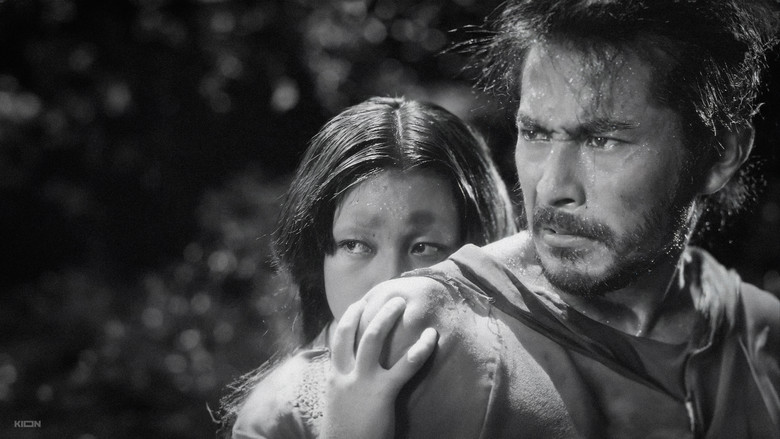

羅生門
"The husband, the wife… or the bandit?"
Director: Akira Kurosawa
Cast: Toshirō Mifune, Machiko Kyō, Takashi Shimura, Masayuki Mori, Minoru Chiaki
Rashomon — Characters & Cast
Character Analysis
Tajōmaru (the bandit)
Toshirō Mifune
Motivation
Tajōmaru is driven by his base desires for lust, power, and notoriety. He wants to be seen as a formidable and legendary outlaw, and his version of the events is crafted to support this image. His motivation is rooted in a deep-seated ego and a desire to control the narrative of his own life and crimes.
Character Arc
Tajōmaru is a notorious bandit who remains largely unchanged throughout the film. His arc is more of a performance; he consistently presents himself as a powerful, dominant figure. His testimony is a boastful and self-aggrandizing account of his prowess as a lover and a fighter. Even when facing capture and likely execution, his primary concern is maintaining his fearsome reputation.
Masako Kanazawa (the wife)
Machiko Kyō
Motivation
Masako's primary motivation is to preserve her honor and navigate the aftermath of her traumatic experience. Her conflicting portrayals suggest a complex interplay of shame, anger, and a desire for agency in a situation where she has been powerless. She seeks validation for her actions and to escape the judgment of the men around her.
Character Arc
Masako's character is presented through multiple, contradictory lenses. In her own testimony, she is a shamed and hysterical victim. In the other accounts, she is portrayed as manipulative and even murderous. Her arc is one of desperation and a struggle for survival in a patriarchal society. Her motivations and true nature remain ambiguous, making her one of the film's most enigmatic figures.
Takehiro Kanazawa (the samurai)
Masayuki Mori
Motivation
The samurai is motivated by a strict adherence to the Bushido code of honor. His actions, and his interpretation of events, are entirely dictated by this code. His primary concern is the preservation of his dignity and social standing, even in death. He would rather be seen as a victim of a tragic, self-inflicted fate than a man who was defeated in a dishonorable fight.
Character Arc
The samurai's arc is one of profound dishonor and despair, as told through the medium. He begins as a respected nobleman and ends as a tragic figure who, according to his own testimony, takes his own life due to the shame of his wife's violation and her subsequent betrayal. His story is one of a man whose rigid code of honor is shattered by events beyond his control.
The Woodcutter
Takashi Shimura
Motivation
The woodcutter's initial motivation is self-preservation; he fears getting entangled in a murder investigation. However, his conscience weighs heavily on him, compelling him to reveal what he saw. His final act of adopting the abandoned baby is motivated by a desire to atone for his earlier dishonesty and to affirm his own belief in the potential for good in the world.
Character Arc
The woodcutter initially presents himself as a neutral observer, but it is later revealed that he is also an unreliable narrator who lied to avoid involvement and to conceal his own theft of the valuable dagger. His arc is one of grappling with guilt and ultimately choosing a path of redemption. He represents the ordinary person caught in extraordinary circumstances, who is capable of both selfishness and profound altruism.
The Priest
Minoru Chiaki
Motivation
The priest is motivated by a deep-seated belief in humanity and a desire to find meaning and goodness in a seemingly chaotic and corrupt world. He is a seeker of truth and is deeply troubled by the moral decay he witnesses. His motivation is to reconcile his faith with the harsh realities of human nature.
Character Arc
The priest's arc is a journey from unwavering faith to profound disillusionment and back to a renewed sense of hope. The contradictory and self-serving testimonies he hears shake his belief in the inherent goodness of humanity. He serves as the film's moral center, articulating the despair that arises from the characters' dishonesty. His faith is ultimately restored by the woodcutter's selfless act.
Cast
Explore More About This Movie
Dive deeper into specific aspects of the movie with our detailed analysis pages