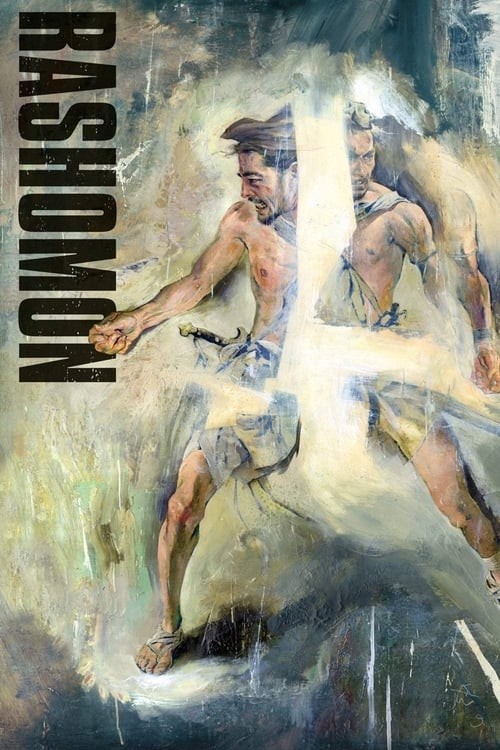
Rashomon
羅生門
"The husband, the wife… or the bandit?"
Overview
Set in 11th-century Japan, "Rashomon" begins under the ruins of the Rashomon city gate where a woodcutter and a priest are taking shelter from a torrential downpour. They are joined by a cynical commoner, and the two men recount a disturbing and perplexing story of a samurai's murder and his wife's rape that they have just heard at a court hearing. The film then unfolds through a series of flashbacks, presenting four contradictory accounts of the same event.
The first testimony is from the captured bandit, Tajōmaru, who boasts of his prowess and claims to have killed the samurai in a fair duel after seducing his wife. The samurai's wife then tells her story, portraying herself as a shamed and distraught victim who, after being violated, was met with contempt by her husband, leading to his death in a moment of her emotional collapse. The third account comes from the dead samurai himself, speaking through a medium, who claims he took his own life out of grief and dishonor after his wife's betrayal. Finally, the woodcutter, who initially claimed only to have found the body, reveals that he witnessed the entire event, offering a fourth, far less heroic version of what transpired.
Core Meaning
The core meaning of "Rashomon" is an exploration of the subjective and elusive nature of truth. Director Akira Kurosawa suggests that objective truth may be unknowable, as human perception is invariably colored by self-interest, ego, shame, and the desire to present oneself in the best possible light. The film posits that individuals construct their own versions of reality to maintain their self-esteem and cope with traumatic events. As Kurosawa himself stated, the film is about the inability of human beings to be honest with themselves about themselves; they cannot speak of themselves without embellishing. Ultimately, the film questions the very foundation of justice and morality when truth itself is malleable. However, the film's ending, with the woodcutter's selfless act of taking in an abandoned baby, offers a glimmer of hope, suggesting that despite the inherent flaws and dishonesty of humanity, redemption and faith in mankind are still possible.
Thematic DNA
The Subjectivity of Truth
This is the central theme of the film, demonstrated through the four conflicting testimonies of the murder. Each character's account is shaped by their personal biases, desires, and shame, making it impossible to discern a single, objective truth. The film suggests that truth is not a fixed entity but is instead a product of individual perception and memory. The "Rashomon effect," a term born from the film, now describes situations where multiple eyewitnesses give contradictory accounts of the same event.
Ego and Self-Deception
Each character's testimony is a performance designed to uphold their honor and self-image. The bandit wants to appear strong and virile, the wife as a chaste and wronged victim, and the samurai as a noble figure who died honorably. They lie not just to others but also to themselves, unable to confront the more shameful or pathetic aspects of their actions. The film masterfully reveals how ego drives individuals to construct self-serving narratives, even in the face of death.
Loss of Faith and Hope for Humanity
The priest's character embodies the struggle with faith in the face of human fallibility. The horrific and contradictory stories he hears shake his belief in humanity's inherent goodness. The crumbling Rashomon gate and the incessant rain serve as powerful symbols of a world in moral and spiritual decay. The film's conclusion, however, where the woodcutter's act of kindness restores the priest's faith, suggests that hope is not entirely lost and that selfless acts can redeem humanity.
Honor and Shame
The concepts of honor and shame are deeply ingrained in the characters' motivations and testimonies, reflecting the cultural context of feudal Japan. The samurai's supposed suicide is driven by the shame of his wife's violation and her alleged betrayal. The wife's actions are dictated by the shame of being raped and her husband's subsequent rejection. The bandit's bravado is a performance to maintain his reputation and a twisted sense of honor. The woodcutter's initial silence is also rooted in a fear of involvement and potential shame.
Character Analysis
Tajōmaru (the bandit)
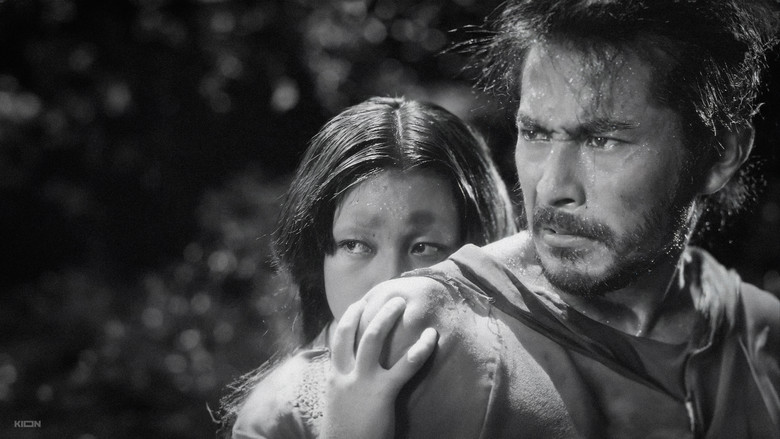
Toshirō Mifune
Motivation
Tajōmaru is driven by his base desires for lust, power, and notoriety. He wants to be seen as a formidable and legendary outlaw, and his version of the events is crafted to support this image. His motivation is rooted in a deep-seated ego and a desire to control the narrative of his own life and crimes.
Character Arc
Tajōmaru is a notorious bandit who remains largely unchanged throughout the film. His arc is more of a performance; he consistently presents himself as a powerful, dominant figure. His testimony is a boastful and self-aggrandizing account of his prowess as a lover and a fighter. Even when facing capture and likely execution, his primary concern is maintaining his fearsome reputation.
Masako Kanazawa (the wife)
Machiko Kyō
Motivation
Masako's primary motivation is to preserve her honor and navigate the aftermath of her traumatic experience. Her conflicting portrayals suggest a complex interplay of shame, anger, and a desire for agency in a situation where she has been powerless. She seeks validation for her actions and to escape the judgment of the men around her.
Character Arc
Masako's character is presented through multiple, contradictory lenses. In her own testimony, she is a shamed and hysterical victim. In the other accounts, she is portrayed as manipulative and even murderous. Her arc is one of desperation and a struggle for survival in a patriarchal society. Her motivations and true nature remain ambiguous, making her one of the film's most enigmatic figures.
Takehiro Kanazawa (the samurai)
Masayuki Mori
Motivation
The samurai is motivated by a strict adherence to the Bushido code of honor. His actions, and his interpretation of events, are entirely dictated by this code. His primary concern is the preservation of his dignity and social standing, even in death. He would rather be seen as a victim of a tragic, self-inflicted fate than a man who was defeated in a dishonorable fight.
Character Arc
The samurai's arc is one of profound dishonor and despair, as told through the medium. He begins as a respected nobleman and ends as a tragic figure who, according to his own testimony, takes his own life due to the shame of his wife's violation and her subsequent betrayal. His story is one of a man whose rigid code of honor is shattered by events beyond his control.
The Woodcutter
Takashi Shimura
Motivation
The woodcutter's initial motivation is self-preservation; he fears getting entangled in a murder investigation. However, his conscience weighs heavily on him, compelling him to reveal what he saw. His final act of adopting the abandoned baby is motivated by a desire to atone for his earlier dishonesty and to affirm his own belief in the potential for good in the world.
Character Arc
The woodcutter initially presents himself as a neutral observer, but it is later revealed that he is also an unreliable narrator who lied to avoid involvement and to conceal his own theft of the valuable dagger. His arc is one of grappling with guilt and ultimately choosing a path of redemption. He represents the ordinary person caught in extraordinary circumstances, who is capable of both selfishness and profound altruism.
The Priest
Minoru Chiaki
Motivation
The priest is motivated by a deep-seated belief in humanity and a desire to find meaning and goodness in a seemingly chaotic and corrupt world. He is a seeker of truth and is deeply troubled by the moral decay he witnesses. His motivation is to reconcile his faith with the harsh realities of human nature.
Character Arc
The priest's arc is a journey from unwavering faith to profound disillusionment and back to a renewed sense of hope. The contradictory and self-serving testimonies he hears shake his belief in the inherent goodness of humanity. He serves as the film's moral center, articulating the despair that arises from the characters' dishonesty. His faith is ultimately restored by the woodcutter's selfless act.
Symbols & Motifs
The Rashomon Gate
The ruined Rashomon gate symbolizes the decay of civilization, morality, and truth. It is a liminal space between the civilized world and the untamed wilderness, a Purgatory-like setting where the characters are trapped by a storm that mirrors their internal turmoil and confusion. Its dilapidated state reflects the broken state of the human soul and the crumbling of societal structures.
The film's framing story takes place entirely under the gate, where the woodcutter, priest, and commoner seek shelter from a torrential downpour while they discuss the murder. The gate is a constant visual reminder of the moral and existential crisis at the heart of the film.
The Rain
The relentless rain symbolizes the overwhelming moral ambiguity and confusion that engulfs the characters. It can be interpreted as a cleansing force or as a representation of the deluge of lies and conflicting narratives that obscure the truth. The storm breaking at the end of the film coincides with the restoration of the priest's faith in humanity.
The rain is a pervasive element in the scenes at the Rashomon gate, creating a bleak and oppressive atmosphere. The sound of the rain is almost constant, underscoring the characters' despair and the seemingly endless nature of their predicament.
The Sun
The use of sunlight in the film is complex and open to interpretation. Kurosawa famously shot directly into the sun, a taboo at the time, to create a sense of harsh, unflinching reality that paradoxically makes the truth harder to see. Some interpretations suggest the sun symbolizes evil or passion, while others see it as representing reason and goodness. The dappled light in the forest creates a visual metaphor for the fragmented and partial truths presented in the testimonies.
The scenes in the forest are often characterized by strong, direct sunlight filtering through the trees, creating a disorienting and visually stunning effect. This play of light and shadow mirrors the moral ambiguity of the events that unfold in the grove.
The Forest
The forest represents a labyrinth of human passion and deceit, a place where civilization's rules do not apply. It is a mysterious and timeless setting where the primal instincts of the characters are unleashed. Kurosawa intended for the forest to be a physical manifestation of the characters' internal confusion and moral entanglement.
The central crime of the rape and murder takes place within the dense, disorienting forest. The camera's hypnotic movements through the trees draw the viewer deeper into this world of moral ambiguity.
The Dagger
The ornate dagger is a key piece of physical evidence that is treated differently in each testimony. It represents the elusive nature of the truth and the unreliability of the narrators. The fact that the woodcutter steals the dagger also reveals his own moral failings and his complicity in the web of lies.
The dagger is present in all four accounts of the murder, but its role and significance change with each telling. In some versions, it is the murder weapon; in others, it is a symbol of honor or betrayal.
The Abandoned Baby
The abandoned baby at the end of the film represents innocence and the potential for a new beginning. It serves as a final moral test for the characters, and the woodcutter's decision to care for the child signifies a restoration of faith in humanity and the possibility of redemption.
After the cynical commoner steals the baby's kimono, the woodcutter, despite his own poverty and family, chooses to take the infant in. This act of selflessness provides a hopeful counterpoint to the film's otherwise cynical exploration of human nature.
Memorable Quotes
I don't understand. I just don't understand.
— The Woodcutter
Context:
The woodcutter utters this line at the beginning of the film, sitting under the Rashomon gate in the pouring rain, as he and the priest begin to recount the perplexing murder trial to the commoner.
Meaning:
This opening line sets the stage for the film's central theme of ambiguity and the elusiveness of truth. It immediately establishes the sense of confusion and moral uncertainty that pervades the narrative. It also highlights the woodcutter's own internal conflict and guilt, as he is not merely a confused observer but also a participant in the deception.
It's human to lie. Most of the time we can't even be honest with ourselves.
— The Commoner
Context:
The commoner says this to the priest and the woodcutter at the Rashomon gate as they express their dismay over the contradictory testimonies. He offers a pragmatic, if pessimistic, explanation for the characters' dishonesty.
Meaning:
This quote encapsulates the film's core philosophy about human nature. It suggests that deception is not just a conscious act but an ingrained part of the human condition, a defense mechanism to protect our fragile egos. The commoner's cynical worldview serves as a counterpoint to the priest's idealism.
If we don't trust each other, this earth might as well be hell.
— The Priest
Context:
The priest says this after hearing all the conflicting stories, expressing his despair to the cynical commoner. It is a plea for a return to a more compassionate and trusting worldview.
Meaning:
This line expresses the priest's anguish and his belief that a world without trust and faith is devoid of meaning and hope. It highlights the stakes of the film's philosophical inquiry: the very foundation of human society and morality rests on a fragile trust that the events of the film have shattered.
I'm the one who should be ashamed. I don't understand my own soul.
— The Woodcutter
Context:
The woodcutter says this towards the end of the film at the Rashomon gate, after his own version of the story has been told and his theft of the dagger has been revealed. It is a moment of profound introspection and guilt.
Meaning:
This is a moment of self-realization for the woodcutter, as he acknowledges his own complicity in the web of lies. He understands that he is no better than the others, as he too has acted out of self-interest. This admission of his own fallibility is a crucial step towards his eventual act of redemption.
Philosophical Questions
What is the nature of truth?
The film's central philosophical question revolves around the nature of truth. By presenting four contradictory yet plausible accounts of the same event, "Rashomon" challenges the notion of a single, objective reality. It suggests that truth is not something that can be definitively known, but is instead a subjective experience, shaped by individual perception, memory, ego, and self-interest. The film forces the audience to question their own ability to discern truth from falsehood and to consider the possibility that multiple, conflicting truths can coexist.
Why do people lie?
"Rashomon" explores the various motivations behind human deception. The film suggests that people lie not only to deceive others but also to deceive themselves. The characters' lies are driven by a need to preserve their honor, to conform to societal expectations, and to maintain a positive self-image. The film posits that self-deception is a fundamental aspect of the human condition, a way of coping with our own flaws and failures. It asks whether it is possible for anyone to be completely honest, even with themselves.
Can faith in humanity be sustained in a corrupt world?
Through the character of the priest, the film examines the fragility of faith in a world rife with selfishness and deceit. The priest's journey from unwavering belief to near-total despair mirrors the audience's own potential reaction to the grim portrayal of human nature. The film asks whether it is naive to believe in the inherent goodness of people when confronted with such overwhelming evidence of their capacity for evil. The ending, however, offers a tentative answer, suggesting that faith is not something that is given, but something that must be actively chosen and nurtured through selfless acts.
Alternative Interpretations
While the most common interpretation of "Rashomon" centers on the subjectivity of truth, several alternative readings have been proposed by critics and scholars. One interpretation posits that the film is not about the impossibility of truth, but rather about the human propensity for lying to oneself and others to maintain one's ego and social standing. In this view, there is a discoverable truth, but the characters are too self-absorbed and dishonest to articulate it.
Another interpretation, particularly popular in the years following the film's release, reads "Rashomon" as an allegory for Japan's defeat in World War II. The chaotic and contradictory accounts of the crime are seen as a metaphor for the conflicting narratives and national trauma that followed the war. The crumbling gate symbolizes a shattered nation, and the characters' self-deception reflects a collective struggle to come to terms with a devastating loss of honor and identity.
A more optimistic interpretation focuses on the film's ending as the key to its meaning. This reading argues that despite the darkness and cynicism of the central narrative, the woodcutter's final act of selfless compassion in adopting the abandoned baby is the film's ultimate message. It suggests that even in a world of lies and moral ambiguity, humanity can be redeemed through acts of kindness and that faith in our fellow human beings is a choice we can make. This interpretation sees the film not as a descent into nihilism, but as a testament to the enduring possibility of hope and redemption.
There is also debate about the 'truthfulness' of the woodcutter's final testimony. While it is presented as the last and most complete version of events, the revelation that he stole the dagger casts doubt on his reliability as a narrator. This ambiguity has led some to believe that even the woodcutter's story is self-serving and that the film intentionally leaves the audience without a definitive answer, forcing them to confront their own assumptions about truth and narrative authority.
Cultural Impact
"Rashomon" had a profound and lasting cultural impact, both in Japan and internationally. Its win at the 1951 Venice Film Festival is widely considered the moment that Japanese cinema was introduced to the world stage, sparking a wave of interest in the works of Kurosawa and other Japanese directors. The film's innovative narrative structure, featuring multiple unreliable narrators and contradictory flashbacks, was revolutionary for its time and has been endlessly imitated and referenced in films, television shows, and literature. The term "Rashomon effect" has become a part of the global lexicon, used in fields as diverse as law, psychology, and journalism to describe the subjective nature of perception and memory.
The film was created in post-war Japan, a period of immense social and cultural upheaval. Some critics have interpreted the film as an allegory for Japan's experience of defeat in World War II and the subsequent struggle to define a new national identity amidst conflicting narratives and a loss of moral certainty. The crumbling Rashomon gate can be seen as a symbol of a nation in ruins, grappling with its past and uncertain of its future.
Philosophically, "Rashomon" resonated with the existentialist currents of the post-war era, questioning the existence of objective truth and exploring the complexities of human nature. It challenged audiences to become active participants in the construction of meaning, rather than passive recipients of a single, authoritative narrative. Its influence can be seen in the works of countless filmmakers who have explored similar themes of memory, truth, and perspective, from Ingmar Bergman to Robert Altman. Despite initial reservations from its own studio, "Rashomon" became a critical and commercial success abroad, forever changing the landscape of world cinema.
Audience Reception
Upon its initial release in Japan, "Rashomon" was met with a moderately positive commercial and critical reception, though some Japanese critics found its story complex and a departure from traditional narratives. However, its reception internationally was overwhelmingly positive, particularly after it won the Golden Lion at the Venice Film Festival. This award brought Japanese cinema to the attention of the world and established Akira Kurosawa as a major international director. Western critics and audiences were captivated by the film's innovative narrative structure, its stunning black-and-white cinematography, and its profound philosophical themes. It was praised for its artistic ambition and its willingness to tackle complex questions about truth and human nature. Over the years, its reputation has only grown, and it is now universally regarded as one of the greatest and most influential films ever made.
Interesting Facts
- The film is based on two short stories by Ryūnosuke Akutagawa: "Rashōmon" (which provides the setting and themes of moral decay) and "In a Grove" (which provides the narrative of the murder from multiple perspectives).
- Director Akira Kurosawa was inspired by silent films for the visual style of "Rashomon", particularly in the forest scenes.
- The iconic torrential rain in the scenes at the Rashomon gate was created using fire hoses, and black ink was added to the water to make the rain more visible on camera.
- During filming, the cast was reportedly so confused by the script's ambiguous nature that they collectively asked Kurosawa to explain the story's true meaning. He told them that the film was a reflection of life, which does not always have clear answers.
- "Rashomon" was the first Japanese film to win a major international award, receiving the Golden Lion at the 1951 Venice Film Festival. This victory is credited with opening up Western audiences to Japanese cinema.
- The film's title has entered the English language as the "Rashomon effect," a term used to describe a situation in which an event is given contradictory interpretations by different individuals involved.
- Cinematographer Kazuo Miyagawa pioneered the technique of pointing the camera directly at the sun for this film, which was considered a technical taboo at the time.
- The studio that produced the film, Daiei, was initially reluctant to make it and the studio head so disliked the final product that he removed his name from the credits.
- The massive Rashomon gate set was so large that the production team could only build a partially dilapidated roof, using the story's setting of decay as a practical excuse for the incomplete construction.
⚠️ Spoiler Analysis
Click to reveal detailed analysis with spoilers
Frequently Asked Questions
Explore More About This Movie
Dive deeper into specific aspects of the movie with our detailed analysis pages
Comments (0)
No comments yet. Be the first to share your thoughts!