羅生門
"The husband, the wife… or the bandit?"
Rashomon - Ending Explained
⚠️ Spoiler Analysis
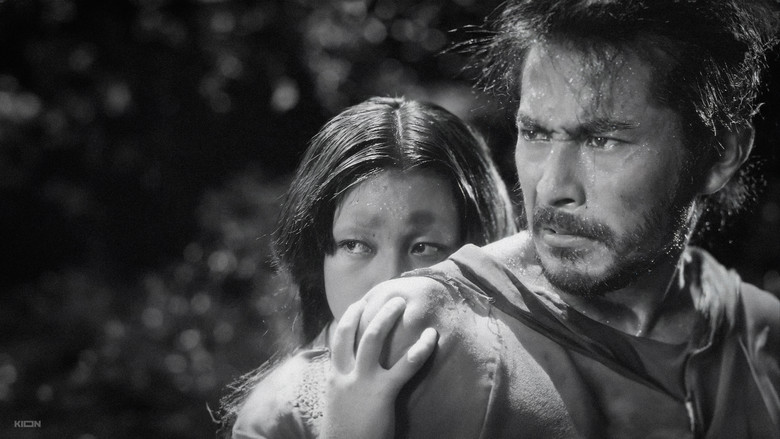
The central twist of "Rashomon" is that there is no definitive resolution to the murder mystery. After the testimonies of the bandit, the wife, and the dead samurai (through a medium) all contradict one another, the woodcutter, who initially claimed only to have found the body, reveals that he witnessed the entire event. His version of the story, however, does not align perfectly with any of the others and paints all three main participants in a far less flattering light. According to the woodcutter, after the rape, the wife goaded both the bandit and her husband into a fight, calling them cowards. The ensuing swordfight was not a noble duel, but a clumsy, pathetic, and fearful struggle. The bandit ultimately kills the samurai more out of luck and desperation than skill.
However, the woodcutter's testimony is also revealed to be tainted. The cynical commoner deduces that the woodcutter did not come forward because he stole the wife's expensive dagger from the crime scene. This revelation casts a shadow over the woodcutter's entire story, suggesting that his version may also be a self-serving lie, perhaps constructed to minimize his own guilt. The film deliberately leaves the audience in a state of uncertainty, suggesting that an objective, verifiable truth is ultimately unattainable. The 'truth' of the film is not what happened in the grove, but the revelation that all humans, even a seemingly honest woodcutter, are fallible and prone to self-interest. The final scene, with the abandoned baby, shifts the film's focus from the unsolvable mystery to a question of moral action in an uncertain world. The woodcutter's decision to adopt the baby, an act of pure altruism, suggests that even if we cannot know the truth, we can still choose to do good, thus providing a sliver of hope and restoring the priest's (and perhaps the audience's) faith in humanity.
Alternative Interpretations
While the most common interpretation of "Rashomon" centers on the subjectivity of truth, several alternative readings have been proposed by critics and scholars. One interpretation posits that the film is not about the impossibility of truth, but rather about the human propensity for lying to oneself and others to maintain one's ego and social standing. In this view, there is a discoverable truth, but the characters are too self-absorbed and dishonest to articulate it.
Another interpretation, particularly popular in the years following the film's release, reads "Rashomon" as an allegory for Japan's defeat in World War II. The chaotic and contradictory accounts of the crime are seen as a metaphor for the conflicting narratives and national trauma that followed the war. The crumbling gate symbolizes a shattered nation, and the characters' self-deception reflects a collective struggle to come to terms with a devastating loss of honor and identity.
A more optimistic interpretation focuses on the film's ending as the key to its meaning. This reading argues that despite the darkness and cynicism of the central narrative, the woodcutter's final act of selfless compassion in adopting the abandoned baby is the film's ultimate message. It suggests that even in a world of lies and moral ambiguity, humanity can be redeemed through acts of kindness and that faith in our fellow human beings is a choice we can make. This interpretation sees the film not as a descent into nihilism, but as a testament to the enduring possibility of hope and redemption.
There is also debate about the 'truthfulness' of the woodcutter's final testimony. While it is presented as the last and most complete version of events, the revelation that he stole the dagger casts doubt on his reliability as a narrator. This ambiguity has led some to believe that even the woodcutter's story is self-serving and that the film intentionally leaves the audience without a definitive answer, forcing them to confront their own assumptions about truth and narrative authority.