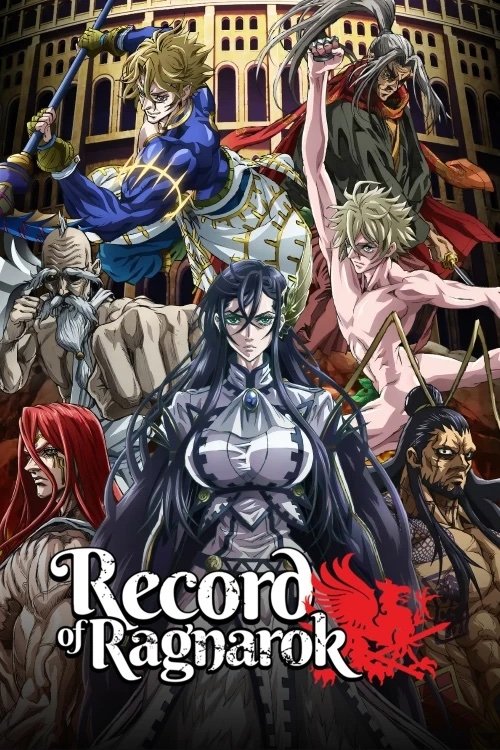
Record of Ragnarok
終末のワルキューレ
Overview
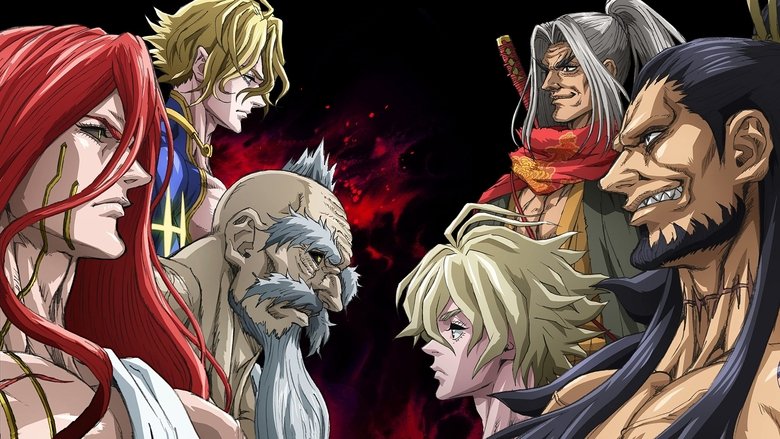
Record of Ragnarok is a high-stakes, action-packed anime series that chronicles the ultimate tournament between 13 of history's most legendary human figures and 13 gods from various global pantheons. The story begins when the Council of Gods, weary of humanity's destructive nature, votes unanimously for their extinction. However, the Valkyrie Brunhilde invokes "Ragnarok," a survival clause allowing humanity a final chance to prove their worth through one-on-one combat to the death. The series spans three seasons, covering the first nine of thirteen planned rounds, with each battle serving as a deep dive into the combatants' origins and philosophies.
As the tournament progresses, the stakes evolve from mere survival to a complex exploration of what it means to be human and the inherent flaws within the divine. From the frozen fields of Norse myth to the sun-drenched arenas of Greece, the series balances explosive combat with poignant backstories, weaving a narrative where every victory and loss carries heavy emotional weight. While Season 1 focuses on the raw power struggle, Season 2 and Season 3 expand the narrative to include political intrigue among the gods and the personal trauma of the Valkyries who sacrifice themselves to become the weapons (Volundr) for their human champions.
Core Meaning
The core message of Record of Ragnarok centers on the triumph of human willpower over predetermined destiny. It posits that humanity’s greatest strength lies not in perfection, but in the relentless pursuit of growth, even in the face of certain doom. Through its reimagining of historical and mythological figures, the series suggests that the "divine" is often stagnant and arrogant, while the "human" is dynamic and empathetic. The creators emphasize that to be human is to struggle, to adapt, and to protect one another—qualities that even the most powerful gods eventually come to respect and fear.
Thematic DNA
The Burden of History and Legacy
Throughout the three seasons, characters are defined by the weight of their past. Whether it is Adam carrying the burden of being humanity's first father or Qin Shi Huang literally feeling the pain of his people, the series explores how the past informs the strength of the present. This theme evolves from simple historical references to a profound look at how collective human memory empowers the individual.
The Duality of Creation and Destruction
This theme is most prominently explored in the conflict between Nikola Tesla (creation/science) and Beelzebub (destruction/despair). The series suggests that while destruction is the natural end of all things, the human drive to create and innovate serves as a light that can momentarily—and meaningfully—defy the darkness of the void.
Sacrifice and the Unity of Soul (Volundr)
The concept of Volundr—the spiritual bond between a Valkyrie and a human—symbolizes the necessity of unity to overcome overwhelming odds. Each battle is a literal fusion of mortal ambition and divine spirit, highlighting that humanity cannot win alone; they must be in harmony with their own spiritual potential and the memory of those who support them.
The Subversion of Divinity
The series consistently portrays the gods as flawed, petty, and susceptible to the same vices they condemn in humans. By having gods like Buddha side with humanity, the show challenges the traditional hierarchy of worship, suggesting that true enlightenment comes from empathy and rebellion against unjust authority rather than blind obedience.
Character Analysis
Brunhilde
Miyuki Sawashiro
Motivation
Driven by a secret vendetta against the gods and a desire to save humanity, though her true connection to the human champion Siegfried hints at deeper personal stakes.
Character Arc
Brunhilde starts as a seemingly cold and manipulative leader who risks her sisters' lives to spite the gods. However, over three seasons, her mask of stoicism cracks, revealing a deep-seated grief and a desperate love for both her sisters and humanity. Her arc is one of calculated sacrifice as she moves closer to her mysterious ultimate goal.
Adam
Soma Saito
Motivation
Pure, unconditional love for his descendants; he needs no complex philosophy to fight—only the instinct to protect his family.
Character Arc
Adam represents the peak of human potential in Season 1. His arc is short but impactful, moving from a silent observer to the ultimate symbol of defiance. He dies on his feet, still swinging, purely to protect his 'children' (mankind), proving that human spirit outlasts physical form.
Jack the Ripper
Tomokazu Sugita
Motivation
Initially obsessed with seeing the 'color' of fear and despair in his victims, later evolving into a begrudging respect for human goodness.
Character Arc
Introduced as the "purest evil" of humanity in Season 2, Jack’s battle against Heracles transforms him. Through the god's unconditional love and sacrifice, Jack experiences a redemptive shift, acknowledging for the first time that the 'color' of love he sought through murder could be found in sacrifice.
Buddha
Yuichi Nakamura
Motivation
To protect the freedom of the soul and to challenge the arrogance of the gods who presume to rule over existence.
Character Arc
Buddha shatters the divine-mortal divide in Season 2. His arc is defined by independence; he refuses to be a pawn for either side, ultimately fighting for humanity because he believes in individual enlightenment and freedom from divine control.
Qin Shi Huang
Kaito Ishikawa
Motivation
To prove that humanity needs no gods to guide them, as he is the 'King where it all began.'
Character Arc
In Season 3, Qin explores the concept of sovereignty through suffering. His development focuses on his childhood trauma and his rise to power, illustrating that a true king is one who carries the weight of his people's pain, eventually earning the respect of the God of the Underworld, Hades.
Symbols & Motifs
Volundr (The Valkyrie Bond)
Symbolizes the ultimate synergy between mortality and divinity.
Used in every human fighter's arsenal, where a Valkyrie transforms into a weapon tailored to the fighter's soul, permanently linking their fates and lives.
The Golden Apple
A symbol of rebellion and paternal love rather than original sin.
Featured in Season 1 during Adam's backstory; he eats the apple not out of greed, but to stand in solidarity with his wife, Eve, after she is framed.
Mirror-Touch Synesthesia (Qin Shi Huang's Blindfold)
Represents empathy as a double-edged sword—both a debilitating curse and the source of a true king's power.
Introduced in Season 3, Round 7; Qin wears the blindfold to block out the visual stimuli of others' pain, which he physically feels as his own.
The Gematria Zone
Represents the domain of human logic and potential conquering the chaotic 'magic' of the gods.
Nikola Tesla's ultimate technique in Season 3, where he turns the arena into a controlled scientific laboratory to defy the laws of physics.
Memorable Quotes
Is there any man that needs a reason to protect his own children?
— Adam
Context:
Season 1, Episode 7; Adam's response to Zeus asking why he hates the gods so much.
Meaning:
The definitive statement of human motivation in the series, stripping away ego and replacing it with pure instinctual love.
In all the Heavens and Earth, I alone am the honored one.
— Buddha
Context:
Season 2, Episode 10; Buddha's announcement that he will fight for humanity.
Meaning:
A declaration of absolute self-governance and defiance against the Council of Gods.
The road is where I lead.
— Qin Shi Huang
Context:
Season 3, Episode 1; Qin's grand entrance into the gods' VIP section.
Meaning:
Emphasizes the autonomy of human leadership and the refusal to follow a path set by higher powers.
No... science will never die!
— Nikola Tesla
Context:
Season 3, Episode 11; Tesla's final words as he faces Beelzebub's void.
Meaning:
A testament to the infinite progress of human thought and invention even in the face of death.
Episode Highlights
The File on No. 00000000001
The climax of Adam vs. Zeus. This episode is famous for its emotional weight and the 'slideshow' animation controversy, yet it remains the most iconic moment of the series for its portrayal of Adam's sacrifice.
It changed the tone of the series from a simple brawl to a tragic epic, proving humanity could stand toe-to-toe with the King of Gods.
The Final Requiem
Jack the Ripper uses a hidden trick with his blood to defeat Heracles. The episode concludes with the crowd hating the winner (Jack) and mourning the loser (Heracles).
It introduced moral ambiguity into the tournament, showing that humanity's survival might require its darkest aspects.
Greatest Loser
Kojiro Sasaki defeats Poseidon. For the first time, humanity wins a round, utilizing 'thousands of years of evolution' against divine perfection.
The turning point of the series where the gods begin to truly fear their creation.
The Enlightened One
Buddha steps into the arena and defects to the side of humanity, throwing the entire tournament into chaos.
It broke the rigid 'God vs. Human' structure and introduced the political instability within Valhalla.
A Fierce Battle of Souls
The finale of Round 9 where Apollo and King Leonidas clash for the final time. Both fighters earn each other's respect through a display of pure grit.
Ends the season with the gods regaining a 5-4 lead, setting up a dire atmosphere for the future.
Philosophical Questions
Is perfection an obstacle to growth?
The series explores this through the gods' arrogance; because they are 'perfect,' they cannot evolve. In contrast, humans like Kojiro Sasaki achieve greatness through the very fact that they can fail and learn from defeat.
What defines a 'Monster' vs. a 'Hero'?
Through the battle of Jack the Ripper vs. Heracles, the series asks if a hero who supports an unjust genocide (the gods) is truly better than a monster who fights to save a race from extinction.
Alternative Interpretations
Critics have often interpreted the series as a metaphor for the climate crisis or societal collapse, where the 'Gods' represent the unavoidable consequences of human negligence, and the 'Ragnarok' is the final, desperate struggle to innovate and change before extinction. Another interpretation suggests the entire tournament is a psychological projection of Brunhilde, representing the internal conflict between her divine origins and her love for the physical world. Some fans read the series as a critique of hierarchical systems, where the gods are the 'old guard' elite and humans are the revolutionary class fighting for a voice.
Cultural Impact
Record of Ragnarok has become a cornerstone of Netflix’s anime strategy, proving the immense global appetite for the 'tournament arc' format. Culturally, it sparked renewed interest in comparative mythology and historical biographies among younger audiences. However, its impact is most notable for the controversy regarding religious depictions, specifically Shiva, which ignited global debates about the limits of artistic license when portraying living faiths. Despite animation hurdles, it remains a dominant force in the 'Seinen' action genre, influencing other series to adopt more philosophical underpinnings for their combat scenarios.
Audience Reception
Audience reception has been a rollercoaster of hype and technical scrutiny. Season 1 was praised for its concept but panned for its animation. Season 2 saw a significant uptick in praise as the production quality stabilized and the character work deepened. By Season 3, the show established a loyal fanbase that values the 'hype' and emotional payoffs over high-frame-rate sakuga. The overall verdict remains that while it isn't a technical masterpiece, its ability to deliver iconic, emotionally resonant moments makes it a 'must-watch' for fans of the genre.
Interesting Facts
- The series transitioned from studio Graphinica to Yumeta Company and Maru Animation for the second and third seasons to improve animation consistency.
- Season 1 faced significant criticism for its limited animation during the Adam vs. Zeus fight, which many fans compared to a PowerPoint presentation.
- The depiction of Shiva caused the series to be banned or heavily censored on Netflix in India due to religious sensitivities.
- Each human fighter is referred to as an 'Einherjar,' a term from Norse mythology for warriors brought to Valhalla by Valkyries.
- The voice actor for Zeus, Wataru Takagi, also voiced the character of Onizuka in GTO, bringing a similarly unhinged energy to the role.
Easter Eggs
Historical Audience Members
Adds a layer of historical world-building and meta-commentary on the legends being portrayed.
Hermes' Musical References
Reflects the series' theme of reinterpreting the old for a modern, high-octane context.
⚠️ Spoiler Analysis
Click to reveal detailed analysis with spoilers
Frequently Asked Questions
Explore More About This Movie
Dive deeper into specific aspects of the movie with our detailed analysis pages
Comments (0)
No comments yet. Be the first to share your thoughts!