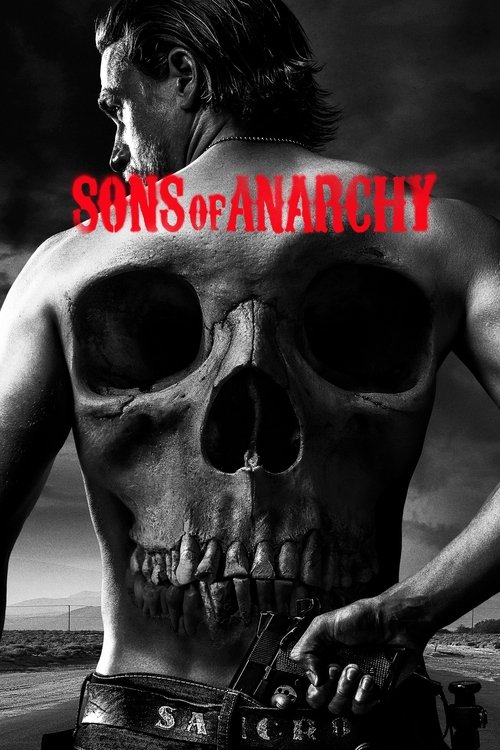
Sons of Anarchy
A Shakespearean crime drama drenched in oil and blood, where the roar of engines masks the screams of a crumbling brotherhood. It is a visceral descent into the dark heart of a toxic legacy.
Sons of Anarchy

Sons of Anarchy

"Let freedom ride."

03 September 2008 — 09 December 2014 United States of America 7 season 92 episode Ended ⭐ 8.4 (3,124)
Cast: Charlie Hunnam, Katey Sagal, Tommy Flanagan, Mark Boone Junior, Kim Coates
Drama Crime
Legacy and Paternal Sins Brotherhood vs. Morality Maternal Manipulation The Cycle of Vengeance

Overview

Sons of Anarchy is a sprawling crime saga that follows the Sons of Anarchy Motorcycle Club, Redwood Original (SAMCRO), an outlaw gang operating out of the fictional town of Charming, California. The series centers on Jackson 'Jax' Teller, the club's vice president, who begins to question the club's criminal path after discovering a manifesto written by his late father, John Teller. This document outlines a vision for the club that contrasts sharply with the violent gun-running enterprise led by Jax's stepfather and current president, Clay Morrow.

Over seven seasons, the narrative transforms from a localized struggle for control into a grand tragedy involving international arms deals, racial tensions, and federal investigations. As Jax attempts to steer the club toward legitimacy, he is constantly pulled back by the weight of tradition, the manipulative influence of his mother Gemma, and the inevitable fallout of his own choices. The series meticulously tracks the moral erosion of its characters as they are forced to choose between personal happiness and the survival of the 'reaper' brotherhood.
Core Meaning

At its heart, the series is a profound exploration of the impossibility of escaping one's legacy. The creators use the subculture of outlaw bikers as a stage to argue that violence is a self-perpetuating cycle that consumes everything it touches, including the ideals of those who seek to change it. Through the arc of Jax Teller, the show suggests that a 'legitimate' existence cannot be built upon a foundation of blood, and that true redemption often requires the total sacrifice of the self to ensure the next generation is not poisoned by the same sins.

Thematic DNA

Legacy and Paternal Sins 30%
Brotherhood vs. Morality 25%
Maternal Manipulation 25%
The Cycle of Vengeance 20%

Legacy and Paternal Sins

The series is framed by the ghost of John Teller. Jax's struggle to reconcile his father's peaceful vision with the reality of SAMCRO's violence is the primary engine of the plot. This theme evolves from a search for identity into a desperate attempt to break a generational curse, eventually leading Jax to realize that he must destroy his own legacy to save his children.

Brotherhood vs. Morality

The concept of 'the club' functions as a religion, demanding absolute loyalty above individual conscience. Throughout the series, characters are frequently forced to commit horrific acts in the name of brotherhood, illustrating how collective identity can be used to justify the erosion of personal ethics.

Maternal Manipulation

Gemma Teller Morrow represents the destructive power of protective love. Her drive to maintain the family and the club's status quo at any cost serves as the show's most consistent source of tragedy. Her character demonstrates how maternal instinct, when twisted by ego and power, becomes a catalyst for the very destruction she fears.

The Cycle of Vengeance

Rooted in Shakespearean logic, every act of violence in the show demands a response. This creates an escalating 'eye-for-an-eye' dynamic that eventually leaves most of the cast dead. The show posits that vengeance is not justice, but a terminal disease that destroys both the victim and the avenger.

Character Analysis

Jax Teller

Charlie Hunnam

Archetype: Tragic Antihero
Key Trait: Moral complexity and leadership

Motivation

Initially motivated by his father's idealism, his drive shifts to a desperate need for revenge following Tara's death, and finally to a desire for total atonement.

Character Arc

Jax begins as a conflicted prince seeking to reform his kingdom. Over seven seasons, he descends into ruthlessness, killing his own mother and rivals to 'clean the table.' His journey ends in a calculated suicide, an act designed to kill the outlaw inside him so his sons can grow up in a different world.

Gemma Teller Morrow

Katey Sagal

Archetype: Dark Matriarch
Key Trait: Ruthless protectiveness

Motivation

The preservation of her family and her influence within the club at any cost.

Character Arc

Gemma remains steadfast in her devotion to the club, but her lies eventually catch up with her. After murdering Jax's wife, Tara, she spends the final season in a state of paranoia and grief before accepting her death at the hands of her own son.

Clay Morrow

Ron Perlman

Archetype: Fallen King
Key Trait: Brutality and pragmatic ego

Motivation

Greed and the maintenance of personal power over the club's original ideals.

Character Arc

The club's brutal president who slowly loses his grip on power as his crimes are revealed. He is eventually stripped of his patches and executed by Jax, serving as a cautionary tale of what Jax might become.

Opie Winston

Ryan Hurst

Archetype: The Martyr
Key Trait: Tragic loyalty

Motivation

Initially seeks to leave the life, but is repeatedly pulled back by grief and his love for Jax.

Character Arc

Jax's best friend who suffers more than any other character. After losing his wife and father to the club's internal politics, he chooses to sacrifice himself in prison to save Jax and the club, proving his ultimate loyalty.

Symbols & Motifs

The Reaper

Meaning:

The Reaper logo symbolizes the club's intimate relationship with death. It represents both the protection of the brotherhood and the grim fate that awaits those who wear it.

Context:

The logo is omnipresent on the members' 'cuts' (vests). The final shot of the series features the Reaper logo carved into wood, stained with Jax's blood, signifying the total consumption of the man by the club.

The Homeless Woman

Meaning:

Often interpreted as a guardian angel, a harbinger of doom, or the ghost of Emily Putner (a woman killed in John Teller's accident), she symbolizes the unseen casualties of the club's violence.

Context:

She appears at pivotal moments of moral choice or impending death, often handing Jax or other characters objects (like a blanket or bread) that provide temporary comfort before a tragedy.

John Teller's Manuscript

Meaning:

The manuscript represents the 'lost' soul of the club and the burden of idealism. It is the catalyst for Jax's internal conflict.

Context:

Found in the pilot, it is read periodically throughout the series. Its eventual destruction by Jax symbolizes his realization that his father's dream was a myth that could not survive the reality of their world.

Crows

Meaning:

A recurrent motif for death and the 'Sons' (often referred to as 'crow eaters').

Context:

The series opens and closes with shots of crows on the highway. Crows also appear in Gemma's home as pets, reflecting her proximity to the deaths that surround her family.

Memorable Quotes

It's not easy being king.

— Jax Teller

Context:

Spoken in the Season 4 finale as Jax finally takes the gavel from Clay, marking his transition to president.

Meaning:

Reflects the heavy burden of leadership and the moral compromises required to keep the club afloat.

I'm not a good man. I'm a criminal and a killer. I need my sons to grow up hating the thought of me.

— Jax Teller

Context:

Spoken in the series finale, 'Papa's Goods,' during Jax's final conversation with Nero.

Meaning:

The ultimate admission of his failure to stay 'clean' and his final act of love: ensuring his children do not follow his path.

Gemma knows. She always knows.

— Clay Morrow

Context:

A recurring sentiment throughout the series that underscores the power dynamics within the Teller-Morrow household.

Meaning:

Highlights Gemma's role as the club's omniscient and manipulative force.

Episode Highlights

The Sleep of Babies

S1E12

The season reaches a breaking point when a hit intended for Opie accidentally kills his wife, Donna.

Significance:

This is the first major club-on-club betrayal, shattering the illusion of 'brotherhood' and setting the stage for the Jax-Clay conflict.

NS

S3E13

The club executes a complex double-cross against Agent Stahl and the IRA to protect their own.

Significance:

Often cited as the show's best finale, it demonstrates the club's tactical brilliance and the depth of their collective bond.

Laying Pipe

S5E3

Opie Winston is brutally beaten to death in county jail while Jax is forced to watch.

Significance:

Opie's death is the moral turning point for Jax, removing his last tether to his better nature and sending him on a darker path.

A Mother's Work

S6E13

In a fit of rage and misunderstanding, Gemma murders Tara with a carving fork.

Significance:

This act effectively ends any hope for Jax's redemption and triggers the total war of the final season.

Papa's Goods

S7E13

Jax settles all club debts and rides his father's bike into an oncoming semi-truck.

Significance:

The series finale completes the Hamlet parallel and ends the cycle of violence by having the protagonist remove himself from the equation.

Philosophical Questions

Can a person truly change their nature while remaining in a toxic environment?

The series explores this through Jax's failed attempts to reform the club. It suggests that the environment of SAMCRO is fundamentally incompatible with the 'good man' Jax wants to be.

Does the end justify the means in the pursuit of peace?

Jax commits horrific murders to 'clear the path' for a peaceful future for the club. The show questions if peace achieved through genocide and betrayal is actually peace or just a temporary silence.

Alternative Interpretations

While the Hamlet parallel is the most common interpretation (Jax as Hamlet, Clay as Claudius, Gemma as Gertrude), some critics view the show as a Western in modern clothing, focusing on the lawless frontier of the American highway. Another perspective argues the show is a Greek Tragedy, where characters are not fighting their circumstances but their own inescapable 'fates.' A more cynical reading suggests the show is a dark soap opera, utilizing sensationalist violence to mask a narrative that became repetitive in its later years.

Cultural Impact

Sons of Anarchy redefined the 'biker' trope in popular culture, moving away from 1960s exploitation clichés toward a high-stakes Shakespearean drama. It was a cornerstone of the 'Second Golden Age of TV,' proving that a niche subculture could sustain a massive, mainstream audience. Its use of licensed music (The Forest Rangers) and long-form montages became a stylistic hallmark. The series also sparked a resurgence in motorcycle culture and 'outlaw' fashion, though it was often criticized for its increasingly graphic violence in later seasons. Its legacy remains as one of FX's most-watched and debated original series.

Audience Reception

Audience reception was overwhelmingly positive for the first four seasons, praised for its tight plotting and emotional depth. Season 3's finale is often cited as a peak television moment. However, the final two seasons were more polarizing; some fans felt the violence became gratuitous and the plot 'convoluted.' Despite this, the series finale was highly rated and generally seen as a satisfying, if heartbreaking, conclusion to Jax's journey. It maintains a strong cult following and high scores on review aggregators like Rotten Tomatoes (87%) and IMDb (8.6/10).

Interesting Facts

  • Creator Kurt Sutter played the character Otto Delaney, the club member in prison who suffers extreme physical torment throughout the show.
  • Katey Sagal (Gemma) and Kurt Sutter are married in real life.
  • Ron Perlman was not the original Clay Morrow; the pilot was initially filmed with Scott Glenn in the role.
  • Charlie Hunnam spent time with a real outlaw biker in Oakland for research; he adopted the biker's white sneaker aesthetic for Jax.
  • David Labrava, who plays Happy, was originally hired as a technical advisor but was cast because of his authentic background as a Hells Angel.

Easter Eggs

The 'Adriana' Reference

In the final season, Drea de Matteo (Wendy) is told she'll be 'riding in the trunk.' She replies, 'It won't be the first time,' a nod to her character Adriana's fate in The Sopranos.

The Shield Cameos

Numerous actors from The Shield (where Sutter was a writer) appear in the show, including Walton Goggins as the trans character Venus Van Dam.

⚠️ Spoiler Analysis

Click to reveal detailed analysis with spoilers

Frequently Asked Questions

Explore More About This Movie

Dive deeper into specific aspects of the movie with our detailed analysis pages

Comments (0)

Leave a comment

No comments yet. Be the first to share your thoughts!