Riverdale
"To save the future, they must survive the past."
Overview
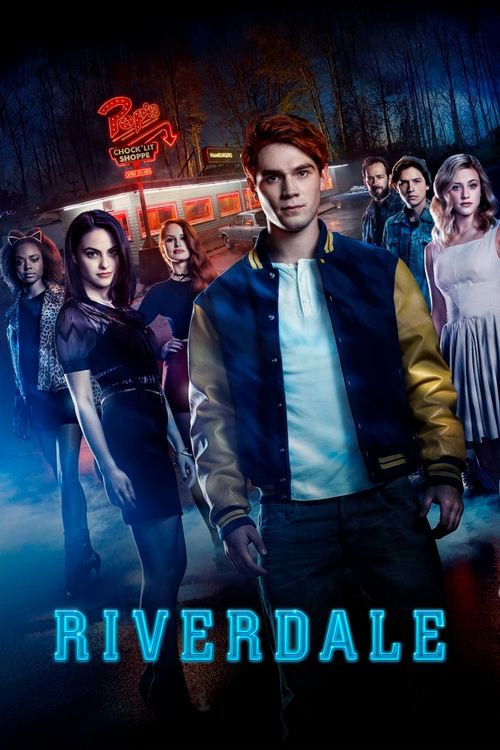
Riverdale begins as a dark, stylized re-imagining of the classic Archie Comics characters, set in a town reeling from the mysterious death of high school golden boy Jason Blossom. What starts as a moody murder mystery quickly evolves into a sprawling saga that defies genre boundaries, incorporating elements of gang warfare, serial killer thrillers, and psychological horror. As the series progresses, the story moves beyond its initial noir roots, eventually embracing supernatural phenomena and multiverse theories.
Across its seven-season run, the show undergoes significant shifts, including a seven-year time jump that follows the characters into adulthood and a final-season reset that transports the entire cast to a 1950s alternate reality. Despite its increasingly fantastical plotlines—ranging from organ-harvesting cults to characters developing superpowers—the series maintains a consistent focus on the complex interpersonal relationships between Archie, Betty, Veronica, and Jughead. It serves as a long-form exploration of small-town corruption and the enduring strength of youthful bonds.
Core Meaning
At its heart, Riverdale is a meta-commentary on the death of American innocence and the cyclical nature of storytelling. The creators used the wholesome framework of Archie Comics to explore the duality of the human psyche—the idea that even the most perfect facades hide deep-seated darkness. Through its many genre shifts, the series suggests that identity is fluid and that individuals are often forced to battle the collective "sins of the fathers" to define their own futures.
The show ultimately posits that nostalgia is both a sanctuary and a prison. By concluding the series in a literal "Sweet Hereafter," the narrative emphasizes that while the physical town and its inhabitants may change or perish, the idealized version of friendship and community lives on through the stories we tell. It is a tribute to the endurance of character archetypes and the way they adapt to reflect the anxieties of the modern era.
Thematic DNA
The Duality of Small-Town Life
Throughout the series, Riverdale is described as the "town with pep," but it constantly reveals a rotting core. This theme is embodied by Betty Cooper and her internal "darkness," as well as the contrast between the sunny Pop's Diner and the dangerous Southside. The show explores how a community's public image often masks systemic corruption and hidden violence.
Generational Legacy and Sin
The characters are perpetually haunted by their parents' pasts. Whether it is Veronica Lodge battling her father Hiram's criminal empire or Cheryl Blossom dealing with her family's murderous history, the series examines the struggle to break free from inherited trauma and bloodlines. The children are often forced to fix the world their parents broke.
The Power of Narrative and Myth-Making
With Jughead Jones serving as the series' narrator, the show frequently comments on the act of writing and recording history. This meta-thematic element peaks in later seasons when the characters realize they are part of a larger, shifting timeline, suggesting that our reality is shaped by the stories we choose to believe and preserve.
Nostalgia vs. Reality
The show constantly plays with vintage aesthetics while injecting them with modern grit. This culminations in Season 7, which explores a 1950s setting that looks like a dream but feels like a nightmare, highlighting how nostalgia often sanitizes a past that was actually filled with prejudice and repression.
Loyalty and Chosen Family
Despite the romantic upheavals and personal betrayals, the core four and their allies represent the concept of chosen family. Their collective resistance against external threats—be it a serial killer or a supernatural tyrant—serves as the emotional anchor for the entire series.
Character Analysis
Archie Andrews
K.J. Apa
Motivation
Initially driven by a desire to protect his father's legacy; later evolves into a drive to save the town's soul from various physical and moral threats.
Character Arc
Transitions from a conflicted athlete/musician to a vigilante, a soldier, and finally a community leader. In the 1950s reset, he finds peace as a construction worker who discovers a love for poetry, shedding his "savior" complex.
Betty Cooper
Lili Reinhart
Motivation
Driven by an insatiable need for truth and a fear of the "serial killer gene" she believes she inherited.
Character Arc
Begins as the "girl next door" suppressed by a controlling mother. She embraces her darker impulses, becomes a literal FBI agent, and eventually finds fulfillment as a progressive feminist writer in the 1950s timeline.
Veronica Lodge
Camila Mendes
Motivation
Wants to build her own legacy and prove that she can be successful without succumbing to her family's ruthless methods.
Character Arc
Moves from a reformed "mean girl" socialite to a savvy businesswoman battling her father's empire. She eventually moves to Hollywood to become a legendary film producer, finally establishing an identity entirely independent of the Lodge name.
Jughead Jones
Cole Sprouse
Motivation
Motivated by the search for a sense of belonging and the need to document the truth, no matter how strange.
Character Arc
Develops from a cynical loner to a gang leader, a teacher, and an angelic observer. He ultimately accepts his role as the town's chronicler, ensuring that the memory of Riverdale survives the end of the world.
Cheryl Blossom
Madelaine Petsch
Motivation
Driven by a profound need for love and validation after being rejected and controlled by her parents.
Character Arc
Starts as a grieving, manipulative antagonist. She evolves through deep trauma to become a powerful witch and an activist for queer rights, ultimately finding a peaceful life as an artist alongside Toni Topaz.
Symbols & Motifs
Jughead's Crown Beanie
Symbolizes Jughead's status as an outsider and his refusal to conform to societal expectations. It represents his crown as the "king" of his own narrative and his emotional armor.
Worn almost constantly in the early seasons; its removal often signifies extreme vulnerability or a shift in his identity, particularly when he joins the Southside Serpents.
Pop's Chock'lit Shoppe
Represents a sanctuary of purity and neutrality in a town of chaos. It is the "moral heart" of Riverdale, where all characters, regardless of their sins, find common ground.
Used as the primary meeting spot across all seven seasons. It becomes a literal battleground for the town's soul when Percival Pickens attempts to destroy it in Season 6.
Sweetwater River
A symbol of the border between life and death, as well as the transition from innocence to experience. It is the site where the town's secrets are washed away or brought to the surface.
The series begins with Jason Blossom's disappearance at the river and ends with the characters' symbolic crossing into the afterlife in the series finale.
The Color Red
Primarily associated with the Blossom family, it symbolizes wealth, danger, blood, and passion. For Archie, it represents his hair and his role as the town's protector/hero.
The Blossom household is saturated in red; Cheryl uses the color as a weapon of intimidation and a sign of her awakening power as a witch.
Memorable Quotes
In case you haven't noticed, I'm weird. I'm a weirdo. I don't fit in. And I don't want to fit in.
— Jughead Jones
Context:
Season 1, Episode 10. Said to Betty during a moment of high emotional stress regarding his birthday party.
Meaning:
The ultimate mission statement for Jughead's character, highlighting his pride in being an outsider.
I've endured the epic highs and lows of high school football.
— Archie Andrews
Context:
Season 3, Episode 2. Archie says this while in juvenile detention to explain his "hardened" experience.
Meaning:
A quote that became a viral meme, illustrating the show's occasionally campy and hyperbolic dialogue.
Riverdale isn't just a place. It's an idea. It's the memory of being young.
— Angel Jughead
Context:
Season 7, Episode 20. Said as the characters transition into the "Sweet Hereafter."
Meaning:
Summarizes the final season's focus on nostalgia and the enduring legacy of the characters' youth.
Episode Highlights
Chapter One: The River's Edge
The pilot episode that sets the noir tone, introduces the core quartet, and launches the mystery of Jason Blossom's death.
Established the show's unique aesthetic and immediate success, launching a new era for teen dramas.
Chapter Thirty-Nine: The Midnight Club
A flashback episode where the main cast plays teenage versions of their parents, revealing a dark secret from the 1990s.
Considered one of the show's most creative hours, paying homage to The Breakfast Club while deepening the town's mythology.
Chapter Fifty-Eight: In Memoriam
A tribute to actor Luke Perry following his death, depicting the passing of Archie's father, Fred Andrews.
A rare, grounded, and deeply emotional episode that redefined Archie's character path and provided closure for the cast and audience.
Chapter One Hundred: The Jughead Paradox
The 100th episode that explores the multiverse and the parallel town of "Rivervale," featuring a crossover with Sabrina Spellman.
Successfully merged the show's grounded elements with supernatural horror, paving the way for the show's high-concept final seasons.
Chapter One Hundred and Thirty-Seven: Goodbye, Riverdale
The series finale where an 86-year-old Betty revisits her final day of high school in a 1950s dreamscape.
Provided a bittersweet, definitive conclusion by revealing the lifelong fates of every character and embracing the show's comic book origins.
Philosophical Questions
Are we defined by the sins of our ancestors?
The series repeatedly asks if the children of Riverdale can escape the criminal and moral failings of their parents, suggesting through the finale that while the past is inescapable, our response to it defines our humanity.
Does a 'pure' world truly exist, or is it a projection of nostalgia?
Season 7 explicitly explores this by placing characters in an 'ideal' 1950s setting only to reveal the racism, sexism, and repression bubbling just beneath the surface of that era's perfection.
What is the nature of a 'soul' in a shifting reality?
As characters move between timelines and gain superpowers, the show explores what remains constant—their loyalty and love for one another—positing that identity is found in relationships rather than circumstances.
Alternative Interpretations
Critics and fans have proposed several ways to view the series' bizarre trajectory. One common interpretation is that the entire show is a meta-narrative written by Jughead, with the increasingly wild plots representing his growth (and perhaps his loss of grip on reality) as an author. Another reading suggests that the final season's move to the 1950s is a purgatorial state, where the characters are being "tested" to see if their souls can reach a just outcome in a different era.
Some viewers view the series as a commentary on the instability of the modern teen experience, where the changing genres reflect the chaotic and often surreal pressure of growing up in a digital, high-stakes age. The finale's revelation of a polyamorous "quad" has been interpreted as a final subversion of the traditional "shipping" wars, suggesting that friendship and collective love are more important than binary romantic choices.
Cultural Impact
Riverdale had a seismic impact on the teen drama landscape, popularized the "dark and gritty reboot" trend for established intellectual properties. It was a pioneer of the "Netflix Bump," where its availability on streaming services after airing on network TV led to a massive spike in popularity. The show's aesthetic—a blend of 1950s retro and neon-noir—influenced fashion and social media trends for several years.
Critics often noted the show's evolution into "camp," as it leaned into increasingly absurd plotlines that generated immense social media engagement. Its legacy is one of narrative fearlessness; it became a cultural touchstone for its willingness to reinvent itself entirely every season, moving from a standard mystery to a superhero fantasy and a period piece. It remains a definitive example of Gen Z's relationship with irony, nostalgia, and genre-bending media.
Audience Reception
The audience reception of Riverdale followed a dramatic curve. Season 1 was almost universally praised for its style and tight mystery. However, Seasons 3 through 5 saw a split in the fandom; while some embraced the "chaos" and campy dialogue, others criticized the show for losing its coherent internal logic. Despite this, the show maintained a massive, dedicated following that delighted in its unpredictability.
The later seasons, particularly the supernatural Season 6 and the retro Season 7, were received by critics as a bold, if divisive, artistic pivot. The series finale was generally well-received for its emotional sincerity and the way it honored the characters' long journeys, even if it didn't provide traditional "endgame" romantic resolutions. Overall, the verdict on Riverdale is that it was one of the most unique and "un-boring" shows on television, often becoming the subject of both ridicule and deep academic analysis.
Interesting Facts
- The series was originally pitched as a feature film before becoming a TV pilot for FOX and finally landing at The CW.
- Cole Sprouse was initially asked to audition for Archie but insisted on playing Jughead so he could be the narrator and 'narratively safe' from early death.
- Luke Perry’s death in 2019 led to a complete rewrite of Season 4's opening, making it a standalone tribute episode.
- The show's musical episodes were a staple every season, featuring adaptations of 'Carrie', 'Heathers', and 'Next to Normal'.
- Vanessa Morgan's public criticism of the show's treatment of Black characters led to her becoming a more central lead and the writers promising more diverse storylines.
- The 'Core Four' characters in the finale were revealed to have been in a polyamorous 'quad' relationship during their final year of high school.
- The show filmed primarily in Vancouver, British Columbia, using the same diner set (Rocko's Family Diner) seen in numerous other films.
Easter Eggs
Archie Comics References
The show is filled with visual nods to the comics, such as the specific fonts used in signage and the exact clothing items (like Archie's R-letterman jacket) being lifted from the pages.
Katy Keene and Sabrina Crossovers
Characters like Josie McCoy move to the spin-off Katy Keene, and Sabrina Spellman appears in Season 6 to help with the town's supernatural crisis, confirming a shared universe.
Meta-Casting
Many of the parents are played by 80s/90s icons (Luke Perry, Molly Ringwald, Mädchen Amick, Skeet Ulrich), paying homage to the teen dramas that preceded Riverdale.
⚠️ Spoiler Analysis
Click to reveal detailed analysis with spoilers
Frequently Asked Questions
Explore More About This Movie
Dive deeper into specific aspects of the movie with our detailed analysis pages
Comments (0)
No comments yet. Be the first to share your thoughts!