
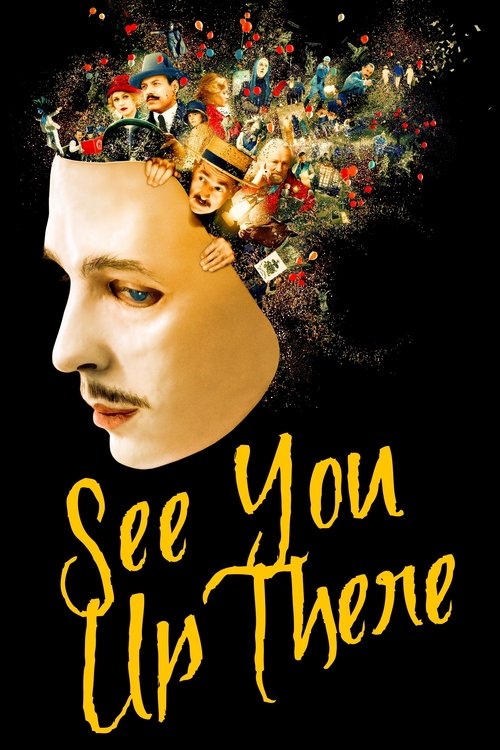
The central plot of "See You Up There" is a pair of converging scams born from the ashes of World War I. The first is perpetrated by Édouard Péricourt and Albert Maillard. After Édouard is disfigured and fakes his death, they launch a nationwide fraud, selling subscriptions for war memorials they never intend to build. They create a catalog of elaborate designs and collect down payments from hundreds of towns, planning to flee with the money.
The second, more sinister scam is run by Lieutenant Pradelle. Having married Édouard's sister Madeleine, he wins a government contract for military reburials. To maximize profit, he uses undersized coffins, sometimes chopping up bodies to fit, and buries soldiers in cheap, unstable ground, all while billing the state for fraudulent services. It is a grotesque enterprise built on the desecration of the war dead.
The climax sees these plots intertwine. Édouard, through an anonymous tip, puts an incorruptible government official, Joseph Merlin, on Pradelle's trail. As Pradelle's scheme unravels, he is tasked by his father-in-law, Marcel Péricourt, to find the perpetrators of the monument scam to deflect from his own scandal. Pradelle tracks the fraud back to Albert and Édouard.
In the final confrontation, Pradelle catches Albert as he is about to flee with the money. As they fight, they are buried under a pile of gravel in a cemetery—a fitting end for Pradelle, who is killed, while Albert is saved. Meanwhile, Édouard arranges a final meeting with his father on the terrace of a grand hotel. He removes his mask, allowing his father to finally see and acknowledge him. After this silent, tragic reconciliation, Édouard leaps from the balcony to his death, a final, deliberate act of escape. The film ends as it began, with Albert in Morocco, having successfully fled with the money and Louise, ready to start a new life.