See You Up There
Au revoir là-haut
Overview
Set in the aftermath of World War I, "See You Up There" chronicles the intertwined fates of two soldiers, Albert Maillard and Édouard Péricourt. In the final, senseless days of the war, their villainous Captain Pradelle orders a suicidal assault. During the chaos, Édouard, a gifted young artist, saves Albert from being buried alive but is horrifically disfigured in the process, losing his lower jaw.
Unable to face his wealthy, estranged family and the world, Édouard decides to vanish, convincing Albert to report him as killed in action. Back in a Paris eager to forget the war, the two men struggle to survive. Édouard, now mute and dependent on morphine, channels his trauma and artistic genius into creating a series of elaborate, expressive masks to hide his injuries. Feeling indebted and responsible, Albert cares for his friend. Together, they devise an audacious scam: selling designs for fake war memorials to towns across France, a grand swindle that serves as both revenge against the society that discarded them and a desperate bid for a new life.
Their scheme runs parallel to another, more ghoulish one orchestrated by the corrupt Captain Pradelle, who has married Édouard's sister and is making a fortune from fraudulent military burials. The two cons are destined to collide, forcing a final confrontation between the forgotten soldiers and the war profiteers thriving in the new era.
Core Meaning
"See You Up There" is a powerful indictment of the absurdity and brutality of war, and more pointedly, its cynical aftermath. Director Albert Dupontel uses the story of two traumatized veterans to explore how a nation's patriotic fervor quickly gives way to neglect, leaving those who sacrificed the most to fend for themselves. The film posits that in a corrupt world that profits from death and glorifies memory while scorning the living survivors, the ultimate act of rebellion and survival is a theatrical, audacious swindle. It is a darkly humorous, picaresque tale about the "lost generation," contrasting the vibrant, frantic energy of the Jazz Age with the lingering scars of the trenches. Through Édouard's art—his magnificent, expressive masks—the film champions the power of creativity to reclaim identity, communicate unspeakable pain, and create beauty out of horror. Ultimately, it's a story of poetic justice, suggesting that true honor is found not in monuments, but in loyalty and defiance against a hypocritical society.
Thematic DNA
The Lost Generation and Post-War Disillusionment
The film vividly portrays the plight of soldiers returning from WWI to a society that wants to move on. Albert and Édouard are physically and psychologically scarred, unable to reintegrate into a civilian life that seems trivial and hypocritical. France is obsessed with commemorating the dead through monuments but ignores the needs of the living veterans, many of whom are left destitute and traumatized. This theme is central to their decision to launch the memorial scam, an act of cynical revenge against the nation that forgot them.
Art as Survival and Rebellion
For Édouard, art is not a luxury but a necessity for survival. His ornate masks are his only means of communication and identity after his injury. They are more than a concealment of his disfigurement; they are a form of expression, allowing him to convey emotion, wit, and defiance without a voice. The monument scam itself is a form of performance art, a grand, satirical commentary on the commercialization of grief and memory. It is through his artistic vision that Édouard finds a way to fight back against the world that destroyed him.
Corruption and Profiteering
The film contrasts two types of swindles. On one hand, there is the desperate, almost artistic scam by Albert and Édouard. On the other is the far more sinister and ghoulish profiteering of Captain Pradelle. Pradelle embodies the moral corruption of the era, first by needlessly sending men to die for his own glory, and then by making a fortune from mass graves and undersized coffins. The film uses this parallel to condemn the hypocrisy of the establishment, where the true criminals are those in power who exploit patriotism and death for personal gain.
Identity and Reinvention
War strips the characters of their former identities. Édouard literally loses his face and fakes his own death, allowing him to be reborn behind his masks. Albert, a modest bookkeeper, is forced into the role of caregiver, thief, and accomplice. The film explores their attempts to forge new identities in a world that no longer has a place for them. The masks symbolize this freedom to reinvent oneself, to become someone else when your own self is too painful to inhabit.
Character Analysis
Édouard Péricourt
Nahuel Pérez Biscayart
Motivation
Initially driven by a desire to escape his family and the horrors of his injury, his motivation evolves into a quest for revenge against a society that has discarded him and the captain who ruined his life. He is also driven by a profound artistic need to create and express himself, even without a voice.
Character Arc
Édouard begins as a rebellious, talented artist from a wealthy family, estranged from his stern father. The war shatters him physically and mentally, leaving him disfigured and mute. Rather than succumb, he channels his despair into creating his masks, transforming his trauma into art. He becomes the mastermind of the memorial scam, an act of vengeance that is also his final, grand artistic statement. His journey is one of tragic defiance, culminating in a final act of liberation where he confronts his father and chooses his own exit.
Albert Maillard
Albert Dupontel
Motivation
His primary motivation is survival and a powerful sense of obligation to care for Édouard, the man who saved his life. He is driven by guilt and loyalty, even when it leads him down a criminal path. He also harbors a simple desire for a normal life and love, which seems perpetually out of reach.
Character Arc
Albert is an ordinary, timid accountant thrown into the extraordinary horror of war. Saved by Édouard, he is bound by a deep sense of debt and loyalty. He is the pragmatic, anxious counterpart to Édouard's flamboyant artistry, often acting as his caretaker and the grounded force in their scheme. Initially a passive victim of circumstance, he is drawn into the scam against his better judgment but eventually finds the courage to confront Pradelle and seek a life for himself, moving from a man haunted by the past to one who can finally look forward.
Henri d'Aulnay-Pradelle
Laurent Lafitte
Motivation
Pradelle is driven by pure greed, ambition, and a sense of aristocratic entitlement. He seeks to restore his family's fortune and climb the social ladder, viewing the war and its aftermath as nothing more than a series of business opportunities. He is completely devoid of honor or empathy.
Character Arc
Pradelle is an aristocrat and a ruthless, ambitious captain who shows no character development; he is corrupt from beginning to end. He starts the film by murdering his own men to trigger a pointless battle for glory. After the war, his villainy simply changes form. He marries into Édouard's wealthy family and launches a lucrative but disgusting business involving fraudulent burials of war dead. His arc is not one of change, but of escalating greed and amorality, leading to an inevitable downfall when his crimes are exposed.
Marcel Péricourt
Niels Arestrup
Motivation
His motivations are complex, rooted in societal expectation, pride, and a repressed love for his son. After Édouard's supposed death, he is driven by guilt and a desire to create a legacy, both for his son and for himself. He seeks to atone for his emotional neglect through grand, public gestures.
Character Arc
Marcel Péricourt is a powerful, cold patriarch who disapproves of his artistic son, Édouard. Believing Édouard to be dead, he is consumed by a belated and remorseful form of grief. His arc is one of thawing and regret. He attempts to honor his son's memory by commissioning a grand war memorial, unknowingly funding his son's escape. The final confrontation with the masked Édouard forces him to acknowledge his failings as a father, leading to a moment of tragic, silent reconciliation.
Symbols & Motifs
The Masks
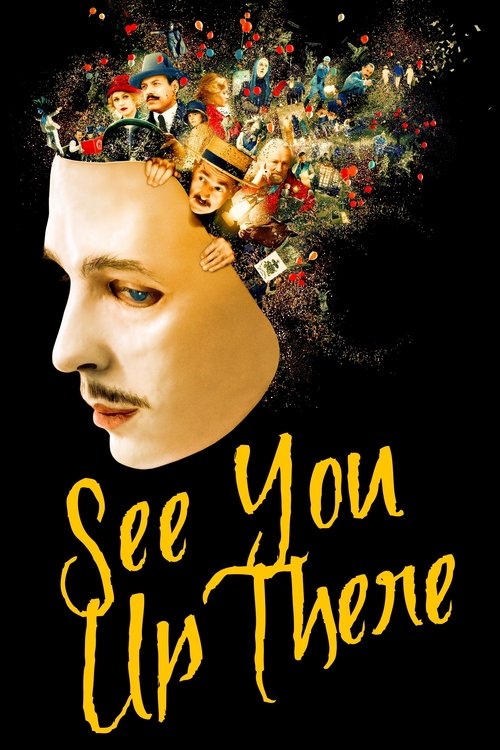
The masks are the film's most powerful symbol. They represent Édouard's lost voice and face, but also his defiant artistic spirit. Each mask is a new identity, a mood, and a form of communication, transforming a horrific injury into a source of stunning, surreal beauty. They symbolize the facade society itself puts on after the war—a beautiful, roaring twenties exterior hiding the ugly trauma underneath. They are both a prison and a liberation for Édouard.
Édouard creates and wears dozens of unique masks throughout the film to hide his disfigured jaw. They range from simple and melancholic to extravagantly theatrical, often reflecting his emotional state or the specific needs of their scam. They become his primary way of interacting with the world, with the young girl Louise often acting as his interpreter.
War Memorials
The war memorials (or the lack thereof) symbolize the hollow and commercialized nature of national grief. The scam itself is a cynical commentary on how society prefers to invest in stone effigies rather than care for the living soldiers. It highlights the absurdity of patriotic remembrance when the ideals fought for have been corrupted.
The central plot revolves around Albert and Édouard's fraudulent business of selling designs for war memorials to municipalities across France. They create an elaborate catalog of heroic, jingoistic, and sometimes absurd designs, none of which they ever intend to build.
Being Buried Alive
This recurring motif symbolizes the suffocating trauma of war and the feeling of being trapped by one's circumstances. It represents both a literal death in the trenches and the metaphorical death of the soldiers' former selves. Albert's survival from this ordeal ties him irrevocably to Édouard and the horrors they endured.
The film's pivotal trench scene shows Albert being pushed into a shell crater by Pradelle and slowly being buried alive, only to be rescued by Édouard at the last second. The imagery of suffocation and confinement reappears in their cramped, impoverished post-war life, contrasting with the open opulence of the Péricourt and Pradelle households.
Philosophical Questions
What is the true meaning of remembrance and honor?
The film critically examines society's methods of honoring its war dead. It juxtaposes the official, state-sanctioned creation of monuments and cemeteries with the neglect of the living, traumatized soldiers. The central scam mocks the very idea of memorialization, suggesting that these stone tributes are more about assuaging collective guilt and political posturing than genuine honor. The film asks whether true honor lies in grand monuments or in the quiet loyalty and care shown between individuals like Albert and Édouard.
Can art be a valid response to profound trauma?
Édouard's entire post-war existence is an exploration of this question. His disfigurement is a direct result of violence, and his response is not to hide in shame but to create. His masks are a defiant act of turning horror into beauty. The film suggests that art is not merely decorative but can be a vital tool for survival, communication, and rebellion. It allows Édouard to process his trauma, reclaim his identity, and even exact revenge, proposing that creativity can be the most potent weapon against despair.
Where is the line between crime and justice in a corrupt society?
The film presents two parallel crimes: the artistic fraud of Albert and Édouard and the ghoulish war-profiteering of Pradelle. While our protagonists are technically criminals, the film frames their actions as a form of poetic justice. They scam a society that has abandoned them, while Pradelle, a decorated officer, commits far more heinous acts under the guise of patriotism and business. The film forces the audience to question conventional morality, suggesting that in a system where the powerful are the biggest criminals, an illegal act of rebellion can be the most just course of action.
Alternative Interpretations
While the film is largely a straightforward narrative, the ending offers room for interpretation, particularly regarding Édouard's final act. On one level, his leap from the hotel balcony is a tragic suicide, the final capitulation of a man too broken to continue living. He achieves his goal—reuniting with his father and securing Albert's future—and has nothing left to live for.
However, an alternative reading views his final act as one of ultimate liberation and artistic performance. Throughout the film, he lives through artifice and masks. By revealing his face to his father and then leaping, he is not just ending his life but completing his final masterpiece. It is a theatrical, defiant gesture, a final "au revoir" on his own terms. Having reconciled, in a way, with his father, he sheds the weight of his past and his trauma in one dramatic, aestheticized exit. The film's more allegorical ending, which differs from the novel's, supports this view of his death as a transcendent, almost beautiful release rather than a purely desperate act.
Cultural Impact
"See You Up There" made a significant impact on French cinema upon its release. As a lavish adaptation of a Prix Goncourt-winning novel, it was a high-profile production that successfully blended the scale of a historical epic with a quirky, tragicomic sensibility. The film was widely praised for its ambitious visual style, production design, and cinematography, which captured both the grim reality of the trenches and the vibrant, almost fantastical atmosphere of post-war Paris. Critics compared its visual flair to the works of Jean-Pierre Jeunet ("Amélie," "A Very Long Engagement"), another director known for his stylized, whimsical depiction of French history.
The film resonated with audiences and critics for its powerful exploration of the aftermath of WWI, a pivotal and traumatic event in French collective memory. Released during the centenary of the war, it offered a fresh, cynical, and deeply human perspective, focusing not on the glory of battle but on the forgotten survivors and the societal corruption that followed. Its success at the César Awards, where it won five major awards including Best Director, cemented its status as a major achievement in contemporary French filmmaking. It demonstrated that a large-budget period film could also be an auteur-driven, poignant, and darkly humorous work of art.
Audience Reception
Audiences generally responded very positively to "See You Up There," praising it as a captivating, unique, and visually stunning film. Many viewers were enchanted by its blend of genres, describing it as a beautiful and magical story that successfully mixes dark humor, tragedy, and fantasy. The performances were frequently highlighted as brilliant and emotionally powerful, particularly Nahuel Pérez Biscayart's ability to convey so much emotion from behind a mask. The production values, including the costumes, sets, and especially the creative design of the masks, were widely lauded.
Points of criticism were less common but tended to focus on the narrative's complexity and tone. Some viewers found the story became progressively bizarre or that the mix of comedy and dark drama was occasionally uneven. A few critics felt that in adapting a dense 600-page novel, the film had to condense so many plot points that character development sometimes felt rushed, prioritizing visual splendor over emotional depth. Despite these minor criticisms, the overall verdict from audiences was that "See You Up There" was a magnificent, ambitious, and deeply moving piece of cinema.
Interesting Facts
- The film is an adaptation of the 2013 novel of the same name by Pierre Lemaitre, which won the prestigious Prix Goncourt, France's highest literary prize.
- Director Albert Dupontel also plays the main role of Albert Maillard. Initially, another actor was cast, but when he had to drop out, Dupontel stepped into the role himself.
- The screenplay went through 13 different versions before filming began.
- Author Pierre Lemaitre was involved in the screenplay adaptation and approved of the changes made for the film, including the different ending, which is more allegorical and less cynical than the book's.
- The title, "Au revoir là-haut" (literally "See you up there"), is taken from a real farewell letter written by a French soldier executed in 1914.
- The film was a major critical and commercial success in France, winning five César Awards (the French equivalent of the Oscars), including Best Director for Albert Dupontel.
- The intricate and expressive masks were a huge part of the production. 38 different masks were created for Édouard, designed by Cécile Kretschmar to convey a wide range of emotions and reflect artistic movements of the era, such as Cubism.
- The opening trench warfare sequence was praised for its technical prowess, with critics noting its fluid, ambitious camera movements reminiscent of Stanley Kubrick's "Paths of Glory".
Easter Eggs
Homage to "Paths of Glory"
The long, sweeping tracking shots that follow soldiers through the trenches at the beginning of the film are a direct visual homage to Stanley Kubrick's 1957 anti-war classic "Paths of Glory," which also deals with the corruption and callousness of the French military high command during WWI.
Artistic Influences in the Masks
Édouard's masks are not random; they are heavily influenced by the art of the era. Inspirations from Picasso, Cubism, and Marcel Duchamp's Dadaism can be seen in their designs, grounding the film's fantasy elements in the real artistic movements of the 1920s.
Reference to "The Eyes Without a Face"
The focus on masks and facial disfigurement has led critics to draw comparisons with Georges Franju's iconic 1960 horror film "Les Yeux sans visage" ("The Eyes Without a Face"), another French masterpiece dealing with identity and surgically altered faces.
⚠️ Spoiler Analysis
Click to reveal detailed analysis with spoilers
Frequently Asked Questions
Explore More About This Movie
Dive deeper into specific aspects of the movie with our detailed analysis pages
Comments (0)
No comments yet. Be the first to share your thoughts!