Skip to content
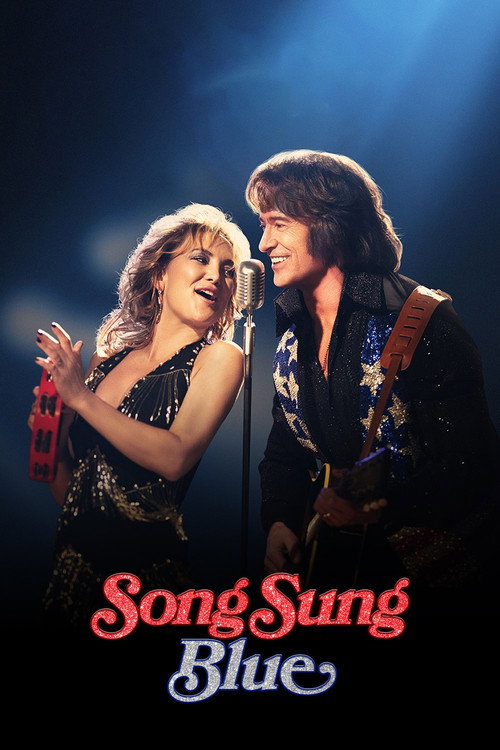
Song Sung Blue
A tender heartland romance where two bruised dreamers borrow another man's songs to find their own voice — sequins and stage lights flickering against the long Milwaukee dark.
Song Sung Blue

Song Sung Blue

"Inspired by a legend. Bound by a dream."

15 December 2025 United States of America 133 min 7.4 (313)

Director: Craig Brewer

Cast: Hugh Jackman, Kate Hudson, Michael Imperioli, Fisher Stevens, Jim Belushi

Drama Romance Music Borrowed songs, authentic lives Love as a working partnership Second chances and late-blooming dreams Catastrophe and comeback Blue-collar showbusiness
Budget: $30,000,000
Box Office: $57,889,762

Overview

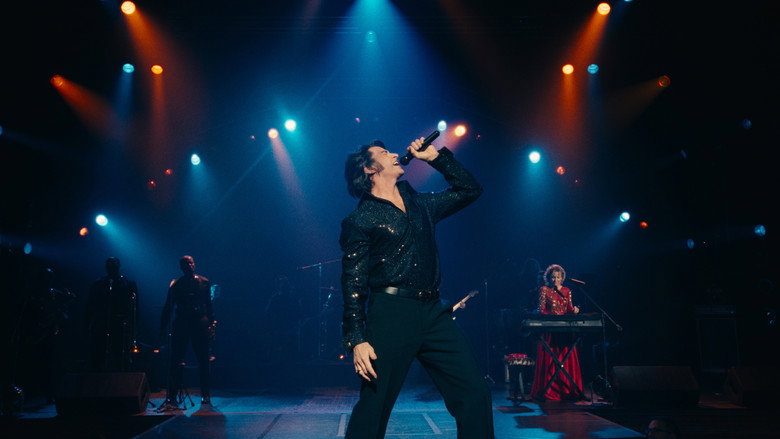
Song Sung Blue is Craig Brewer's 2025 musical drama, which he wrote, produced and directed, adapting Greg Kohs' 2008 documentary of the same name — a film Brewer first encountered at the Indie Memphis film festival. It tells the true story of Mike and Claire Sardina (Hugh Jackman and Kate Hudson), a Milwaukee couple who, in the late 1980s, formed the Neil Diamond tribute act Lightning & Thunder.

Both are musicians whose ambitions have already been dented by life — second marriages, kids, day jobs, bar gigs that go nowhere. What begins as a novelty act built on borrowed hits becomes something bigger: a local phenomenon, a livelihood, and the glue holding two patched-together lives together. Michael Imperioli, Fisher Stevens and Jim Belushi round out the world of clubs, promoters and hangers-on around them.

Brewer frames the story as a chronicle of highs and lows rather than a standard rise-to-fame arc: the couple's Milwaukee-area success is real but modest, and it is tested by a life-altering accident and the slow, unglamorous work of a comeback. The film's interest lies less in stardom than in why ordinary people need songs at all — and what it costs to spend a life singing someone else's.

Core Meaning

Brewer's central argument is that a tribute act is not a lesser art form but a sacrament. Mike and Claire never write the songs that define them, and the film insists this doesn't diminish them: joy delivered secondhand is still joy, and a man who makes a room full of strangers feel loved for two hours has done something real.

Beneath that sits a quieter idea about persistence as a form of faith. Variety's review noted the film plays like a different kind of faith-based movie — the belief here is not religious but musical, a conviction that the next show, the next chorus, will redeem the week. The Sardinas' story argues that it's never too late to find love or chase a dream, while refusing to pretend that dreams protect anyone from what's coming.

Ultimately the film is about marriage as a duet: two people who are more capable together than apart, whose partnership is literally staged every night, and whose greatest performance is continuing to show up for each other after the worst has happened.

Thematic DNA

Borrowed songs, authentic lives 25%
Love as a working partnership 22%
Second chances and late-blooming dreams 20%
Catastrophe and comeback 18%
Blue-collar showbusiness 15%

Borrowed songs, authentic lives

Mike and Claire build an entire identity out of another artist's catalogue. The film treats the tribute band not as imitation but as translation: Neil Diamond's songs become the language the couple uses to say things they can't say plainly — courtship, apology, grief. Jackman's performances are pitched to signify what audiences love about Diamond rather than to impersonate him, which is exactly the film's point about the difference between copying and channeling.

Love as a working partnership

The romance is inseparable from the act. Lightning and Thunder are a married couple whose bond is rehearsed, performed and monetized nightly, so every strain in the marriage becomes a strain in the music and vice versa. The film tracks how two people with previous marriages and prior disappointments decide, repeatedly, to keep choosing each other — including through disability, financial precarity and the temptation to quit.

Second chances and late-blooming dreams

Neither character is young or undiscovered; they are down-on-their-luck musicians whose window supposedly closed. The film's insistence that it's never too late is dramatized through modest, local success — packed Milwaukee rooms rather than arenas — arguing that scale is not the measure of a dream fulfilled.

Catastrophe and comeback

A horrific accident splits the story in half, and the film's second movement is about rebuilding a life and an act around permanent loss. Critics observed that the movie swings between triumph and tragedy; that oscillation is structural, mirroring how the Sardinas actually lived — a run of luck, a disaster, a return to the stage, another disaster.

Blue-collar showbusiness

Set in Milwaukee clubs, fairs and function rooms, the film honors the unglamorous economy of regional entertainment: promoters, bar owners, sidemen and the endless load-in. The supporting characters played by Michael Imperioli, Fisher Stevens and Jim Belushi populate a working-class showbiz ecosystem where art and rent are never separate questions.

Character Analysis

Mike Sardina ("Lightning")

Hugh Jackman

Archetype: The dreamer / holy fool showman Key Trait: Irrepressible, self-aware generosity of spirit

Motivation

To perform — and, more deeply, to be worth something to the people in the room and to Claire. The applause is not vanity so much as evidence that his life adds up.

Character Arc

Introduced as a talented but stalled musician with a history of false starts, Mike finds his calling not in originality but in service — becoming the vessel through which a crowd gets its Neil Diamond. Success as Lightning gives him a purpose and a marriage; catastrophe forces him to become a caretaker as well as a frontman. Reviewers singled out how he acknowledges his own flaws even as he commands the stage, and the arc ends at a career-high performance rather than in decline.

Claire Sardina ("Thunder")

Kate Hudson

Archetype: The grounded partner turned survivor-hero Key Trait: Warmth braced by steel

Motivation

To build a stable life that still has music in it — and, later, to prove that neither a car nor grief gets the last word on who she is.

Character Arc

Claire begins as the pragmatic half of the duo, a singer with her own thwarted ambitions who bets on Mike and on the act. A devastating accident and its permanent physical consequences remake her, and the film's back half is her refusal to be defined by it — returning to the stage, then, after loss, taking authorship of her own story. Critics called it Hudson's strongest work since Almost Famous, praising the warmth and empathy she brings to the character's struggles.

Symbols & Motifs

The color blue

Meaning:

Blue is the film's emotional key signature — the Diamond hit that gives the movie its title makes melancholy singable. It signifies sorrow that has been transmuted into performance: the thing you can dance to precisely because it hurts.

Context:

Embedded in the title, the song, and the stage lighting of the act's shows; the film repeatedly returns to the idea that the saddest song in the set is also the one the crowd loves most.

Lightning and Thunder

Meaning:

The stage names encode the marriage itself: two halves of a single storm, one seen and one heard, meaningless apart. It also foreshadows the film's structure — the flash of success, then the delayed, inevitable crash.

Context:

Used as the band's billing throughout, and as the couple's private shorthand for how they function as a unit both onstage and at home.

The garden

Meaning:

Tending growing things stands for the domestic life the couple keeps trying to cultivate alongside the act. After the accident it becomes a symbol of reclaiming ground where you were once destroyed — care as defiance.

Context:

Claire is gardening in the front yard when her life is shattered by an out-of-control car; the film closes by returning her to that same patch of earth, planting rather than being planted.

The stage costume and sequins

Meaning:

The spangled Diamond-style shirt is armor: a persona that lets an ordinary Milwaukee man become someone worth watching. It symbolizes the gap between the self that pays bills and the self that gets applauded.

Context:

Worn for every gig, the outfit marks the transition from Mike Sardina to "Lightning," and the moments he is seen out of it are the film's most vulnerable.

The microphone as shared object

Meaning:

Passed, shared and sung into together, the mic is the film's image of a marriage that only works when both voices are on it — and of the terrifying silence when one of them stops.

Context:

Duet staging recurs across the couple's performances, from small bars to their career-peak show, making their physical proximity onstage a barometer of the relationship.

Neil Diamond's catalogue itself

Meaning:

Diamond functions as an absent patron saint — a figure whose songs about longing, immigration and belonging give working people a vocabulary for their own dignity.

Context:

Diamond never needs to appear for his presence to organize the film; the songs are diegetic, performed by the characters rather than dropped in as score.

Philosophical Questions

Can a life spent performing someone else's art be a fully realized creative life?

The film puts the question directly: Mike and Claire's masterpiece is a set list they didn't write. Brewer answers by shifting the criterion from authorship to effect — what the act does for a room of strangers — while never quite denying the ache of never having written your own "Sweet Caroline."

What is the relationship between joy and grief?

A song called "Song Sung Blue" is a happy song about being sad, and the movie is built on that paradox. It repeatedly stages celebration and catastrophe in close proximity, suggesting the two are not opposites but the same energy pointed in different directions.

Does a dream still count if it stays small?

The Sardinas succeed regionally and never nationally. By refusing to grant them a conventional breakout, the film asks whether we can accept fulfillment on a modest scale — or whether we've been trained by biopics to see anything short of fame as failure.

How much of a marriage survives the loss of what it was built on?

When the act is interrupted by injury and, finally, by death, the film tests whether the partnership was ever really about the music. Its answer lies in what Claire does after the songs stop.

Why do strangers need a stand-in for someone they'll never meet?

The crowds who come to see Lightning & Thunder know it isn't Neil Diamond, and come anyway. The film treats this willing suspension of disbelief as a form of communal faith — an argument reviewers picked up in calling it a faith-based movie of a secular kind.

Alternative Interpretations

Celebration or sentimentality? The most persistent split among viewers is whether the film's relentless emotional swings are earned. One reading takes them as formally honest — real lives don't modulate, and the Sardinas' actually did lurch from career highs to catastrophes. The opposing reading, voiced by the film's harsher critics, is that the movie pendulum-swings from triumph to tragedy for effect, using true events as permission for manipulation.

Full ending explanation

Cultural Impact

Song Sung Blue arrived at the end of a decade dominated by music biopics about superstars — and pointedly told the story of people who were not stars. By dramatizing a tribute act from Milwaukee rather than a chart-topper, it joined a small counter-tradition of films about the labor and dignity of working musicians, and reviewers framed it as an argument that the fan's relationship to a song is as worthy of cinema as the songwriter's.

Critically it landed well without unanimity: a 77% Tomatometer from more than 200 reviews, with a consensus crediting Jackman and Hudson's heartfelt performances for keeping the film from being a mere cover version of the documentary it adapts. Variety read it as a different kind of faith-based movie; Deadline called it a surprising biopic of a tribute band; detractors objected that it lurches between triumph and tragedy without modulation.

With audiences the response was extraordinary — a 97% Popcornmeter, reported as among the highest audience scores ever registered on Rotten Tomatoes — and the $30 million production grossed roughly $58 million after its Christmas Day 2025 release, making it a genuine word-of-mouth holiday success. The film also renewed attention on Neil Diamond's catalogue and on Greg Kohs' 2008 documentary, and it functions culturally as a defense of the karaoke bar, the county fair and every other stage where borrowed songs do real emotional work.

Audience Reception

Overwhelmingly warm. The film registered a 97% audience score on Rotten Tomatoes — reported as one of the highest ever recorded on the site — against a 77% critics score, an unusually wide gap that says a lot about who the movie was made for. Its $58 million gross on a $30 million budget confirmed strong word of mouth from its Christmas Day 2025 opening.

What audiences praised:

  • Hugh Jackman's live musical performances, repeatedly described as transcendent in their ability to capture what people love about Neil Diamond;
  • Kate Hudson's turn as Claire, widely called her best work since Almost Famous;
  • the couple's chemistry and the film's unusual affection for ordinary, non-famous people;
  • the emotional payoff — viewers overwhelmingly reported crying, and treating that as the point.

Where the criticism landed: the tonal whiplash between triumph and tragedy was the chief complaint, with one critic writing that the film swings between the two with all the self-control of a drunk driver. Others felt it smooths the rougher edges of the documentary it adapts, and a few questioned whether a story of this scale needed a star-driven feature at all.

Points of contention: how much the screenplay reshapes the real chronology, whether the depiction of the accident and its aftermath is compassionate or exploitative, and whether the ending consoles too readily. Verdict: a crowd-pleaser with real craft behind it — critics admired it, audiences adored it.

Interesting Facts

  • The film is based on Greg Kohs' 2008 documentary Song Sung Blue, about the real Milwaukee Neil Diamond tribute act Lightning & Thunder.
  • Director Craig Brewer (Hustle & Flow) discovered Kohs' documentary at the Indie Memphis film festival in Tennessee and found it irresistible movie material.
  • Brewer wrote the screenplay in addition to directing and producing the film.
  • Although the story is set in and around Milwaukee, the movie was shot in and around northern New Jersey.
  • Hugh Jackman and Kate Hudson perform the Neil Diamond songs themselves as Mike and Claire Sardina.
  • The film premiered at AFI Fest in the fall of 2025 before Focus Features released it nationwide on December 25, 2025.
  • It was made for roughly $30 million and grossed about $58 million worldwide.
  • The real Claire Sardina was hit by an out-of-control car while gardening in her front yard on May 10, 1999, and part of her left leg was amputated.
  • The real Mike Sardina died in 2006 at age 55 from a head injury.
  • The film earned a 77% critics score and a 97% audience score on Rotten Tomatoes, with the audience number reported as one of the highest ever recorded on the site.
  • The US DVD release followed on February 17, 2026.

Easter Eggs

An unexpected phone call from Eddie Vedder

Among the true-life details dramatized in the film is a surprise call involving the Pearl Jam frontman — a nod to how far the Sardinas' small-time act rippled outward, and one of the moments audiences most often ask whether the movie invented. Fact-checks of the film single it out alongside the heart attack and the accident.

The title itself is a Neil Diamond song

Song Sung Blue was Diamond's 1972 hit, and the phrase does triple duty: the name of the source documentary, the name of the film, and a thesis statement about turning sadness into something people sing along to.

Craig Brewer's Hustle & Flow lineage

Brewer's breakthrough was also about a working-class outsider who believes music can redeem an ordinary life. Viewers familiar with that film will recognize the same faith in the regional, unfashionable performer as a legitimate artist.

A cast drawn from blue-collar-showbiz character actors

Casting Michael Imperioli, Fisher Stevens and Jim Belushi — faces associated with clubs, crews and hustlers in American screen tradition — quietly signals the milieu the film is honoring.

Frequently Asked Questions

Explore More About This Movie

Dive deeper into specific aspects of the movie with our detailed analysis pages

Comments (0)

Leave a comment

No comments yet. Be the first to share your thoughts!

Similar Movies