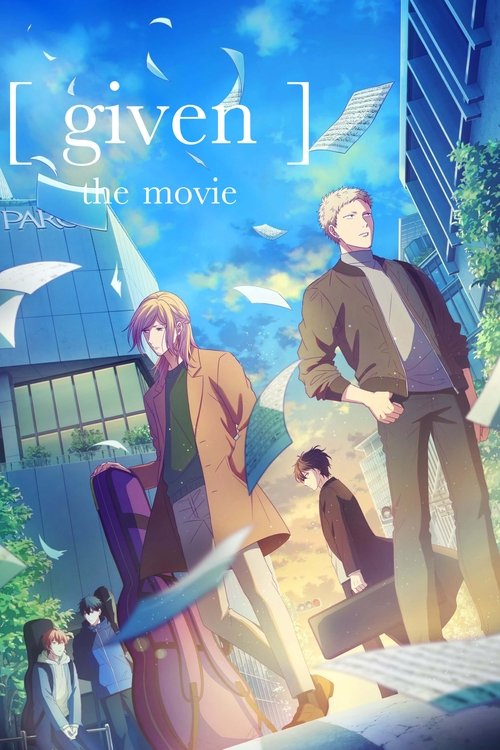
Given
映画 ギヴン
"A story of a certain summer."
Overview
The 2020 animated film "Given" serves as a direct sequel to the popular anime series, shifting its focus from the main couple, Mafuyu and Ritsuka, to the more tumultuous relationship between the band's other members: bassist Haruki Nakayama and drummer Akihiko Kaji. The narrative delves into the complexities of their dynamic, particularly Akihiko's toxic and codependent relationship with his ex-boyfriend and roommate, the gifted violinist Ugetsu Murata.
As the band, "Given," prepares for a major music festival audition, Haruki grapples with his long-held, unrequited feelings for Akihiko. The film explores the messy and painful process of letting go of past loves and the courage it takes to embrace new beginnings. Music remains a central element, acting as a catalyst for emotional expression and healing for the characters as they navigate their tangled relationships.
Core Meaning
The central message of "Given" (2020) revolves around the painful but necessary process of moving on from toxic relationships and the healing power of both music and genuine affection. The director, Hikaru Yamaguchi, portrays the complexities of love, highlighting that it isn't always gentle or straightforward. The film suggests that true growth often requires confronting one's own flaws and making difficult choices to break free from destructive patterns. It's a story that emphasizes that while past relationships shape us, they do not have to define our future, and that new love can flourish even in the aftermath of heartbreak.
Thematic DNA
Letting Go and Moving On
This is the film's primary theme, explored through the central love triangle of Akihiko, Ugetsu, and Haruki. Akihiko and Ugetsu are trapped in a codependent cycle, unable to fully separate despite the pain their relationship causes. The film meticulously portrays the difficulty of severing deep emotional ties, even when they are unhealthy. Akihiko's journey is about finally choosing to leave this toxic dynamic behind to become a better person, not just for himself but for a potential future with Haruki. Ugetsu, too, must learn to let go to pursue his own path without being tied to a love that stifles him.
Unrequited Love and Self-Worth
Haruki's character arc is a poignant exploration of unrequited love. He silently pines for Akihiko, often feeling inadequate compared to the other talented members of the band. His gentle and caring nature is contrasted with the passionate and destructive energy of Akihiko and Ugetsu's relationship. The film delves into his internal struggles with self-doubt and the pain of loving someone who is emotionally unavailable. His journey is about finding his own strength and worth, independent of Akihiko's affections, which ultimately makes a healthy relationship between them possible.
The Complexity of Adult Relationships
Unlike the high school romance focus of the TV series, the movie delves into more mature and complicated romantic territory. It explores the "murkier aspects" of relationships, including codependency, emotional manipulation, and a controversial scene involving a non-consensual sexual advance. The film does not shy away from depicting its characters as flawed individuals who make serious mistakes, reflecting a more grounded and realistic portrayal of adult relationships.
Music as Emotional Expression
While the focus shifts from Mafuyu's songwriting, music remains a crucial vehicle for the characters' emotions. Mafuyu, now in a more supportive role, writes a new song inspired by the turbulent emotions he observes between Akihiko, Haruki, and Ugetsu. The film also highlights the contrast between rock music and the classical violin performances of Akihiko and Ugetsu, using the different genres to reflect their distinct personalities and emotional states. The climactic musical performance serves as a cathartic release, articulating feelings that the characters struggle to express in words.
Character Analysis
Akihiko Kaji
Takuya Eguchi
Motivation
Initially, his motivation is a confusing mix of lingering attachment to Ugetsu and a casual attraction to Haruki. As the story progresses, his primary motivation becomes the desire to break free from his self-destructive patterns and build a healthier life and relationship, spurred by his growing feelings for Haruki and the realization of the pain he's caused.
Character Arc
Akihiko begins the film as a 'disaster'—a playboy drummer caught in a destructive, on-and-off relationship with his ex, Ugetsu. He is emotionally immature and hurts those around him, particularly Haruki. His arc is one of confronting his own toxicity and making the painful decision to finally break away from Ugetsu. He hits rock bottom after a particularly ugly confrontation, which forces him to reflect on his actions. By the end, he resolves to change, dedicating himself to his music and taking steps to become a better person, ultimately confessing his feelings for Haruki in a more mature and stable state of mind.
Haruki Nakayama
Masatomo Nakazawa
Motivation
His main motivation is his deep and unwavering love for Akihiko. He wants to be with him and support him, but he also grapples with feelings of inadequacy and the fear of his love being unrequited. Ultimately, his motivation evolves to also include self-preservation and the desire for a healthy, reciprocal relationship.
Character Arc
Haruki starts as the gentle, reliable bassist who secretly harbors deep feelings for Akihiko. He is often a passive observer of Akihiko's drama, suffering in silence. His arc involves enduring emotional turmoil and a violation of his trust by Akihiko. However, this experience forces him to find his own strength. He learns to set boundaries and prioritize his well-being. While he does forgive Akihiko, it is on the condition that Akihiko genuinely changes. His journey is about maintaining his kind nature while learning to demand the respect and love he deserves.
Ugetsu Murata
Shintaro Asanuma
Motivation
Ugetsu is motivated by a conflicting desire for both musical genius and his love for Akihiko. He believes he cannot have both, which leads to his self-destructive behavior within the relationship. He is driven by a deep-seated belief that for their talents to flourish, they must be apart, yet he is emotionally unable to make the final break for most of the film.
Character Arc
Ugetsu is a violin prodigy who is Akihiko's ex-boyfriend and roommate. Their relationship is a painful mix of love and resentment; Ugetsu believes their romance holds them both back musically. He often acts cruelly to push Akihiko away, yet can't fully let go. His arc is one of mutual release. Through Mafuyu's song, which reflects their painful story, he finds the strength to finally sever ties with Akihiko, understanding that it's necessary for both of them to move forward and truly dedicate themselves to their music and find happiness.
Symbols & Motifs
Apartment Spaces
The characters' apartments symbolize the nature of their relationships and their emotional states.
Ugetsu's apartment, which he shares with Akihiko, is depicted as a cold, dark, and minimalist space, often in monochrome colors. This reflects the suffocating, impersonal, and depressing nature of their relationship. In contrast, Haruki's apartment is shown to be warm, colorful, and homey, symbolizing the potential for a healthier, more liberating, and supportive relationship for Akihiko. Akihiko's eventual move from Ugetsu's place to Haruki's signifies his conscious decision to leave a toxic past and embrace a brighter future.
The Violin
The violin represents Akihiko's past, his connection to Ugetsu, and his own neglected talent and emotional state.
Both Akihiko and Ugetsu are talented violinists, and the instrument is deeply intertwined with their shared history. For much of the film, Akihiko has a strained relationship with the violin, reflecting his overall unhappiness and feeling of being stuck. His decision to start playing seriously again at the end of the film is a powerful symbol of his personal growth and his commitment to moving forward and becoming someone worthy of Haruki's love.
Philosophical Questions
Can love and immense talent coexist without one destroying the other?
The film explores this question through the relationship between Akihiko and Ugetsu, both talented violinists. Ugetsu firmly believes that their love for each other is a cage that hinders their musical genius. Their dynamic suggests that when two passionate artists are romantically involved, their individual ambitions and competitive natures can create a toxic environment that stifles both their emotional well-being and their creative potential. The film's resolution, where they finally separate for good, seems to suggest that for some individuals, true artistic fulfillment can only be achieved through solitude and sacrifice.
What does it mean to truly move on from a past love?
"Given" presents moving on not as a simple act of forgetting, but as a painful, messy, and conscious process of disentanglement. Akihiko's struggle shows that even when a relationship is over, lingering feelings, shared history, and codependency can keep people trapped. The film posits that moving on requires immense personal growth, confronting one's own flaws, and making a definitive, often painful, choice to create a new future. It's not about erasing the past, but about accepting its influence and choosing not to be defined by it.
Cultural Impact
The "Given" movie, following the groundbreaking TV series, continued to solidify the presence of Boys' Love (BL) stories in mainstream anime. The series was the first BL anime to air on Fuji TV's prestigious Noitamina block, and the movie's production under the dedicated Blue Lynx label signaled a growing industry investment in high-quality queer narratives. The film was well-received by the existing fanbase, though some critics and viewers found its short runtime led to a rushed plot compared to the meticulous pacing of the TV show. It tackles more adult themes than the series, including toxic relationships and a controversial scene of sexual assault, sparking discussions among fans about the portrayal of consent and trauma in BL media. The movie's focus on the supporting characters was appreciated for expanding the world and emotional depth of the franchise, proving that the stories of side characters could be just as compelling as the main romance.
Audience Reception
Audience reception for the "Given" movie was generally positive, particularly among fans of the manga and anime series. Many viewers praised the film for giving much-needed depth and development to the supporting characters of Akihiko and Haruki, whose story was a focal point. The emotional intensity and mature handling of their complex relationship were frequently highlighted as strengths. However, a common point of criticism was the film's short, 59-minute runtime. Many felt this led to a rushed narrative, with some plot points feeling underdeveloped compared to the more slowly paced TV series. A specific scene involving a non-consensual sexual act by Akihiko towards Haruki was controversial, with discussions centering on its necessity and how the aftermath was handled. Despite these critiques, the overall verdict from the audience was that it was a satisfying, albeit brief, continuation of the "Given" story.
Interesting Facts
- The film is a direct continuation of the 2019 anime series and adapts the second story arc of the manga.
- The movie's release was originally scheduled for May 16, 2020, but was postponed to August 22, 2020, due to the COVID-19 pandemic.
- The film was produced by Fuji TV's boys' love (yaoi) anime label, Blue Lynx.
- The film has a short running time of approximately 59 minutes, which some critics felt was too brief to fully develop the story arc.
- The main couple from the TV series, Mafuyu Sato and Ritsuka Uenoyama, have significantly less screen time in the movie as the focus shifts to the other band members.
⚠️ Spoiler Analysis
Click to reveal detailed analysis with spoilers
Frequently Asked Questions
Explore More About This Movie
Dive deeper into specific aspects of the movie with our detailed analysis pages
Comments (0)
No comments yet. Be the first to share your thoughts!