Skip to content
Squid Game
A neon-drenched dystopian survival thriller where crushing financial desperation collides with existential dread, painting a horrifying portrait of human fragility upon a pastel-colored childhood playground drenched in blood.
Squid Game

Squid Game

오징어 게임

"The final games begin."

17 September 2021 — 27 June 2025 South Korea 3 season 22 episode Ended 7.9 (17,595)

Cast: Lee Jung-jae, Wi Ha-jun, Jeon Young-soo, Lee Byung-hun, Yim Si-wan

Drama Action & Adventure Mystery Late-Stage Capitalism & Debt Exploitation The Illusion of Free Will & False Meritocracy Morality vs. Survival Solidarity vs. Individual Betrayal Dehumanization & Entertainment of the Elite

Overview

Squid Game centers on Seong Gi-hun, a divorced, deeply indebted father in Seoul who accepts an invitation from a mysterious recruiter to compete in a series of traditional Korean children's games for a life-changing ₩45.6 billion grand prize. Transported to a secret island, Gi-hun and 455 other impoverished contestants quickly discover that elimination means instant execution by masked guards operating within a rigid visual hierarchy. Over three seasons, the narrative expands from a desperate fight for individual survival into a sprawling battle against the systemic machinery behind the contest.

As the series progresses, Gi-hun evolves from a traumatized sole survivor into an unyielding crusader determined to dismantle the organization from within. Re-entering the games in subsequent seasons, he attempts to mobilize his fellow players, spark rebellions, and expose the shadowy figures who exploit human suffering for elite entertainment. Simultaneously, an undercover police investigation reveals the deep-seated corruption and global reach of the shadowy syndicate.

Spanning 22 episodes across three seasons, the overall narrative explores whether human morality and solidarity can endure against late-stage capitalist exploitation. The series traces the clash between Gi-hun’s enduring faith in humanity and the cold, cynical ideology enforced by the game’s mysterious Front Man.

Core Meaning

Creator Hwang Dong-hyuk designed Squid Game as a scathing critique of late-stage capitalism, hyper-competitiveness, and systemic debt bondage. The complete story asserts that hyper-capitalism strips individuals of their agency, forcing the economically marginalized to view one another as fatal adversaries under the fraudulent guise of "equal opportunity" and "meritocracy."

Across all three seasons, the series emphasizes that individual martyrdom alone cannot instantly eradicate structural cruelty. However, it maintains that preserving empathy, mutual trust, and human dignity remains the ultimate form of resistance against a dehumanizing system.

Thematic DNA

Late-Stage Capitalism & Debt Exploitation 30%
The Illusion of Free Will & False Meritocracy 25%
Morality vs. Survival 20%
Solidarity vs. Individual Betrayal 15%
Dehumanization & Entertainment of the Elite 10%

Late-Stage Capitalism & Debt Exploitation

The series portrays extreme financial debt as a modern form of slavery. The recruiters target the vulnerable, offering an illusionary escape while commodifying their desperation.

The Illusion of Free Will & False Meritocracy

The games claim to offer absolute equality in a world biased against the poor. In reality, the rules are manipulated by the elite, proving that "free choice" under extreme duress is a coercive illusion.

Morality vs. Survival

As stakes escalate, characters are tested on whether they will cling to moral decency or succumb to brutal self-preservation, showing how social structures incentivize moral erosion.

Solidarity vs. Individual Betrayal

Early alliances frequently disintegrate into betrayal, yet small acts of selflessness prove that human connection is the only counterweight to systemic malice.

Dehumanization & Entertainment of the Elite

The rich VIPs reduce human agony to a spectator sport, reflecting societal indifference toward the suffering of the lower socioeconomic class.

Character Analysis

Seong Gi-hun / Player 456

Lee Jung-jae

Archetype: Reluctant Hero / Tragic Crusader Key Trait: Undying empathy despite profound trauma

Motivation

Initially driven by debt and money for his family; later driven by an unyielding obsession to expose and destroy the game system.

Character Arc

Transforms from an incompetent, gambling-addicted deadbeat father in Season 1 into a trauma-haunted, vengeful revolutionary across Seasons 2 and 3, ultimately choosing self-sacrifice to preserve a newborn child's life.

Hwang In-ho / The Front Man

Lee Byung-hun

Archetype: Cynical Enforcer / Corrupted Victor Key Trait: Cold, calculated pragmatism masked behind an iron mask

Motivation

Preserving the game's twisted vision of "pure equality" and order.

Character Arc

A former police officer and 2015 game winner who converted into the game's ruthless administrator; his absolute belief in human depravity is shaken in the finale by Gi-hun’s ultimate sacrifice.

All 5 characters and cast

Symbols & Motifs

Geometric Shapes (Circle, Triangle, Square)

Meaning:

Representing the Korean Squid Game board, these symbols denote the hierarchy of the workers (Circles = Laborers, Triangles = Soldiers, Squares = Managers).

Context:

Displayed on the guards' masks and invitation cards based on the Korean Squid Game board hierarchy.

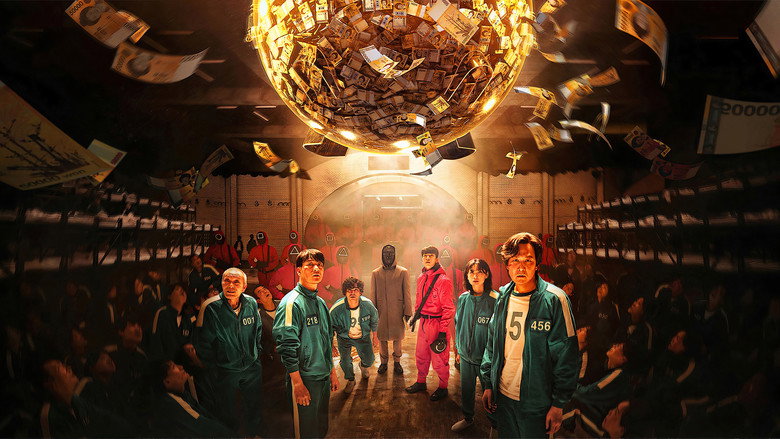
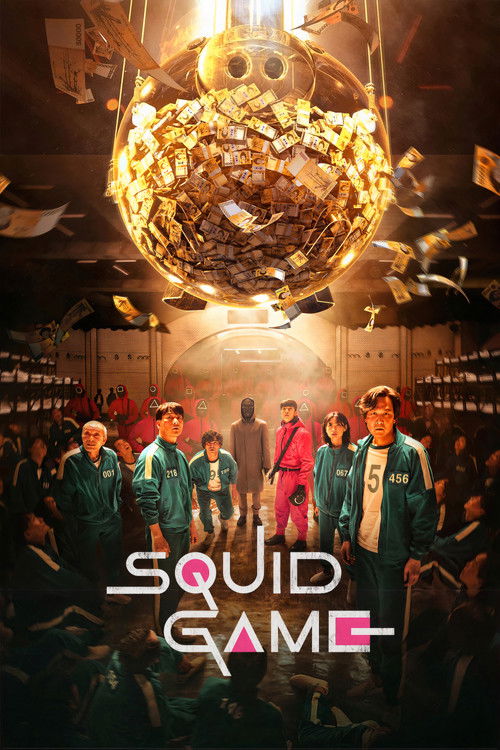
The Giant Glass Piggy Bank

Meaning:

Visually equates human lives directly with currency as cash fills the container with every player death.

Context:

Suspended high above the players' dormitory throughout the competition.

Dalgona / Honeycomb Candy

Meaning:

Symbolizes the fragile innocence of childhood pitted against life-or-death anxiety, where a single crack leads to death.

Context:

Featured during the second game challenge where players must carve out fragile shapes cleanly.

Animatronic Dolls (Young-hee & Chul-soo)

Meaning:

Nostalgic childhood icons repurposed as lethal panoptic surveillance tools.

Context:

Used during games like Red Light, Green Light to spot and execute moving players.

Marbles (Gganbu)

Meaning:

Represent friendship, trust, and shared memory, which are tragically weaponized during forced mutual elimination rounds.

Context:

Used in the marble game round where partners are forced to eliminate each other.

Pink Jumpsuits vs. Green Tracksuits

Meaning:

Contrasting visual uniforms that reduce individuals to anonymized roles—prisoners/competitors versus systemic enforcers.

Context:

Worn continuously by players and guards inside the game facility to enforce visual separation.

Memorable Quotes

우린 깐부잖아.
— Oh Il-nam (Player 001)

Context

Season 1, Episode 6 ("Gganbu").

Meaning

Represents absolute trust and partnership in Korean neighborhood culture; carries tragic irony when Il-nam uses it during the marble game.

선생님, 저랑 게임 하나 하시겠습니까?
— The Salesman (Gong Yoo)

Context

Season 1, Episode 1 ("Red Light, Green Light").

Meaning

The inciting line that lures desperate individuals into the deadly apparatus.

All 6 quotes

Episode Highlights

Red Light, Green Light

S1E1

Introduces Seong Gi-hun and establishes the deadly premise of the tournament.

Significance:

Establishes the core premise, introducing Gi-hun and the shocking escalation from innocent childhood nostalgia to horrific execution.

Hell

S1E2

The contestants vote to suspend the games and return to their harsh lives in Seoul.

Significance:

The players vote to leave, only to discover real life in debt is even worse than the game, compelling them to return voluntarily.

Gganbu

S1E6

Players are forced to pair up with their closest allies for a game of marbles.

Significance:

Widely regarded as the emotional peak of Season 1; forces beloved character pairs into fatal 1v1 marble duels.

One Lucky Day

S1E9

The final game concludes and Gi-hun learns the true mastermind behind the tournament.

Significance:

Season 1 finale featuring the rainy final showdown between Gi-hun and Sang-woo, followed by the reveal of Il-nam as the mastermind.

Bread and Lottery

S2E1

Gi-hun re-enters the arena to intervene and guide players through the rules.

Significance:

Launches Gi-hun’s re-entry arc, setting up the new voting mechanism (OX) and showing his attempt to intervene before games begin.

Friend or Foe

S2E7

Gi-hun tries to spark a player rebellion against the game guards.

Significance:

Season 2 finale where Gi-hun’s player rebellion collapses in tragedy, ending on a cliffhanger that sets up the final conflict.

Keys and Knives

S3E1

The immediate fallout of the failed rebellion forces remaining players into brutal trials.

Significance:

Direct continuation from Season 2's failed rebellion, escalating the darkness and establishing the grim stakes of the remaining trials.

Humans Are...

S3E6

The final game takes place with Gi-hun fighting to preserve an innocent life.

Significance:

The climax of the entire series; Gi-hun makes the ultimate moral sacrifice during the final challenge to protect a baby born in the games, deeply affecting the Front Man.

Philosophical Questions

Does true free choice exist when the alternative is intolerable financial ruin?

Explored through the game's illusion of choice, where impoverished players voluntarily return to fatal trials because their reality outside is equally unlivable.

Is human nature inherently selfish when stripped of societal safety nets, or is solidarity our fundamental instinct?

Tested as characters choose between lethal betrayal for individual gain and selfless acts of solidarity during high-stakes games.

Can an oppressive system be reformed from within, or does participation inevitably corrupt the reformer?

Examined through Gi-hun's attempts to organize rebellions and shift player behavior after re-entering the competition.

What value does human dignity hold when society measures individual worth purely through monetary capital?

Demonstrated through the VIPs commodifying human lives for sport and Gi-hun's ultimate rejection of being treated as a pawn.

Alternative Interpretations

The narrative supports multiple key interpretations:

Full ending explanation

Cultural Impact

Squid Game emerged out of South Korea's real-world economic pressures, specifically skyrocketing household debt, youth unemployment, and fierce competitive stress. Upon its release in September 2021, Season 1 became Netflix's most-watched television series of all time.

The series created a massive pop culture wave: sales of green tracksuits and Vans sneakers skyrocketed, Dalgona street challenges went viral globally, and greenlit international Korean television productions surged. Seasons 2 and 3 sparked intense global discourse on whether modern entertainment can successfully critique capitalism while remaining a massive commercial product.

Audience Reception

Season 1: Unanimous critical acclaim (95%+ on Rotten Tomatoes). Praised for its sharp social commentary, tragic character depth, and striking production design.

Season 2: Very positive yet slightly divided reception. Audiences lauded the expansion of the lore and Gi-hun’s darker performance, though some missed the self-contained simplicity of Season 1.

Season 3: Generally strong critical reviews with a polarized audience reaction to the dark finale. Many fans celebrated the emotional depth of Gi-hun’s final sacrifice, while others criticized the tragic deaths of beloved characters and the lingering cynical tone.

Interesting Facts

  • Writer-director Hwang Dong-hyuk conceived the concept in 2008, but local Korean studios rejected the script for over ten years, deeming it too grotesque and unrealistic until Netflix picked it up.
  • The production built real, full-sized sets for the dormitory towers, maze-like staircases, and the Red Light, Green Light arena instead of relying on greenscreen CGI to give actors a tangible sense of claustrophobia.
  • Seasons 2 and 3 were envisioned as two halves of a single continuous arc, written and filmed simultaneously over a multi-year production period.
  • Hwang Dong-hyuk lost multiple teeth due to extreme stress during the production of Season 1.
  • Music director Jung Jae-il purposefully used elementary school instruments like recorders and simple castanets mixed with haunting string arrangements to heighten the unsettling contrast between childhood play and death.

Easter Eggs

Dormitory Murals

The drawings depicting every upcoming game were painted directly on the dormitory walls behind the bunk beds from Episode 1, hidden in plain sight as the beds were slowly removed.

Player 001's Clues

Oh Il-nam was never targeted by the animatronic doll's green-scan overlay in Episode 1, and his binder file was missing from the archive when Jun-ho searched it.

M.C. Escher Architecture

The brightly painted, endless staircases are directly modeled after M.C. Escher’s famous surreal lithograph Relativity.

Casting Cameos

Major South Korean star Gong Yoo made a memorable guest appearance as the Salesman, while top star Lee Byung-hun was hidden behind the Front Man's mask.

US Expansion Epilogue

The post-credits/finale sequence of Season 3 shows a recruiter playing ddakji in an alley in Los Angeles, proving the global reach of the syndicate.

Frequently Asked Questions

Explore More About This Movie

Dive deeper into specific aspects of the movie with our detailed analysis pages

Comments (0)

Leave a comment

No comments yet. Be the first to share your thoughts!

Similar Movies