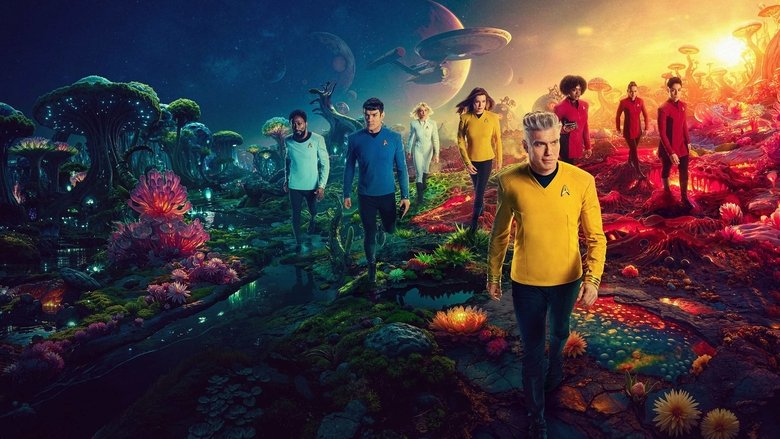
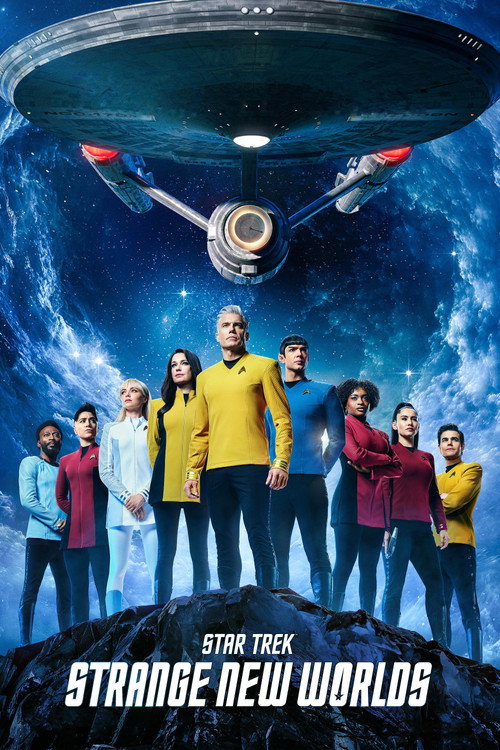
Season one. Pike carries a vision of his own future — the accident that will leave him catastrophically injured, an outcome fixed in franchise canon long before this series existed. The premiere's real work is dragging him out of that paralysis and back to command. The finale, A Quality of Mercy, closes the loop: Pike's future self appears and walks him through an alternate timeline in which he avoided his fate, demonstrating that the avoidance costs other lives and reshapes history for the worse. The alternate timeline pointedly restages events from The Original Series that Kirk resolves, so the audience's own canon knowledge becomes the instrument of Pike's defeat. He accepts his destiny — not as surrender but as the price of everyone else's future. Every subsequent season is lived under that accepted verdict.
Season two. Una's concealed Illyrian genetic modification goes to court-martial in Ad Astra per Aspera, where her defense reframes the proceeding from her guilt to the justice of the law itself, and she is able to remain in Starfleet — a victory that leaves the underlying prejudice intact and turns her into an advocate for Illyrians without her record. Under the Cloak of War detonates M'Benga's and Chapel's war histories when a Klingon defector comes aboard, revealing what the ship's gentlest characters carry from the Klingon conflict and ending without absolution. Those Old Scientists brings Lower Decks' Boimler and Mariner backward in time, where their fan-worship of the crew makes the show's dramatic irony explicit. Subspace Rhapsody forces every suppressed feeling aboard into song, most consequentially between Spock and Chapel. The season ends on a harrowing Gorn incursion cliffhanger with the crew scattered and in genuine peril.
Season three. The season opens by resolving that Gorn crisis and then spends its run on the aftermath — what survival cost, and who the crew became in order to survive. The finale, New Life and New Civilizations, delivers its own twist: the Vezda lifeform inhabiting Ensign Gamble has rebuilt his body out of the transporter buffer and slipped off the Enterprise down to Skygowan, meaning the season's threat exits the ship intact and unaccounted for rather than being defeated. The transporter-buffer resurrection rhymes deliberately with the series' earlier use of the buffer as a place to hold what you cannot bear to lose.
Season four and the endgame. Season four continues the genre-per-episode design — including Human Best Friend, a puppet episode built with Jim Henson's Creature Shop, and an episode staged in real time, a franchise first. Behind the scenes, Paramount Global moved to end the series after this season amid financial pressure and the Skydance merger; Goldsman and Myers argued they required roughly six more episodes to connect the show to The Original Series, which produced a fifth and final season expressly built as that bridge. The meaning that only fully lands in retrospect is structural: the series was always a prologue. Pike's crew are people the audience meets knowing their endings, and the show's entire argument — that the journey is the destination — is the only honest response available to characters who exist inside someone else's finished history.