Skip to content
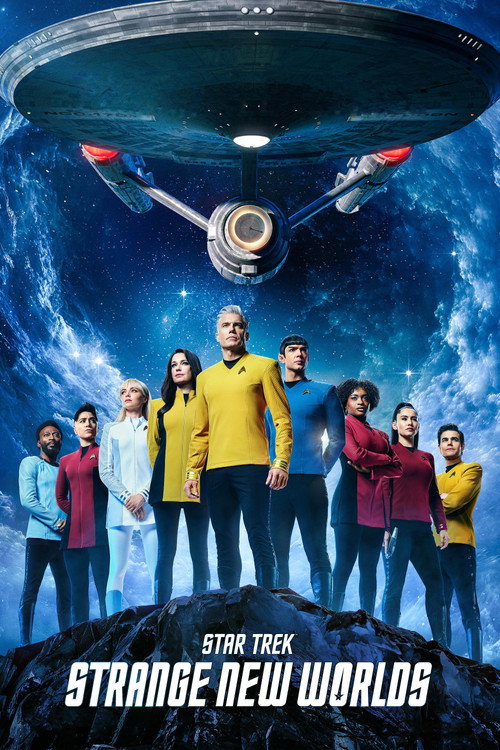
Star Trek: Strange New Worlds
A luminous, episodic voyage through wonder and dread, where a captain who has already glimpsed his own ending keeps choosing the stars anyway — starlight on a polished hull, warmed by a shared kitchen table.
Star Trek: Strange New Worlds

Star Trek: Strange New Worlds

"Boldly go one step closer to where it all began."

05 May 2022 — 03 September 2026 United States of America 4 season 40 episode Returning Series 7.9 (844)

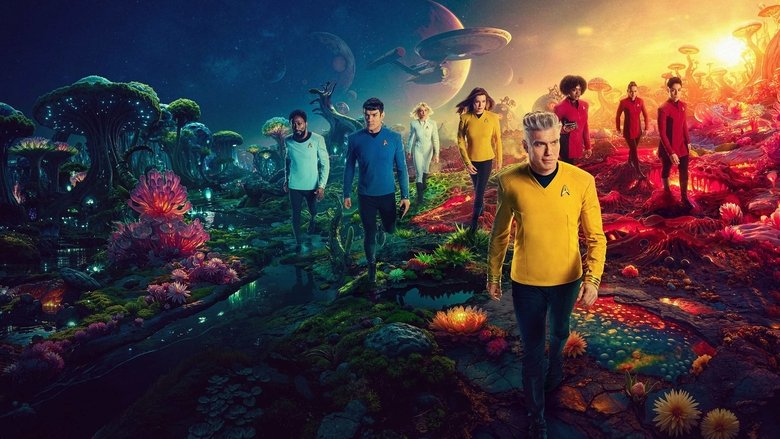
Cast: Anson Mount, Ethan Peck, Jess Bush, Christina Chong, Celia Rose Gooding

Drama Sci-Fi & Fantasy Fate, foreknowledge and free will Optimism as an act of will Identity, prejudice and the right to exist War, trauma and moral injury Found family and the ordinary life aboard ship

Overview

Star Trek: Strange New Worlds returns the franchise to the decade before James T. Kirk, following Captain Christopher Pike (Anson Mount) and the crew of the USS Enterprise on a mission of exploration that is deliberately structured the old way: one world, one moral problem, one genre experiment per week. Spun off from Star Trek: Discovery, the series launched on Paramount+ with a ten-episode first season (May 5 – July 7, 2022), followed by season two (June 15 – August 10, 2023), season three (July 17 – September 11, 2025) and a fourth season, with showrunners Akiva Goldsman and Henry Alonso Myers steering throughout.

The ensemble is the engine. Alongside Pike stand first officer Una Chin-Riley (Rebecca Romijn), science officer Spock (Ethan Peck), security chief La'an Noonien-Singh (Christina Chong), nurse Christine Chapel (Jess Bush), cadet-turned-officer Nyota Uhura (Celia Rose Gooding), pilot Erica Ortegas (Melissa Navia) and Dr. Joseph M'Benga (Babs Olusanmokun). Across seasons the show cycles through courtroom drama, body horror, screwball comedy, an animated crossover, a full musical and — in season four — puppetry and an episode staged in real time, while a handful of slow-burn arcs (the Gorn incursion, Una's legal status, Spock's divided nature, the long shadow of the Klingon war) accumulate underneath the standalone stories.

What holds it together is a question the pilot plants and never fully releases: how do you live generously when you already know how your story ends? Pike's foreknowledge of his own fate turns every rescue, every dinner he cooks for his officers, every calculated risk into an argument about whether optimism is naïveté or discipline. The series answers, week after week, that it is discipline — and that the Enterprise's real mission is less about mapping space than about deciding, repeatedly, what kind of people its crew intend to be when the mapping gets hard.
Core Meaning

At its center, Strange New Worlds is an argument that hope is a practice, not a temperament. The show hands its captain the one thing utopian fiction usually withholds — certain knowledge of his own catastrophic future — and then asks him to keep running a ship built on the premise that the future is worth reaching. Pike's conclusion, articulated by Anson Mount as the realization that the journey is the destination, is the thesis of the whole series: you cannot outrun what is coming, but you can refuse to let it hollow out the time you have.

From that core the show extends outward into a broader claim about institutions and individuals. The Federation is portrayed neither as flawless nor as secretly rotten, but as something people have to keep choosing — by defending an officer the law says shouldn't exist, by refusing an easy war, by treating an enemy defector as a patient rather than a target. The creators repeatedly stage scenarios in which the efficient answer and the decent answer diverge, and the series' meaning lives in the crew's willingness to pay for the decent one.

Finally, the format itself carries the message. By returning to episodic storytelling — each installment "its own little movie," as the showrunners have described their approach — the series insists that the small encounter matters as much as the season-ending catastrophe. A musical, a puppet story and a genocide trial can sit in the same run because the show believes that curiosity, in all its registers, is the most serious thing a civilization can do.

Thematic DNA

Fate, foreknowledge and free will 25%
Optimism as an act of will 25%
Identity, prejudice and the right to exist 20%
War, trauma and moral injury 18%
Found family and the ordinary life aboard ship 12%

Fate, foreknowledge and free will

Pike enters the series already knowing the shape of his end, and the show refuses to let that knowledge become simple tragedy. Season one drives him through an existential crisis that Anson Mount has described as the first episode's job — getting Pike back on mission — and culminates in the finale, where a glimpse of an alternate timeline proves that rewriting his fate would cost other people theirs.

Later seasons convert the question from personal to structural: time travel, prophecy, alternate futures and long-known canonical destinies (Spock's, Uhura's, the Enterprise's own) keep reappearing, each time asking whether knowing the ending changes the obligation to live the middle well. The series' answer hardens from anguish into something like discipline.

Optimism as an act of will

Critics repeatedly framed the show as a return to the openhearted, exploratory spirit of The Original Series, and the series earns that framing by making optimism costly. Every season stages at least one situation where cynicism would be cheaper and safer, and the crew declines.

The theme evolves across the run: season one asserts hope, season two stress-tests it against law, trauma and war, season three lets it survive genuine horror in the Gorn conflict's aftermath, and season four — arriving as the show's own end is announced — plays it as something worth preserving precisely because it is finite.

Identity, prejudice and the right to exist

Una Chin-Riley's concealed Illyrian genetic modification turns Federation idealism into a courtroom question in season two's Ad Astra per Aspera, where her trial becomes an argument about whether a law can be just when it criminalizes what someone is. La'an carries a parallel burden in her inherited Noonien-Singh name, and Spock's half-human nature is the franchise's oldest version of the same problem.

Across the seasons these threads braid: the show keeps returning to characters who must decide whether to hide, to assimilate, or to demand that the institution change — and, unusually for Trek, it lets the institution be genuinely wrong.

War, trauma and moral injury

The Klingon war is over when the series begins, but it has not finished with Dr. M'Benga and Nurse Chapel. Season two's Under the Cloak of War detonates that history when a Klingon defector comes aboard, and the episode was widely singled out for igniting exactly the kind of moral debate great Trek is built on.

The Gorn arc extends the theme into the present tense, moving from the claustrophobic dread of early encounters to a full incursion and its aftermath in season three. The series consistently treats violence as something that leaves residue in people rather than resolving a plot.

Found family and the ordinary life aboard ship

Pike cooks. The crew eats together, sings together, argues in corridors and carries romances that survive across seasons — Spock and Chapel most prominently. The show deliberately spends screen time on the domestic register that action-driven Trek often skips.

Over four seasons this becomes the show's emotional accounting system: the more the crew loses to war, law and fate, the more weight the shared table carries, so that by the later seasons the small rituals read as the thing actually being defended.

Character Analysis

Captain Christopher Pike

Anson Mount

Archetype: Mentor-hero / the doomed shepherd Key Trait: Warm, deliberate moral courage

Motivation

Initially, to avoid or outmaneuver the fate he has seen. That curdles into a need to make the remaining years count for other people — protecting his crew and the Federation's principles rather than his own survival.

Character Arc

Pike begins the series in retreat, hiding in Montana with the knowledge of his own catastrophic future; the premiere's task, as Anson Mount has described it, is to get him back on mission and through the existential crisis. Season one ends with him reconciled to his destiny after the finale demonstrates what changing it would cost others.

From there his arc is not about escape but about stewardship: across seasons two through four he becomes a captain defined by how he spends borrowed time — defending his first officer's right to serve, refusing wars that could be won, mentoring officers whose futures he already knows, and holding a crew together through the Gorn conflict's aftermath. Mount has framed the ongoing challenge as reminding himself that the journey is the destination.

Spock

Ethan Peck

Archetype: The divided initiate Key Trait: Precision undercut by feeling

Motivation

To reconcile Vulcan discipline with human feeling without amputating either. Over time this shifts from a private torment to a deliberate professional identity — logic chosen as a way of loving people responsibly.

Character Arc

Peck's Spock arrives younger, more emotionally permeable and far less settled than the icon audiences know, engaged to T'Pring and genuinely uncertain which half of himself to serve. The series repeatedly externalizes that division — through Vulcan ritual, through comedy, through the musical's forced confessions — and through a long, complicated closeness with Christine Chapel.

Across the run the arc is a controlled convergence: each crisis pushes him a step nearer the composed officer of The Original Series, and the pathos lies in watching him choose that composure rather than simply mature into it. The Lower Decks crossover pointedly treats him as a historical figure while he is still figuring himself out.

All 5 characters and cast

Symbols & Motifs

Pike's kitchen

Meaning:

Domesticity as command philosophy — a captain who feeds his officers is one who treats them as people rather than assets. It symbolizes the ordinary life that the mission exists to protect, and the intimacy that makes later losses land.

Context:

Recurring from season one onward as the show's confessional space, where crises are metabolized over food rather than in ready rooms. Its warmth is deliberately set against the cold geometry of the bridge and the vacuum outside.

The Gorn

Meaning:

Predation without negotiation — the limit case for Federation diplomacy, and the show's embodiment of the idea that some encounters cannot be talked out of existence. They also stand for inherited dread: La'an's childhood trauma made flesh.

Context:

Introduced as creeping horror in season one, escalated into a full incursion whose harrowing cliffhanger opens season three, where the crew must live with what survival cost them.

Genetic modification and the Illyrians

Meaning:

The body as legal category. Illyrian augmentation symbolizes every identity a society decides is inadmissible, and the gap between a law's letter and its justice.

Context:

Central to Una's concealment and to her trial in Ad Astra per Aspera, and echoed inversely in La'an's Noonien-Singh ancestry, where the same science produces inherited guilt rather than inherited shame.

The transporter buffer

Meaning:

Suspended existence — life held between states, neither saved nor lost. It is the series' recurring image of refusing to let go, and of the moral cost of that refusal.

Context:

Used as a device of desperate preservation in M'Benga's storyline, and turned uncanny in the season three finale, where the Vezda lifeform inhabiting Ensign Gamble rebuilds his body out of the buffer and slips off the Enterprise to Skygowan.

Music and song

Meaning:

Involuntary honesty. When the characters must sing, they cannot maintain the composure that rank, Vulcan discipline or professional distance normally supplies.

Context:

Literalized in the musical episode Subspace Rhapsody, whose songs by Kay Hanley and Tom Polce force every buried feeling in the ensemble into the open, and echoed elsewhere in the show's fondness for shipboard performance and shared ritual.

The captain's chair

Meaning:

Continuity and succession. The chair outlives whoever sits in it, symbolizing an institution that persists past individual fate — and, given canon, the seat Pike is keeping warm.

Context:

Present in every bridge scene but charged by the audience's foreknowledge; the season one finale's alternate-timeline encounter with a very different Enterprise command makes the succession explicit.

Episode Highlights

Strange New Worlds

S1E1

The premiere pulls Pike out of self-imposed exile in the wake of his vision of the future and back into the center seat, establishing the series' episodic mission structure, its ensemble, and the first-contact moralism that defines it. Anson Mount has said the production deliberately handled Pike's dark future up front so the character could get back on mission.

Significance:

Sets the show's founding tension — a captain who knows his ending, commanding a ship premised on the future — and announces the return to standalone, optimistic storytelling that critics immediately identified as a course correction for modern Trek.

A Quality of Mercy

S1E10

The season one finale brings Pike face to face with his own future self, who shows him the consequences of altering his fate. The resulting alternate timeline restages a foundational piece of Original Series history and forces Pike to weigh his survival against other lives.

Significance:

Resolves season one's central question by closing the escape hatch: Pike accepts his destiny not out of resignation but because the alternative costs more. Everything the character does afterward is lived under that accepted sentence.

Ad Astra per Aspera

S2E2

Una's court-martial for concealing her Illyrian genetic modification becomes the series' courtroom drama, with her defense arguing less about what she did than about whether the law that forbids her existence can be called just. Widely cited as one of the show's finest and most emotional hours.

Significance:

The episode where the series stops treating the Federation as a settled utopia and starts treating it as an institution that must be argued with. It transforms Una from exemplary officer into advocate and gives the show its clearest statement on prejudice.

Those Old Scientists

S2E7

The live-action crossover with the animated Star Trek: Lower Decks, bringing Ensigns Boimler and Mariner aboard the Enterprise as time-displaced fans meeting their own historical legends. Praised for fusing two very different tonal registers while still taking its character arcs seriously.

Significance:

Frequently ranked the series' single best episode, it crystallizes the show's relationship with its own mythology: the crew are people in the present, and legends only in someone else's future — a joke that doubles as the series' thesis about living inside a known destiny.

Under the Cloak of War

S2E8

A Klingon defector's arrival aboard the Enterprise exposes what M'Benga and Chapel did and endured during the war, in an hour built as a study of moral injury rather than a mystery with a clean answer.

Significance:

The series' darkest and most debated episode, it permanently complicates two beloved characters and establishes that Strange New Worlds will let its optimism be interrogated rather than assumed. It is the strongest evidence that the show's episodic form can carry serious weight.

Subspace Rhapsody

S2E9

A subspace anomaly forces the crew to express themselves in song, in the franchise's first full musical episode — written by Dana Horgan and Bill Wolkoff, directed by Dermott Downs, with original songs by Kay Hanley and Tom Polce, and openly influenced by Buffy the Vampire Slayer's Once More, with Feeling.

Significance:

The purest demonstration of the show's genre-hopping license, and structurally a confession engine: relationships the ensemble had been avoiding — Spock and Chapel foremost — are forced into the open, with consequences that outlast the gimmick.

New Life and New Civilizations

S3E10

The season three finale, in which the crew discover that the Vezda lifeform inhabiting Ensign Gamble has rebuilt his body out of the transporter buffer and slipped off the Enterprise down to Skygowan, leaving a threat loose rather than neatly contained.

Significance:

Titled from the franchise's founding monologue, it closes the season that had to absorb the aftermath of the Gorn crisis and deliberately leaves the ship's ledger open, carrying unresolved consequence into the final stretch of the series.

Human Best Friend

S4E3

An early season four installment that exemplifies the showrunners' stated method of treating each episode as its own little movie, in a season whose formal experiments also include a puppet story built with Jim Henson's Creature Shop and an episode staged in real time — a first for the franchise.

Significance:

Representative of the final act's strategy: with the end of the series scheduled, season four leans harder into tonal variety and character intimacy rather than serialized escalation, betting that the show's legacy rests on its range.

Philosophical Questions

If you knew exactly how and when your life would end, would that knowledge free you or destroy you?

This is the show's founding premise and it is tested from multiple angles across the run: Pike's initial paralysis and withdrawal, the season one finale's demonstration that changing the ending redistributes the suffering rather than removing it, and the later seasons' portrait of a man whose leadership is sharpened by his deadline. The series lands on the position Anson Mount has articulated — that the journey is the destination — while never pretending the knowledge stops hurting.

Can a law be just if it forbids someone from existing as they are?

Ad Astra per Aspera stages this directly, turning Una's court-martial into an argument about the difference between legality and justice, and forcing Starfleet to answer for a rule it had never been made to defend aloud. The question recurs through La'an's inherited name and Spock's divided nature, with the series consistently siding with the individual against the statute while conceding that the institution's fear has a history behind it.

What does a decent person owe an enemy who is now helpless?

Under the Cloak of War builds an entire hour around this, placing a Klingon defector under the care of people the Klingons damaged, and deliberately declining to hand the audience a verdict. The Gorn arc poses the harder version — whether the obligation survives when the enemy is genuinely incapable of reciprocity — and the show's refusal to resolve either case is the point.

Is optimism a moral achievement or a form of denial?

The series continually places its hopeful instincts next to evidence that should defeat them: war trauma, institutional prejudice, predation, and a captain's known doom. Because the show keeps letting the darkness be real and then choosing generosity anyway, it argues that hope is best understood as a practice performed under pressure rather than a belief about how the universe actually is.

Are people who become legends still free?

Those Old Scientists turns this into comedy by letting future fans gush at a crew still improvising their lives, while the presence of Spock, Uhura and the Enterprise itself means the audience is always watching people fill roles history has already written. The series suggests that the legend is assembled retroactively out of ordinary choices — which restores the freedom that foreknowledge seemed to take away.

Alternative Interpretations

Pike's acceptance as heroism or as capitulation. The dominant reading treats his reconciliation with his fate as moral maturity — the journey as destination, in Anson Mount's phrasing. A dissenting reading holds that the season one finale rigs the argument: by showing an alternate timeline where saving himself costs others, it converts a genuine ethical choice into a foregone one, so what looks like acceptance is really a story that never let him refuse.

Full ending explanation

Cultural Impact

Strange New Worlds arrived in 2022 at the end of a decade in which prestige television — and modern Star Trek in particular — had committed heavily to serialization, mystery-box plotting and darker moral registers. Its deliberate retreat to standalone, optimistic, genre-flexible storytelling was read by critics as a corrective, and the first season's reception reflected that: near-universal praise for its episodic structure and its cast, a Saturn Award, and a Primetime Creative Arts Emmy nomination. On Rotten Tomatoes the seasons scored 98%, 97%, 88% and 90% respectively — an unusually strong and stable critical record for a four-season genre show.

Its influence has been most visible in the license it claimed for formal experimentation inside a legacy franchise. Subspace Rhapsody gave Star Trek its first full musical episode, extending a lineage that runs through Buffy the Vampire Slayer's Once More, with Feeling, which the producers named as a direct influence. Those Old Scientists executed a live-action crossover with the animated Lower Decks that was widely treated as a model for how a shared universe can move between media without condescending to either. Season four's puppet episode, built with Jim Henson's Creature Shop, and its real-time episode — a first for the franchise — continued that pattern of using a fifty-year-old format as a playground.

Culturally, the show also recentered Star Trek's argumentative tradition. Ad Astra per Aspera placed a civil-rights courtroom drama at the heart of a mainstream sci-fi hit, and Under the Cloak of War revived the franchise's habit of leaving audiences to fight over a moral question the episode refuses to settle. Its legacy is further shaped by the circumstances of its ending: Paramount moved to conclude the series after season four amid financial pressure and the Skydance merger, and the showrunners' insistence on additional episodes to bridge the series into The Original Series produced a fifth and final season — making the show a rare case of a franchise entry negotiating for the right to finish its own connective work.

Audience Reception

Season one (2022) landed as a broad consensus success. Critics and viewers alike praised the return to episodic storytelling and the strength of the ensemble, and the season's 98% Rotten Tomatoes score, its Saturn Award win and its Primetime Creative Arts Emmy nomination reflected an audience that had been waiting for a modern Trek built on standalone exploration rather than season-long conspiracies. Anson Mount's Pike drew particular affection, with commentators framing the show as a warm counterweight to the franchise's darker contemporary entries.

Season two (2023) is widely regarded as the show's creative peak and holds a 97% critical score. It produced the three episodes most often cited in fan rankings — Those Old Scientists, Ad Astra per Aspera and Under the Cloak of War — and drew praise for demonstrating that the same series could run a courtroom drama, an animated crossover and a full musical within weeks of each other. Under the Cloak of War was the season's flashpoint, generating exactly the kind of unresolved moral argument audiences associate with the franchise's best work, while Subspace Rhapsody split viewers between delight and resistance to the gimmick.

Season three (2025) saw the first meaningful cooling, at 88%. Having to open by resolving season two's Gorn cliffhanger, it drew more mixed responses to its balance of arc obligation and standalone whimsy, and its finale, New Life and New Civilizations, deliberately left threads open rather than delivering closure. Season four (2026) recovered somewhat to 90%, with attention focused on its formal risks — the Jim Henson's Creature Shop puppet episode and the franchise's first real-time episode — and on the news that Paramount intended to end the series, which recast the season for many viewers as the beginning of a goodbye.

Overall verdict: the most consistently well-liked Star Trek series of its era, valued above all for its cast chemistry, its optimism and its willingness to change shape weekly. The recurring criticisms are the inverse of the praise — tonal whiplash between heavy and light episodes, arcs that resolve unevenly, and a reliance on canon foreknowledge — and the announcement that the show would conclude with a shortened fifth season sharpened audience feeling that it was ending before it had exhausted itself.

Interesting Facts

  • Akiva Goldsman and Henry Alonso Myers serve as showrunners across the series; they have described their method as treating each episode as "its own little movie," deliberately varying genre and tone from week to week.
  • The series is a spin-off of Star Trek: Discovery, carrying over Anson Mount's Pike, Rebecca Romijn's Una Chin-Riley and Ethan Peck's Spock into their own show.
  • Season one (10 episodes) ran May 5 – July 7, 2022; season two June 15 – August 10, 2023; season three July 17 – September 11, 2025.
  • Season one won a Saturn Award and received a Primetime Creative Arts Emmy Award nomination.
  • The musical episode "Subspace Rhapsody" was written by Dana Horgan and Bill Wolkoff, directed by Dermott Downs, with original songs composed by Kay Hanley and Tom Polce; the producers have cited Buffy the Vampire Slayer's "Once More, with Feeling" as a direct influence.
  • "Those Old Scientists" crossed the live-action series over with the animated Star Trek: Lower Decks, bringing that show's actors into live action — a transition critics singled out for praise.
  • Season four was filmed at CBS Stages Canada in Mississauga, Ontario, from March to August 2025.
  • Season four includes a puppet episode, teased publicly in 2025, with puppet work by Jim Henson's Creature Shop, as well as an episode told in real time — a first for the Star Trek franchise.
  • Paramount Global initially decided to end the series after its fourth season amid financial pressures and the Skydance Media merger; Goldsman and Myers argued they needed roughly six more episodes to connect the show to The Original Series, which led to a fifth and final season.
  • Lakeshore Records released a soundtrack album for the show's third season in November 2025.

Easter Eggs

Boimler and Mariner from Star Trek: Lower Decks appear in live action in "Those Old Scientists"

A rare animated-to-live-action crossover within the same franchise, it lets the show comment on its own canonical status: the ensigns treat Pike's crew as revered historical figures, which is exactly how the audience sees them. Critics praised it for merging two opposite tonal registers without flattening either.

The season one finale title "A Quality of Mercy" comes from Shakespeare's The Merchant of Venice

The phrase "the quality of mercy is not strained" belongs to Portia's courtroom plea, which makes the title a pointed gloss on an episode about whether Pike may mercifully spare himself — and on a franchise that has always borrowed Shakespeare for its ethical dilemmas.

"Ad Astra per Aspera" is Latin for "to the stars through hardship"

An aspirational motto attached to a trial about exclusion, it distills the episode's argument that reaching the stars is inseparable from the hardship imposed on those the institution refuses to admit.

The series title and the season three finale title both come from the classic Star Trek mission statement

"Strange new worlds" and "new life and new civilizations" are lifted straight from the franchise's founding monologue, framing the whole show — and the close of its third season — as an explicit act of return to Gene Roddenberry's original premise rather than a reinvention of it.

The season one finale restages events from The Original Series' Romulan-war history

By dropping Pike into a scenario Kirk canonically resolves, the episode turns fan foreknowledge into dramatic irony: viewers who know how the story is supposed to go watch a different captain fail to get there, which is precisely what convinces Pike to accept his fate.

Frequently Asked Questions

Explore More About This Movie

Dive deeper into specific aspects of the movie with our detailed analysis pages

Comments (0)

Leave a comment

No comments yet. Be the first to share your thoughts!

Similar Movies