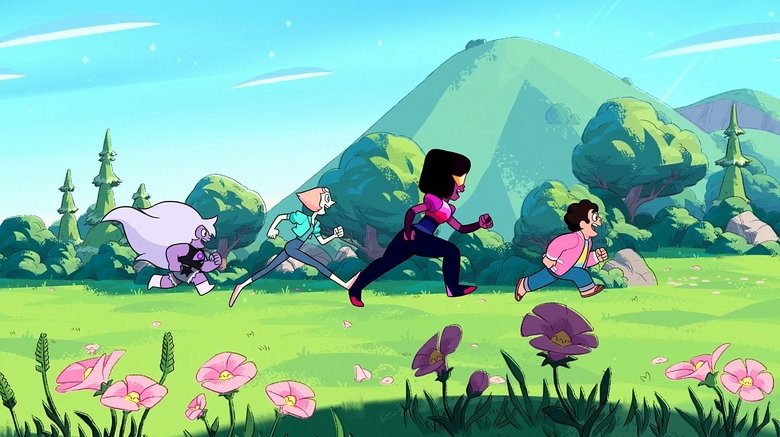

"The true kinda love."
Steven Universe: The Movie - Symbolism & Philosophy
Symbols & Motifs
The Gem Rejuvenator
The Rejuvenator symbolizes forced regression and the erasure of personal growth. It's a weapon that doesn't shatter a Gem, but rather strips away their developed identity and memories, reverting them to a factory-default state. It represents a violent refusal to acknowledge change and experience, serving as the physical manifestation of Spinel's desire to turn back time to before she was hurt.
Spinel uses the scythe-like weapon at the beginning of the film to "poof" and reset the Crystal Gems, effectively wiping their character development from the entire series. Steven later uses it on Spinel herself, which ironically restores her to her original, innocent personality, creating a moral dilemma for him as he must help her remember the trauma that defines her current state.
Spinel's Garden
The garden where Pink Diamond left Spinel symbolizes promises broken and the painful stasis of abandonment. For 6,000 years, it was a place of hopeful waiting that slowly decayed into a monument of neglect and forgotten love. It represents the beautiful memory that curdled into a source of immense trauma.
The garden is revealed in a flashback during Spinel's song "Drift Away." She stands perfectly still as millennia pass, the once-vibrant space becoming overgrown and desolate. This image is the root of her motivation and is what flashes through her mind, reigniting her rage.
The Injector
The giant drill and the poison it injects into the Earth symbolize the external manifestation of Spinel's internal pain. It is a tool of pure destruction, meant to kill all organic life on Earth. This represents how personal trauma, when left unaddressed, can become toxic and harmful to everyone and everything around the person suffering.
The injector is Spinel's primary weapon against Earth. It lands in Beach City at the beginning of the film and acts as a ticking clock for the plot. The poison visibly drains life from the ground, creating a tangible threat that Steven and the Gems must stop before it destroys the planet.
Philosophical Questions
What does it truly mean to achieve a 'happily ever after'?
The film directly confronts this question by setting up and then dismantling the idea. Steven's initial belief in a permanent, peaceful ending is shown to be a form of stagnation. The narrative argues that a meaningful life is not one devoid of conflict, but one defined by continuous growth, adaptation, and the willingness to do the 'work' of healing oneself and others. It posits that happiness is not a static state but an active, ongoing process.
Can you truly move on from the past, or are you destined to repeat it?
This is explored through the Rejuvenator, which literally resets the Gems to their past selves. To move forward, they must re-learn the lessons that shaped them. Spinel's struggle is central to this: she is trapped by her past trauma and her rage causes her to inflict pain on others. The film suggests that while the past is inescapable and shapes who you are, you are not doomed to be defined by it. Change and choosing a new path are possible, but it requires confronting that past rather than ignoring it or trying to erase it.
Who is responsible for healing inherited trauma?
Steven is once again forced to deal with the consequences of his mother's mistakes. Spinel's pain is a direct result of Pink Diamond's actions, yet Steven bears the full burden of addressing it. The film explores the ethics of this responsibility, showing Steven's empathy and determination to help. However, it also raises questions about the fairness of such a burden and whether true resolution is possible when the original perpetrator is gone.
Core Meaning
The core meaning of Steven Universe: The Movie is a profound exploration of trauma and the fallacy of a permanent "happily ever after." Director Rebecca Sugar conveys that personal growth is not a finite process with a neat conclusion; it is an ongoing, lifelong effort. The film posits that true healing comes from confronting painful truths and accepting that change is an inevitable and necessary part of life. It challenges the simplistic notion of happy endings, suggesting instead that fulfillment is found in the continuous work of self-improvement, empathy, and helping others heal from their own scars. Spinel's story serves as a powerful allegory for unresolved trauma and abandonment, while Steven's journey highlights that moving forward requires embracing change, rather than clinging to a static idea of perfection.