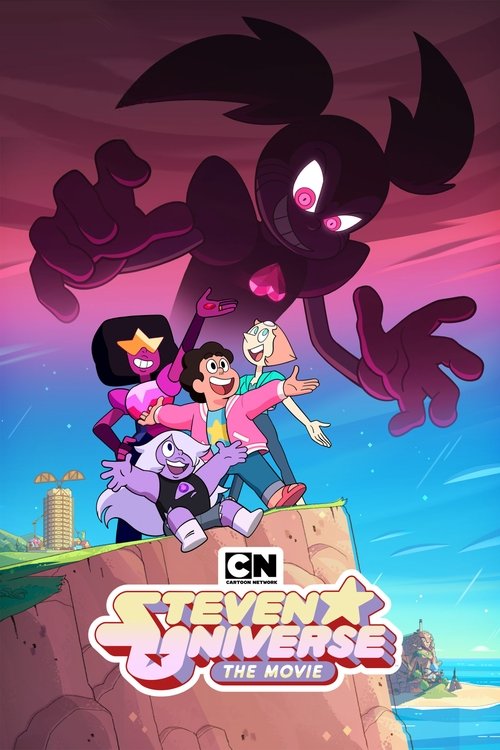
Steven Universe: The Movie
"The true kinda love."
Overview
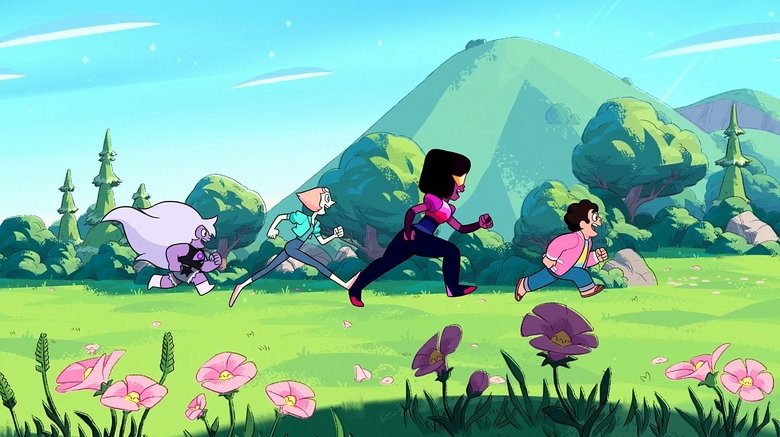
Taking place two years after the conclusion of the original series, Steven Universe: The Movie finds a 16-year-old Steven believing he has finally achieved his "happily ever after." This peace is shattered by the arrival of Spinel, a frantic and powerful Gem with a mysterious connection to Steven's mother, Pink Diamond. Armed with a scythe-like weapon called the Gem Rejuvenator, Spinel attacks the Crystal Gems, reverting Garnet, Amethyst, and Pearl to their original states and wiping their memories.
With his own powers weakened and Earth's very existence threatened by a massive injector pumping poison into the soil, Steven must embark on a desperate journey to rediscover his friends' identities and unlock the truth of Spinel's tragic past. The film unfolds as a musical, with Steven needing to recreate the pivotal moments of growth for his friends, all while confronting the painful legacy his mother left behind and learning that true happiness isn't a final destination but a continuous journey of change and growth.
Core Meaning
The core meaning of Steven Universe: The Movie is a profound exploration of trauma and the fallacy of a permanent "happily ever after." Director Rebecca Sugar conveys that personal growth is not a finite process with a neat conclusion; it is an ongoing, lifelong effort. The film posits that true healing comes from confronting painful truths and accepting that change is an inevitable and necessary part of life. It challenges the simplistic notion of happy endings, suggesting instead that fulfillment is found in the continuous work of self-improvement, empathy, and helping others heal from their own scars. Spinel's story serves as a powerful allegory for unresolved trauma and abandonment, while Steven's journey highlights that moving forward requires embracing change, rather than clinging to a static idea of perfection.
Thematic DNA
The Fallacy of 'Happily Ever After'
The film opens with Steven celebrating what he believes is his hard-won peace, only to have it immediately disrupted. This theme is central to Steven's character arc; he must learn that life is not a story with a final chapter. His desire for a static, perfect ending is precisely what weakens his powers. The climax involves him explicitly stating, "There's no such thing as happily ever after. I'll always have more work to do," signifying his maturation and acceptance that growth, challenges, and change are constant.
Trauma and Abandonment
This theme is embodied by the antagonist, Spinel. Her entire motivation stems from the trauma of being abandoned by Pink Diamond for 6,000 years. Her rage and destructive actions are a direct result of this deep-seated pain. The song "Drift Away" powerfully encapsulates her story of waiting in vain, showcasing how unresolved grief can fester into a desire for revenge. The film treats her trauma with empathy, positioning her not just as a villain, but as a deeply wounded individual.
The Importance of Change and Growth
Change is presented as the fundamental force for healing and strength. The Crystal Gems are literally "reset" and must re-experience their character development to regain their identities. Pearl must remember her independence, Amethyst her self-worth, and Garnet the love that forms her. Steven's own powers only return when he accepts the necessity of change within himself, realizing his resistance to it has been holding him back. The film argues that identity is not fixed but is constantly evolving through experience.
Inherited Burdens
Once again, Steven is forced to confront the negative consequences of his mother's actions. Spinel is another mess left behind by Pink Diamond, and the responsibility of healing this pain falls squarely on Steven's shoulders. This continues a central theme from the series: the younger generation having to fix the mistakes of the past. The film explores the complexity of this, as Steven must find a way to offer genuine compassion without simply being a stand-in for his mother.
Character Analysis
Steven Universe
Zach Callison
Motivation
Initially, his motivation is to restore the status quo and get back to his peaceful life. However, as he learns about Spinel's past, his motivation shifts to genuinely helping her heal from the trauma his mother inflicted, all while trying to save his friends and the world.
Character Arc
Steven begins the film believing his work is done and he can finally rest. His arc is about dismantling this naive belief in a "happily ever after." After Spinel resets his friends, he is forced to revisit their pasts and facilitate their growth all over again. In doing so, he confronts his own resistance to change. His powers fully return only when he accepts that life is a continuous process of growth and challenges, and his role as a healer and leader is never truly over.
Spinel
Sarah Stiles
Motivation
Her primary motivation is revenge against the legacy of Pink Diamond. She wants to destroy the Earth, the planet Pink chose over her, and hurt Steven, Pink's son. This is driven by 6,000 years of unresolved grief, loneliness, and a feeling of being discarded.
Character Arc
Spinel's arc is one of confronting trauma. Introduced as a maniacal villain bent on destruction, her backstory reveals her to be a victim of profound abandonment. After being reset, she is playful and innocent, but as her memories return, so does her pain. Her journey is volatile; she wavers between wanting friendship and lashing out in rage. Her arc concludes not with a simple defeat, but with an acknowledgment of her pain and a chance for a new beginning with the Diamonds, who understand loss and the desire for companionship.
Pearl
Deedee Magno Hall
Motivation
In her reset state, her motivation is simply to obey and serve Greg Universe. Her underlying journey, however, is to rediscover her identity as a self-possessed individual and a Crystal Gem.
Character Arc
When reset by the Rejuvenator, Pearl reverts to her default state: a servant completely devoted to her owner, who she assumes is Greg. Her arc in the movie is a condensed version of her series-long journey toward independence. She only regains her memory and sense of self when Steven and Greg fuse into Steg, whose music inspires her to remember her rebellious spirit and her fight for her own freedom, separate from her devotion to a single figure.
Garnet
Estelle
Motivation
Garnet's motivation is to protect Steven and the Earth. When split apart, Ruby and Sapphire are motivated by their base instincts (passion and precognition, respectively) until they are driven to find each other again and restore their balanced, loving relationship.
Character Arc
As Garnet is a fusion of Ruby and Sapphire, the Rejuvenator separates them and erases their memories of each other. Her arc is about rediscovering the love that is her very foundation. Separately, Ruby is filled with unfocused rage and Sapphire is coldly logical. Only when they are reminded of their connection and the strength they find in each other do they fuse back into Garnet, remembering that their love is their identity.
Symbols & Motifs
The Gem Rejuvenator
The Rejuvenator symbolizes forced regression and the erasure of personal growth. It's a weapon that doesn't shatter a Gem, but rather strips away their developed identity and memories, reverting them to a factory-default state. It represents a violent refusal to acknowledge change and experience, serving as the physical manifestation of Spinel's desire to turn back time to before she was hurt.
Spinel uses the scythe-like weapon at the beginning of the film to "poof" and reset the Crystal Gems, effectively wiping their character development from the entire series. Steven later uses it on Spinel herself, which ironically restores her to her original, innocent personality, creating a moral dilemma for him as he must help her remember the trauma that defines her current state.
Spinel's Garden
The garden where Pink Diamond left Spinel symbolizes promises broken and the painful stasis of abandonment. For 6,000 years, it was a place of hopeful waiting that slowly decayed into a monument of neglect and forgotten love. It represents the beautiful memory that curdled into a source of immense trauma.
The garden is revealed in a flashback during Spinel's song "Drift Away." She stands perfectly still as millennia pass, the once-vibrant space becoming overgrown and desolate. This image is the root of her motivation and is what flashes through her mind, reigniting her rage.
The Injector
The giant drill and the poison it injects into the Earth symbolize the external manifestation of Spinel's internal pain. It is a tool of pure destruction, meant to kill all organic life on Earth. This represents how personal trauma, when left unaddressed, can become toxic and harmful to everyone and everything around the person suffering.
The injector is Spinel's primary weapon against Earth. It lands in Beach City at the beginning of the film and acts as a ticking clock for the plot. The poison visibly drains life from the ground, creating a tangible threat that Steven and the Gems must stop before it destroys the planet.
Memorable Quotes
Happily ever after, never ends.
— Steven and the Crystal Gems
Context:
This is sung at the beginning of the movie as the Crystal Gems celebrate their victory and the new era of peace. It's a cheerful, optimistic moment that is immediately shattered by Spinel's arrival.
Meaning:
This line, from the opening song "Happily Ever After," ironically sets up the film's central theme. It represents Steven's naive belief that he has achieved a permanent state of peace. The entire movie serves to deconstruct this idea, proving that challenges will always arise and that life is a constant process of change.
That's right I heard the story over and over again! Gee, it's swell to finally meet her other friends!
— Spinel
Context:
Spinel sings this during her dramatic and menacing introduction, right before she attacks Steven and the Crystal Gems for the first time. It establishes her motivation and her history with Pink Diamond.
Meaning:
This sarcastic and bitter line from the song "Other Friends" perfectly encapsulates Spinel's rage and sense of betrayal. She has spent millennia waiting while Pink Diamond/Rose Quartz made a new life and new friends on Earth. The line drips with the pain of being forgotten and replaced.
I'll always have more work to do.
— Steven Universe
Context:
Steven says this to a defeated Spinel near the end of the film, showing her empathy while also acknowledging the hard truth he's learned. It's what allows him to fully understand and heal both himself and the damage done to the Earth.
Meaning:
This quote marks the climax of Steven's emotional journey. It is his direct refutation of the "happily ever after" ideal he clung to. He accepts that his life will be one of continuous growth, problem-solving, and helping others. It's a moment of maturation that unlocks his full power again.
Who am I? Who am I? What are you even saying? I'm the loser of the game you didn't know you were playing!
— Spinel
Context:
This is part of the climactic song where Spinel, having had her memory restored, recounts her 6,000-year wait in the garden. It is the emotional turning point where the audience fully understands the depth of her pain.
Meaning:
From the song "Drift Away," this line reveals the core of Spinel's tragedy. Pink Diamond left her under the guise of playing a "game," telling her to stand still. This quote shows Spinel's heartbreaking realization that the game was a lie and she was simply abandoned, making her feel like an unwitting fool.
Philosophical Questions
What does it truly mean to achieve a 'happily ever after'?
The film directly confronts this question by setting up and then dismantling the idea. Steven's initial belief in a permanent, peaceful ending is shown to be a form of stagnation. The narrative argues that a meaningful life is not one devoid of conflict, but one defined by continuous growth, adaptation, and the willingness to do the 'work' of healing oneself and others. It posits that happiness is not a static state but an active, ongoing process.
Can you truly move on from the past, or are you destined to repeat it?
This is explored through the Rejuvenator, which literally resets the Gems to their past selves. To move forward, they must re-learn the lessons that shaped them. Spinel's struggle is central to this: she is trapped by her past trauma and her rage causes her to inflict pain on others. The film suggests that while the past is inescapable and shapes who you are, you are not doomed to be defined by it. Change and choosing a new path are possible, but it requires confronting that past rather than ignoring it or trying to erase it.
Who is responsible for healing inherited trauma?
Steven is once again forced to deal with the consequences of his mother's mistakes. Spinel's pain is a direct result of Pink Diamond's actions, yet Steven bears the full burden of addressing it. The film explores the ethics of this responsibility, showing Steven's empathy and determination to help. However, it also raises questions about the fairness of such a burden and whether true resolution is possible when the original perpetrator is gone.
Alternative Interpretations
While the film's ending is presented as hopeful, some viewers and critics have offered alternative interpretations. One perspective critiques Steven's solution for Spinel as a form of emotional offloading. By sending her away with the Diamonds, who are also dealing with their own grief over Pink, Steven avoids the long-term, difficult work of helping Spinel integrate into the Earth community. This interpretation suggests that Spinel is simply being passed from one dysfunctional situation to another, reverting to a role as a "plaything" to appease the grieving Diamonds rather than finding true independence.
Another interpretation questions the effectiveness of the show's core philosophy of universal redemption when faced with extreme trauma. Some argue that Spinel's actions—attempting planetary genocide—were so severe that her quick forgiveness feels unearned. From this viewpoint, the ending prioritizes the theme of empathy over the realistic consequences of destructive behavior, raising questions about whether some wounds are too deep to be healed so neatly and whether every villain should be redeemable.
Cultural Impact
Steven Universe: The Movie serves as a capstone and continuation of a series already lauded for its significant cultural impact. The show was groundbreaking for its deep exploration of LGBTQ+ themes, non-binary identities, and complex emotional issues in a children's animated format, earning a GLAAD Media Award. The movie builds on this foundation, using the musical format to tackle mature themes of trauma, abandonment, and mental health with nuance and empathy.
Critics and audiences praised the film for its sophisticated storytelling, stunning animation, and memorable soundtrack, with many noting its Broadway-level quality. Spinel became an instant fan-favorite character, celebrated for her compelling and sympathetic portrayal as a villain born from tragedy. Her design and story resonated deeply, sparking widespread discussion about the long-term effects of emotional abuse and neglect. The movie reinforced the series' core message that healing is an ongoing process, not a final destination, influencing how subsequent animated shows approach complex character arcs and mental health narratives. It solidified Steven Universe's legacy as a touchstone of modern animation that champions compassion, self-acceptance, and the power of change.
Audience Reception
Audience reception for Steven Universe: The Movie was overwhelmingly positive. Fans praised the film as a satisfying and emotionally resonant continuation of the series. The musical numbers were a major highlight, with songs like "Other Friends" and "Drift Away" becoming instant classics celebrated for their catchy melodies and deep emotional storytelling. Spinel was widely lauded as a compelling and sympathetic villain, with many viewers connecting to her story of abandonment and trauma. The high-quality animation and the exploration of mature themes were also points of frequent praise. Minor criticisms from some viewers centered on the ending, with a portion of the audience feeling that Spinel's redemption was too swift or that sending her to live with the Diamonds was an imperfect resolution that risked repeating old patterns. Others found the condensed re-telling of the Crystal Gems' character arcs to be a bit rushed, though many understood it was a necessary device for the plot. Overall, the film was embraced as a powerful and essential chapter in the Steven Universe saga.
Interesting Facts
- The movie is a full-fledged musical, with the songs being integral to advancing the plot and character development, much like a classic Broadway or Disney film.
- Spinel's animation style is deliberately different from other characters, inspired by the fluid, "rubber-hose" animation of 1930s cartoons to reflect her original purpose as a playful companion.
- The film features musical collaborations with several artists, including Chance the Rapper, Estelle (who voices Garnet), and Aimee Mann.
- The movie takes place two years after the finale of the original series, "Change Your Mind," aging Steven from 14 to 16.
- The title of Pearl's reset song, "system/BOOT. PearlFinal(3).Info," is a nod to computer file names, reflecting her systematic and orderly default personality.
- The new fusion between Steven and his father Greg is named Steg, and he makes his first and only appearance in the movie.
- Creator Rebecca Sugar confirmed that the movie was intentionally designed to be a musical, with a higher concentration of songs than any arc in the show.
Easter Eggs
Disney Storybook Opening
The film opens with a storybook, narrating the events of the series. This is a direct homage to the opening sequences of classic Disney animated films like Snow White and the Seven Dwarfs and Cinderella, setting the stage for its musical, fairy-tale-like structure.
Akira Motorcycle Slide
When Connie and Lion emerge from a portal, Lion performs a dramatic sliding stop. This is a visual reference to the iconic motorcycle slide from the seminal 1988 anime film Akira, a frequently homaged moment in animation.
Objects in Steven's Room
Steven's redesigned house is filled with mementos from the original series, acting as a museum of his past adventures. Items include the Cheeseburger Backpack, Rose's shattered sword, a GameCube, Greg's t-shirt cannon, and posters for the in-universe movie franchise "Lonely Blade."
Katamari Damacy Game
Among Steven's collection of video games next to a PlayStation 2 console is a clear parody of the game Katamari Damacy, a nod to the creators' and fans' love for video game culture.
⚠️ Spoiler Analysis
Click to reveal detailed analysis with spoilers
Frequently Asked Questions
Explore More About This Movie
Dive deeper into specific aspects of the movie with our detailed analysis pages
Comments (0)
No comments yet. Be the first to share your thoughts!