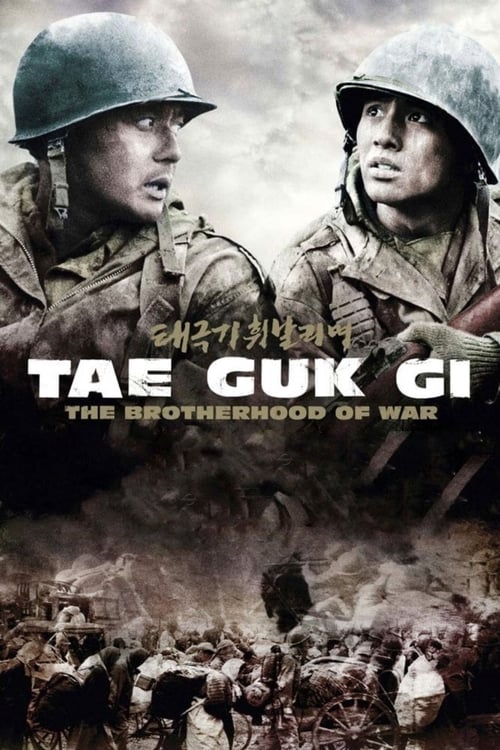
Tae Guk Gi: The Brotherhood of War
A visceral war epic where the fierce love between two brothers is tragically consumed and redefined by the devastating crucible of the Korean War.
Tae Guk Gi: The Brotherhood of War

태극기 휘날리며

"One country, one family… divided by war."

05 February 2004 South Korea 148 min ⭐ 8.0 (732)
Director: Kang Je-kyu
Cast: Jang Dong-gun, Won Bin, Lee Eun-ju, Gong Hyung-jin, Lee Young-ran
Drama War History Action Adventure
The Dehumanizing Nature of War Brotherhood and Familial Sacrifice The Tragedy of a Divided Nation The Loss of Innocence
Budget: $1,500,000

Tae Guk Gi: The Brotherhood of War - Ending Explained

⚠️ Spoiler Analysis

The plot of "Tae Guk Gi" is driven by a series of tragic twists that escalate the conflict between the brothers. The first major turn is Jin-tae's transformation from a caring brother into a ruthless war machine. This change, which Jin-seok witnesses with growing horror, creates the central rift between them. A critical turning point occurs when Jin-tae's fiancée, Young-shin, is executed as a suspected communist sympathizer by a zealous South Korean militia. As the brothers try to intervene, they are arrested by their own side.

The most significant spoiler is the sequence of events that leads to Jin-tae's defection. While imprisoned, the building is set on fire during an enemy attack. A commander prevents Jin-tae from saving his brother, and Jin-tae wakes up believing Jin-seok perished in the flames. Consumed by grief and a profound sense of betrayal by his country, he kills the commander and subsequently joins the North Korean army, becoming the feared leader of an elite unit. In reality, Jin-seok survived and was sent to a military hospital.

The climax reveals this misunderstanding. Jin-seok, having learned of his brother's defection, intentionally seeks him out on the battlefield. They have a violent confrontation where the brainwashed Jin-tae initially doesn't recognize his own brother and tries to kill him. Jin-seok's desperate pleas finally break through, and Jin-tae has a moment of lucid recognition. To save his wounded brother from advancing North Korean and Chinese forces, Jin-tae makes his final sacrifice. He stays behind, manning a machine gun to cover Jin-seok's retreat, and is killed. The film's ending frames this entire story as a flashback. An elderly Jin-seok is at a modern-day excavation site, where the remains found have been identified as his brother's. He is given his brother's few possessions, including the fountain pen he had lost 50 years prior, and collapses in grief, finally able to mourn.

Alternative Interpretations

While the primary interpretation of "Tae Guk Gi" is as a powerful anti-war statement focused on brotherhood, there are more nuanced readings. One interpretation focuses on the film as a critique of nationalism and ideology. Jin-tae's quest for the Taeguk Cordon (the medal of honor) can be seen as a pursuit of a nationalistic symbol that ultimately brings him nothing but suffering and causes him to lose his humanity. His eventual defection to the North Korean army, born of personal betrayal rather than political conviction, highlights the arbitrary and destructive nature of the ideological lines drawn during the war. The film suggests that for the ordinary soldier, the grand narratives of nationhood and political systems collapse into the singular, primal need to protect one's family.

Another interpretation views Jin-tae's transformation not just as dehumanization, but as a depiction of Post-Traumatic Stress Disorder (PTSD). His increasing aggression, emotional numbness, and eventual violent rage can be read as the psychological unraveling of a man subjected to unbearable trauma. From this perspective, his actions are less a descent into evil and more a tragic manifestation of a mind shattered by the horrors he has witnessed and perpetrated. His brief moment of clarity and recognition of Jin-seok at the end is then a fleeting return of his true self before his inevitable death.