Skip to content
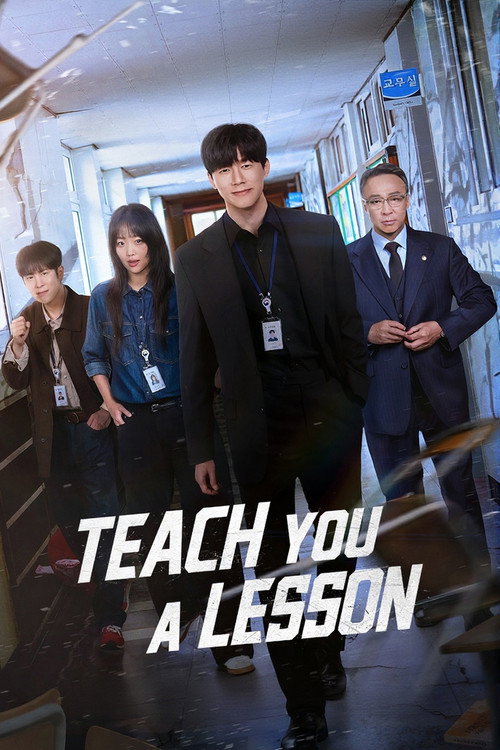
Teach You a Lesson
A bruised physical storm colliding with quiet human grief, Teach You a Lesson casts a harsh, neon-tinted shadow over broken classrooms, where righteous fury serves as a sledgehammer breaking open frozen institutions.
Teach You a Lesson

Teach You a Lesson

참교육

"Let us protect you!"

05 June 2026 — 05 June 2026 South Korea 1 season 10 episode Ended 9.4 (746)

Cast: Kim Moo-yul, Lee Sung-min, Jin Ki-joo, Pyo Ji-hoon, Kim Jong-soo

Drama Action & Adventure Comedy Restorative vs. Retributive Justice The Institutional Failure of Adults Power Dynamics and the Illusion of Impunity Grief, Vengeance, and Duty Exploitation of Youth by Adult Criminal Syndicates

Overview

Set in a contemporary South Korea where classroom authority has utterly collapsed under the weight of toxic parental interference, political corruption, and systemic administrative paralysis, Teach You a Lesson portrays the dramatic intervention of the Educational Rights Protection Bureau (ERPB). Established under a landmark legislative amendment, this specialized government task force operates with sweeping legal immunity to restore order, protect defenseless educators, and shield vulnerable students from unchecked physical, emotional, and systemic violence.

Across its ten-episode arc, the narrative follows lead field inspector Na Hwa-jin and his elite operational team as they tackle increasingly complex school crises. Beginning with localized instances of high-school bullying and juvenile extortion, the series gradually expands its scope from individual classroom power struggles to grander societal sicknesses, including cyber-harassment, exam-rigging, juvenile gambling networks, and illicit prescription drug syndicates operating inside elite academic institutions.

As the bureau enforces its unorthodox "eye-for-an-eye" interventions, the inspectors find themselves targeted not only by student delinquents, but by corrupt politicians and shadow syndicates operating from above. The overarching narrative connects these episodic school cases to a central, deeply personal tragedy: the murder of a passionate young teacher, which catalyzed the formation of the ERPB and now threatens to tear down the bureau from within.


Core Meaning

The central thesis of Teach You a Lesson is that when adult-run social institutions abandon their moral duty to protect the vulnerable, unchecked freedom degenerates into tyranny. Through its visceral depiction of fractured schools, the series argues that true education cannot exist without boundary enforcement and institutional courage.

Rather than advocating for mindless corporal punishment or vigilante violence as an end in itself, the show uses radical physical intervention as a narrative device to expose systemic cowardice. The creators emphasize that true justice is not merely about punishing offenders, but about restoring dignity to victims and holding enablers—specifically negligent parents, corrupt administrators, and complicit politicians—fully accountable for the rot they allow to spread.

Thematic DNA

Restorative vs. Retributive Justice 30%
The Institutional Failure of Adults 25%
Power Dynamics and the Illusion of Impunity 20%
Grief, Vengeance, and Duty 15%
Exploitation of Youth by Adult Criminal Syndicates 10%

Restorative vs. Retributive Justice

Throughout the show, retributive violence serves as the initial hook, but restorative justice emerges as the true objective. While Na Hwa-jin physically subdues abusers, the narrative repeatedly highlights that physical punishment alone changes nothing unless the victim is empowered to reclaim their agency and space within society.

The Institutional Failure of Adults

The series places primary blame for juvenile delinquency on the adult ecosystem. Parents who buy their children's way out of legal trouble, teachers who turn a blind eye to save their careers, and politicians who manipulate school policy for votes are revealed to be the true architects of school violence.

Power Dynamics and the Illusion of Impunity

The narrative examines how unchecked authority, whether held by a politician's spoiled child or a popular social media influencer, creates monsters when left unchallenged. The ERPB acts as an artificial equalizer, demonstrating that those who prey on the weak are fundamentally cowards when faced with real consequences.

Grief, Vengeance, and Duty

Through Na Hwa-jin and Minister Choi Gang-seok, the series explores the thin boundary between personal revenge and public duty. Both men are haunted by the tragic loss of Choi Ga-yun, driving them to walk a dangerous ethical line where personal trauma fuels their pursuit of systemic reform.

Exploitation of Youth by Adult Criminal Syndicates

As the series evolves, juvenile delinquency is shown to be connected to adult criminal networks. From underground gambling rings to student-driven drug distribution networks, the show reveals how vulnerable teens are exploited by predatory adult organizations.

Character Analysis

Na Hwa-jin

Kim Moo-yul / Kim Mu-yeol

Archetype: Antihero / Ruthless Protector Key Trait: Unshakeable composure combined with lethal combat capability

Motivation

To ensure no teacher or student ever suffers the unprotected fate that befell his late fiancée, Choi Ga-yun.

Character Arc

Begins as a seemingly cynical, brutal enforcer driven by deep personal trauma over the loss of his fiancée. Throughout the series, he evolves from a blunt force weapon into a tactical strategist who realizes that true "education" requires protecting victims long after the fights are over.

Choi Gang-seok

Lee Sung-min

Archetype: Mentor / Political Mastermind Key Trait: Strategic political vision and stoic determination

Motivation

Systemic educational reform and honoring his late daughter’s belief in true mentorship.

Character Arc

Operates as the high-ranking Minister of Education who created the ERPB. He navigates political attacks and legal challenges, balancing his institutional duty with the personal grief of losing his daughter. His arc culminates in standing firm against corrupt political powers even when his career is threatened.

All 4 characters and cast

Symbols & Motifs

The Black Official Bureau Car / Yellow School Bus

Meaning:

The black ERPB sedan represents state-sanctioned force and impending reckoning, contrasting visually with standard school environments.

Context:

Its entry onto school grounds signals the immediate suspension of conventional rules.

The Teacher's Desk / Podium

Meaning:

Symbolizes lost institutional authority.

Context:

In early episodes, desks are overturned, vandalized, or ignored; as ERPB inspectors take the podium, the physical space is cleansed and restored to its original purpose of guidance.

Prescription Pill Bottles / Illicit Vapes

Meaning:

Representing the insidious creep of adult criminality into academic sanctuaries, these items symbolize the hidden corruption decaying elite youth behind shiny academic facades.

Context:

Discovered within elite academic institutions as visual proof of systemic decay among youth.

The School Rooftop

Meaning:

Represents the absolute edge of isolation where desperate students are pushed when the system fails them completely.

Context:

The recurrent setting for extreme trauma, bullying, and attempted suicide.

Memorable Quotes

말을 들으면 말로 하고, 매를 맞아야 들으면 매로 가르친다.
— Na Hwa-jin

Context

Spoken by Na Hwa-jin during Episode 1 upon making a dramatic entrance to discipline a violent student.

Meaning

Establishes the core operational philosophy of the ERPB during Na Hwa-jin’s entrance.

어른이 아이를 두려워하는 세상은 망한 세상이다.
— Na Hwa-jin

Context

Spoken by Na Hwa-jin in Episode 1.

Meaning

Summarizes the societal crisis that led to the creation of the bureau.

All 5 quotes

Episode Highlights

The Arrival of the ERPB

S1E1

After a victimized student's friend leaps to his death from a rooftop, Na Hwa-jin enters Daehan High School to dismantle the untouchable bully—the son of a powerful presidential candidate.

Significance:

Sets the tone for the series and introduces the ERPB's legal authority.

Digital Execution

S1E3

Shifts focus to cyberbullying and social media toxicity. Im Han-rim takes point against a popular teen influencer who uses her massive online follower base to ruin her homeroom teacher’s reputation.

Significance:

Expands the series beyond physical fight scenes into psychological warfare and digital accountability.

The Substitute Teacher

S1E5

Explores abuse within elementary schools, where toxic, entitled parents destroy a young teacher's mental health. Na Hwa-jin steps in as a substitute teacher to turn the tables on the parents.

Significance:

Pivotal moment demonstrating that adults, not just teenagers, are often the primary perpetrators of educational collapse.

Undercover and Underground

S1E7

Bong Geun-dae goes undercover to dismantle an underground illegal gambling operation targeting high schoolers. Simultaneously, Assemblyman Hwang Gi-tae visits jailed Cho Gyu-cheol to launch a political plot against the bureau.

Significance:

Connects school-level issues to high-level political conspiracy and organized crime.

Rogue Execution

S1E10

The ERPB appears to be disbanded after public backlash engineered by politicians. The team goes rogue, staging a covert operation to expose a student-run drug empire led by Cho Gyu-cheol and solving the murder of Choi Ga-yun.

Significance:

Concludes the season's overarching narrative arc, brings down corrupt political figures, and solidifies the legacy of the bureau.

Philosophical Questions

Can physical coercion ever serve as a legitimate tool for moral education?

Explored through Na Hwa-jin’s interactions with incorrigible bullies who only respond to physical intimidation.

At what point does protecting juvenile offenders cross into abandoning their victims?

Explored in Episode 1 and Episode 6 regarding statutory immunity for underage criminals.

Is an authority figure who remains neutral in the face of injustice morally complicit?

Explored through quiet, timid school administrators who appease abusive parents to safeguard their careers.

Alternative Interpretations

1. The Power Fantasy Reading: Views the show primarily as a cathartic vigilante action spectacle—an artificial sanctuary where suffering victims receive immediate, satisfying payback that real-world legal systems fail to provide.

Full ending explanation

Cultural Impact

Teach You a Lesson arrived during an intense real-world national discourse in South Korea regarding the tragic decline of teachers' rights (gyokwon) and high-profile teacher suicides brought on by relentless parental harassment (gapjil). The show resonated with audiences by tapping into collective frustration over an education system where teachers felt completely defenseless.

The series ignited global debates on the balance between juvenile protection laws and victim rights. While some social critics questioned the ethics of portraying state-sanctioned vigilante violence, international viewers in various countries praised the show for highlighting universal issues in modern schooling.

Audience Reception

Praise: Viewers overwhelmingly praised the show's intense pacing, cathartic action choreography, and Kim Moo-yul's charismatic lead performance. The writing was commended for reshaping a controversial source comic into a story focused on victim empowerment.

Criticisms: A minority of critics and viewers felt that certain episodic resolutions (such as Episode 2's gang storyline) occurred too quickly and cleanly. Others noted that the political subplots involving Assemblyman Hwang felt less urgent than the immediate classroom cases.

Verdict: Boasting a 9.0/10 on MyDramaList and breaking global Netflix viewership records, the show was widely acclaimed as one of the most compelling and addictive K-drama releases of 2026.

Interesting Facts

  • Reunion of Juvenile Justice Team: Director Hong Jong-chan reunited with actors Kim Moo-yul and Lee Sung-min after working together on Netflix's acclaimed 2022 legal drama Juvenile Justice.
  • Major Webtoon Tone Adaptation: Director Hong Jong-chan and the writing team intentionally overhauled the narrative tone of the original Naver webtoon (Get Schooled) to eliminate controversial elements such as excessive violence, misogyny, and racial insensitivity, shifting the story's focus toward victim protection and system restoration.
  • Jin Ki-joo's Vocal Training: Actress Jin Ki-joo revealed in interviews that her character's signature loud, animalistic shouting roars were inspired by military documentaries, an idea suggested by senior co-star Lee Sung-min during initial script readings.
  • Global Chart Success: Just three days after release, Teach You a Lesson claimed the #1 spot on Netflix's Global Top 10 Non-English TV chart and entered the Top 10 in over 48 countries.
  • All-Time Non-English Record: By July 2026, the series became only the second Korean drama in history (after Squid Game) to break into Netflix's top 10 most-viewed Non-English TV series of all time.
  • John Cena Connection: Kim Moo-yul gained viral international attention for his resemblance to WWE star John Cena, leading Cena to post Kim's photo on his official Instagram account.

Easter Eggs

Webtoon Multiverse Cameo

In Episode 7 during the illegal gambling arc, characters from To Not Die (another popular YLab webtoon sharing the same universe as Get Schooled and Study Group) are subtly referenced on screen.

Real-World Incident Parallels

Episode 1's plot directly mirrors real-life high-profile South Korean school violence cases involving high-ranking government officials' children who evaded initial police scrutiny.

Support from Kim Hye-soo

A subtle off-screen cultural nod occurred when legendary actress Kim Hye-soo publically cheered for Kim Moo-yul, Lee Sung-min, and director Hong Jong-chan on social media, referencing their shared history on Juvenile Justice.

Frequently Asked Questions

Explore More About This Movie

Dive deeper into specific aspects of the movie with our detailed analysis pages

Comments (0)

Leave a comment

No comments yet. Be the first to share your thoughts!

Similar Movies