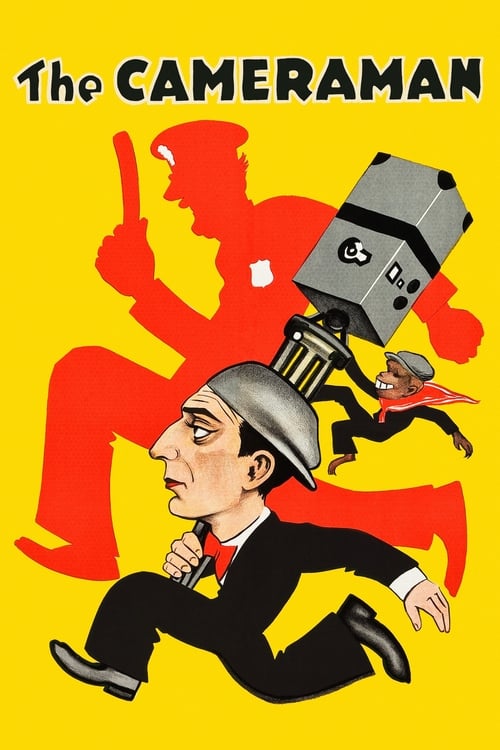
The Cameraman
A silent comedy's earnest heart pulses with a romantic fervor, painting a portrait of ambition and accidental genius through the chaotic lens of a clumsy cameraman's world.
The Cameraman
The Cameraman

"You'll laugh yourself completely out of focus!"

10 September 1928 United States of America 74 min ⭐ 7.8 (411)
Director: Edward Sedgwick Buster Keaton
Cast: Buster Keaton, Marceline Day, Harold Goodwin, Sidney Bracey, Harry Gribbon
Comedy Romance
Love as a Catalyst for Ambition The Nature of Filmmaking and Reality The Triumph of the Underdog Man vs. Machine

The Cameraman - Ending Explained

⚠️ Spoiler Analysis

The central twist of "The Cameraman" hinges on a reel of film shot by a monkey. After bravely filming a violent Tong War in Chinatown, Buster returns to MGM only to be humiliated when it appears he forgot to load film in his camera. Heartbroken, he gives up on his dream. However, it is revealed that the mischievous monkey he befriended had switched the film reels. The 'blank' reel was the unexposed one, and Buster had successfully captured the entire gang war.

The climax occurs during a boat race. Buster is filming when his rival, Harold, and Sally are thrown from their speedboat. Harold cowardly swims to safety, abandoning Sally who is trapped by the circling boat. Buster abandons his camera to dive in and save her. It seems his heroism will go unrecorded. However, the monkey, Josephine, picks up the camera and films the entire rescue. When Buster later submits his Tong War footage to MGM, the reel of the rescue is attached. The boss, Sally, and Harold watch in amazement not only at the incredible Tong War footage but also at the undeniable proof of Buster's bravery and Harold's cowardice. This cinematic evidence vindicates Buster, gets him the job and the girl, and provides a deeply satisfying conclusion where the film-within-the-film becomes the ultimate arbiter of truth.

Alternative Interpretations

While on the surface a straightforward romantic comedy, "The Cameraman" can be interpreted as a poignant allegory for Buster Keaton's own professional anxieties. His move to MGM marked the end of his independent studio where he had total creative freedom. The film's plot, in which an individual artist (Buster) struggles against the rigid, formulaic expectations of a large media corporation (MGM Newsreels), directly mirrors Keaton's own battle with the studio system. Buster's ultimate success comes not from conforming, but from his unique, chaotic, and accidental footage—a potential argument from Keaton that true artistry can't be tamed by studio mandates.

Another interpretation focuses on the nature of cinema itself. The film constantly plays with the idea of what is real versus what is recorded. Buster's "failed" footage, with its surreal double exposures, is arguably more artistic than the straightforward newsreels. The climax, where a monkey becomes the 'cameraman' who captures the most truthful and heroic event, can be seen as a commentary on the unpredictable, almost magical ability of film to capture reality, suggesting that the intention of the person behind the camera is less important than the truth the lens happens to record.