Skip to content
The Equalizer
A quiet man in a fluorescent-lit hardware store, counting seconds until violence — a neo-noir thriller where insomnia, decency and old blood meet in the rain-slick dark of a sleeping city.
The Equalizer

The Equalizer

"What do you see when you look at me?"

24 September 2014 United States of America 132 min 7.3 (10,173)

Director: Antoine Fuqua

Cast: Denzel Washington, Marton Csokas, Chloë Grace Moretz, David Harbour, Haley Bennett

Crime Action Thriller Purpose reclaimed from grief Vigilante justice and institutional failure Violence as identity and craft Protection of the vulnerable and quiet mentorship Anonymity and the dignity of ordinary work
Budget: $55,000,000
Box Office: $192,330,738

Overview

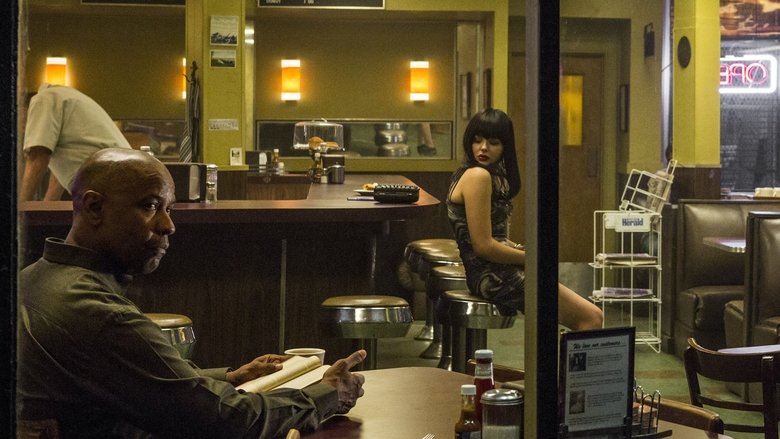
Robert McCall (Denzel Washington) lives a life stripped down to routine: a modest apartment, a job on the floor of a big-box home-improvement store called Home Mart, and long insomniac nights at an all-night diner. He is polite, precise and almost invisible — a former black-ops operative who promised his dying wife he would leave that world behind and has, for years, kept the promise.

At the diner he strikes up a fragile late-night friendship with a young woman controlled by Russian traffickers. When she is beaten and hospitalized, McCall first tries the reasonable route — he goes to her handlers and offers to buy her freedom. Reason is not on the menu. What follows pulls a man who had carefully buried his skills back into the open, and puts him against an organization that answers to money and fear rather than law.

Directed by Antoine Fuqua from a script by Richard Wenk and nominally based on the 1980s television series, the film is less a conventional revenge picture than a study of a disciplined man rediscovering why he was ever dangerous in the first place. Fuqua stages it as neo-noir: patient, watchful stretches of ordinary working life, then sudden, surgical eruptions — culminating in a night siege inside the store where McCall stocks shelves.
Core Meaning

The film argues that capability without purpose is a kind of death. McCall has retired not only from violence but from consequence; his obsessive tidiness and fixed routines are the behavior of a man holding himself very still so that nothing spills. Fuqua's interest — as he described it, the story is "almost quiet, where he's working at the Home Mart" — is the stillness before the decision.

What re-animates McCall is not rage but obligation. He acts because the institutions that should protect a trafficked teenager do not, and because he is one of the few people alive who can. The film's central proposition is that goodness is not a feeling but a set of actions somebody has to actually perform, and that the man best equipped to perform them is precisely the one who most wants to be left alone.

Denzel Washington framed McCall as "just a guy that works at HomeMart trying to fit in," a man who "has done some awful things in his past" and "has tried to put that behind him but circumstances won't allow that." The meaning of the film sits in that refusal: the past does not get to be past, and the only redemption available is to point the old skills at something worth protecting.

Thematic DNA

Purpose reclaimed from grief 25%
Vigilante justice and institutional failure 25%
Violence as identity and craft 20%
Protection of the vulnerable and quiet mentorship 15%
Anonymity and the dignity of ordinary work 15%

Purpose reclaimed from grief

McCall's life is organized around a promise to his dead wife — that he would stop being what he was. The result is a man functionally retired from his own existence: work, diner, book, sleep, repeat. His friendship with the young woman at the diner, and her hospitalization, is the shock that restarts him. Critics have identified purpose as the first film's governing theme: the retired, lonely McCall rediscovering that his purpose is to help people.

Vigilante justice and institutional failure

The film leans on the enduring appeal of the vigilante hero: McCall operates outside the law precisely because the law and its institutions do not reach the people who need them. A trafficked girl has no realistic recourse; the organized apparatus that owns her is protected by money, corruption and distance. The film never pretends this is legally defensible — it simply shows the vacuum, and the one man willing to step into it.

Violence as identity and craft

McCall does not enjoy killing; he is simply exceptionally good at it. His violence is presented as method rather than fury — assessment, timing, improvisation with whatever is at hand. The Home Mart climax literalizes the idea: a man defined by his trade turns the inventory of an ordinary workplace, down to barbed wire and bags of cement, into an arsenal. The question the film keeps asking is whether such a skill can be owned without owning you.

Protection of the vulnerable and quiet mentorship

Alongside the mayhem runs a gentler current: McCall coaching a coworker toward a better job, listening to a teenager describe who she wants to become, treating people the world has written off as though their plans matter. His most characteristic act is not a killing but attention — the willingness to take someone seriously. That mentorship, not vengeance, is what the ending's farewell scene finally pays off.

Anonymity and the dignity of ordinary work

The film takes the big-box store seriously as a world: name badges, closing shifts, small kindnesses among coworkers. McCall's disguise is not a false identity but genuine labor, and Fuqua shoots that labor with the same patience he gives the set pieces. The tension of the film comes from knowing what is folded inside the polite man in the store vest — and from the sense that he would genuinely rather stay him.

Character Analysis

Robert McCall

Denzel Washington

Archetype: Reluctant avenger / retired warrior-monk Key Trait: Lethal patience

Motivation

To keep a promise to the dead — and, when that becomes impossible, to make sure the person in front of him survives. As Washington put it, McCall 'has tried to put that behind him but circumstances won't allow that.'

Character Arc

Begins as a deliberately diminished man — a former CIA black-ops operative living a small, orderly life at a home-improvement store, faithful to a promise made to his dying wife. A friendship formed over late nights at a diner, and the brutal beating that ends it, draws him back into the capacities he had renounced. By the finale he has stopped hiding, accepted what he is, and redirected it outward as protection rather than profession.

Teddy

Marton Csokas

Archetype: Mirror antagonist / corporate enforcer Key Trait: Cold, tailored menace

Motivation

Restoring his employers' control and profit, and satisfying the professional's need to beat the only opponent who has ever been his equal.

Character Arc

Arrives as the fixer sent to clean up after McCall's first strike and to restore order to a criminal organization that has never been meaningfully challenged. Confident, articulate and methodical, he spends the film narrowing in on who the anonymous killer is — and steadily discovering that he is outmatched by a man with better reasons. His hunt drives the plot to the store siege where he takes the employees hostage to force McCall into the open.

All 3 characters and cast

Symbols & Motifs

The hardware store

Meaning:

The everyday world as both refuge and armory. It stands for the ordinary life McCall has chosen and, when invaded, for the truth that nothing domestic stays neutral around him.

Context:

Home Mart is where McCall works, mentors coworkers and hides in plain sight — and where the film's climax unfolds when his enemies take the staff hostage after closing to draw him out. He fights them with the store's own stock, including barbed wire rigged to bags of cement dropped from the high shelving.

The all-night diner

Meaning:

Insomnia made into a place — a lit island for people who cannot sleep and have nowhere to be. It symbolizes the possibility of connection between strangers at the margins.

Context:

McCall's nightly ritual of tea and a book at the 24-hour diner is where he meets the young woman controlled by the traffickers; their conversations there are the film's moral engine and the reason everything that follows happens.

The $9,800 offer

Meaning:

The last attempt at a civilized solution, and a measure of how the antagonists see human beings: as inventory with a price. Its rejection is the moment negotiation dies and McCall stops being retired.

Context:

McCall goes to Slavi's club and, holding his temper, calmly offers his savings to buy the girl's freedom. The contempt he receives in return is the pivot on which the entire film turns.

The promise to the dead wife

Meaning:

A vow functioning as a cage. It represents love expressed as self-erasure — and the film's hardest question: whether keeping a promise to the dead is worth failing the living.

Context:

McCall's retirement exists because he promised his dying wife he would leave his old life behind; his return to violence is therefore not just a plot beat but a private betrayal he chooses to commit.

Ritual and order

Meaning:

Control as survival. Meticulous routine is the discipline of a man who knows exactly how much damage he is capable of and is managing it minute by minute.

Context:

Fuqua noted that on the first day of shooting Washington was 'really quiet,' saying 'so much with his form and movement' — the performance builds McCall out of precision, arrangement and stillness long before it builds him out of action.

Philosophical Questions

Can a person genuinely retire from what they are?

McCall's entire life is a structure built to contain a capability. The film tests whether renunciation is real or merely deferred: he keeps the promise to his wife perfectly, right up until keeping it would cost someone else's life. The answer the film offers is uncomfortable — the skill never left, only the occasion for it.

When institutions fail the vulnerable, who has the right to act?

The film deliberately removes every legitimate option before McCall acts: he tries money and negotiation first, offering to buy the girl's freedom. Only when reason is refused does violence begin. That structure frames vigilantism not as preference but as the last available move — while quietly acknowledging that the argument works only because this particular vigilante happens to be right.

Is a promise to the dead binding on the living?

McCall's vow to his dying wife is the film's invisible antagonist. Honoring it means letting a teenager be destroyed; breaking it means betraying the person who made him want to be better. The film suggests that the spirit of such a promise — become someone good — can require violating its letter.

Does doing terrible things for good reasons make a person good?

McCall is unambiguously a killer, and the film does not aestheticize his kills into weightlessness — it makes them methodical, close and unpleasant. His decency toward coworkers and strangers is presented as equally real. The film declines to reconcile the two, leaving the viewer to decide whether the kindness redeems the violence or merely accompanies it.

What does it mean to actually see another person?

Everyone in the story looks past the girl at the diner; the traffickers see property, the customers see nothing. McCall's radical act, before any bloodshed, is to ask what she wants to become and treat the answer as serious. The film proposes attention itself as the origin of every moral obligation that follows.

Alternative Interpretations

Redemption story or relapse story. The generous reading is that McCall is restored — a man reclaiming his purpose, which is to help people. The darker reading is that the film shows an addict finding a socially acceptable excuse to use again: his 'retirement' was never healing, only abstinence, and the trafficked girl gives him permission. The film supports both; it never lets McCall look happier than when he is working.

Full ending explanation

Cultural Impact

Arriving in 2014, The Equalizer landed in the middle of a wave of late-career action reinventions for veteran stars, and it did something few of them managed: it turned a modestly scaled adaptation of an 1980s CBS television series into a durable modern franchise. Grossing $193 million worldwide against generally positive reviews, it gave Denzel Washington — at that point one of the last true old-model movie stars — his first recurring franchise role, spawning two sequels under Fuqua's direction.

Its cultural significance rests largely on casting and register. The vigilante-hero template was long established, but the film placed a middle-aged Black leading man in the role of the unhurried, morally certain avenger, and refused to make him either a wisecracker or a wreck. The reunion with his Training Day director was widely read as a masterstroke: reviewers called McCall the strongest, most fitting performance Washington had given in the genre since that earlier collaboration, noting that this is a man who does not burn for violence and does not desire it — he is simply good at leveling the playing field.

The film also helped normalize the hardware-store set piece as an action-cinema idea: the anonymous big-box retail floor as a maze of improvised weapons, a place where consumer banality becomes lethal. That climax became the film's most quoted visual shorthand and its most imitated sequence, and it is the image most audiences retain years later.

Audience Reception

The verdict was broadly positive. The film drew generally favorable reviews and performed strongly commercially, taking $193 million worldwide — enough to establish a franchise around a star who had never had one.

What audiences praised. Overwhelmingly, Washington. Reviewers singled out McCall as his strongest and most fitting performance in this genre since Training Day, praising a portrayal built on stillness rather than swagger — a man who neither burns for violence nor wants it, but is simply very good at leveling the playing field. The Fuqua reunion was widely called a masterstroke, and the deliberate, quiet first act — Fuqua's 'almost quiet' Home Mart material — was appreciated by viewers who expected a generic shoot-'em-up and got a character study with detonations. The store-set climax is consistently named the standout sequence.

Points of criticism. The most common complaints concern pacing and formula: a long, patient build that some found slack, a villain configuration that follows the template closely, and a level of violence that a portion of the audience found excessive and gratuitously staged. Others noted that the film's resolution is warmer and neater than its subject matter — organized trafficking — would seem to allow, and one recurring line of discussion is that the happy ending sits slightly at odds with the grim world the film builds.

Overall. A star vehicle that outperformed expectations — praised as a superior example of the vigilante-thriller form, carried by a controlled central performance, and criticized mainly by those who wanted either more restraint in the bloodshed or less patience in the setup.

Interesting Facts

  • The film is a 2014 American neo-noir action thriller directed by Antoine Fuqua and written by Richard Wenk, nominally based on the 1980s television series of the same name.
  • It reunited Denzel Washington with Antoine Fuqua, who had previously directed him in Training Day.
  • Principal photography began in June 2013 in Massachusetts, with production based around Boston.
  • The Home Mart store was built inside a real, massive empty Lowe's Home Improvement superstore — the chain had relocated the location to New Hampshire for sales-tax reasons, leaving the building available to the production.
  • For the climax, Denzel Washington was filmed high on the store shelving rigging barbed wire to bags of cement to hurl down at the gangsters below.
  • Fuqua described the tone of the film's first half as 'almost quiet, where he's working at the Home Mart,' and summed up his directing approach as 'Let the actors drive the movie.'
  • Fuqua recalled that on the first day of shooting Washington was 'being really quiet,' and that it was 'just interesting to watch him, because he just says so much with his form and movement.'
  • Washington described McCall as 'just a guy that works at HomeMart trying to fit in' who 'has done some awful things in his past.'
  • The supporting cast includes Marton Csokas as Teddy, Chloë Grace Moretz, David Harbour, Bill Pullman as Brian and Melissa Leo.
  • The film received generally positive reviews and was a commercial success, grossing $193 million worldwide, launching a franchise for Washington.

Frequently Asked Questions

Explore More About This Movie

Dive deeper into specific aspects of the movie with our detailed analysis pages

Comments (0)

Leave a comment

No comments yet. Be the first to share your thoughts!

Similar Movies